 Image 1 of 2
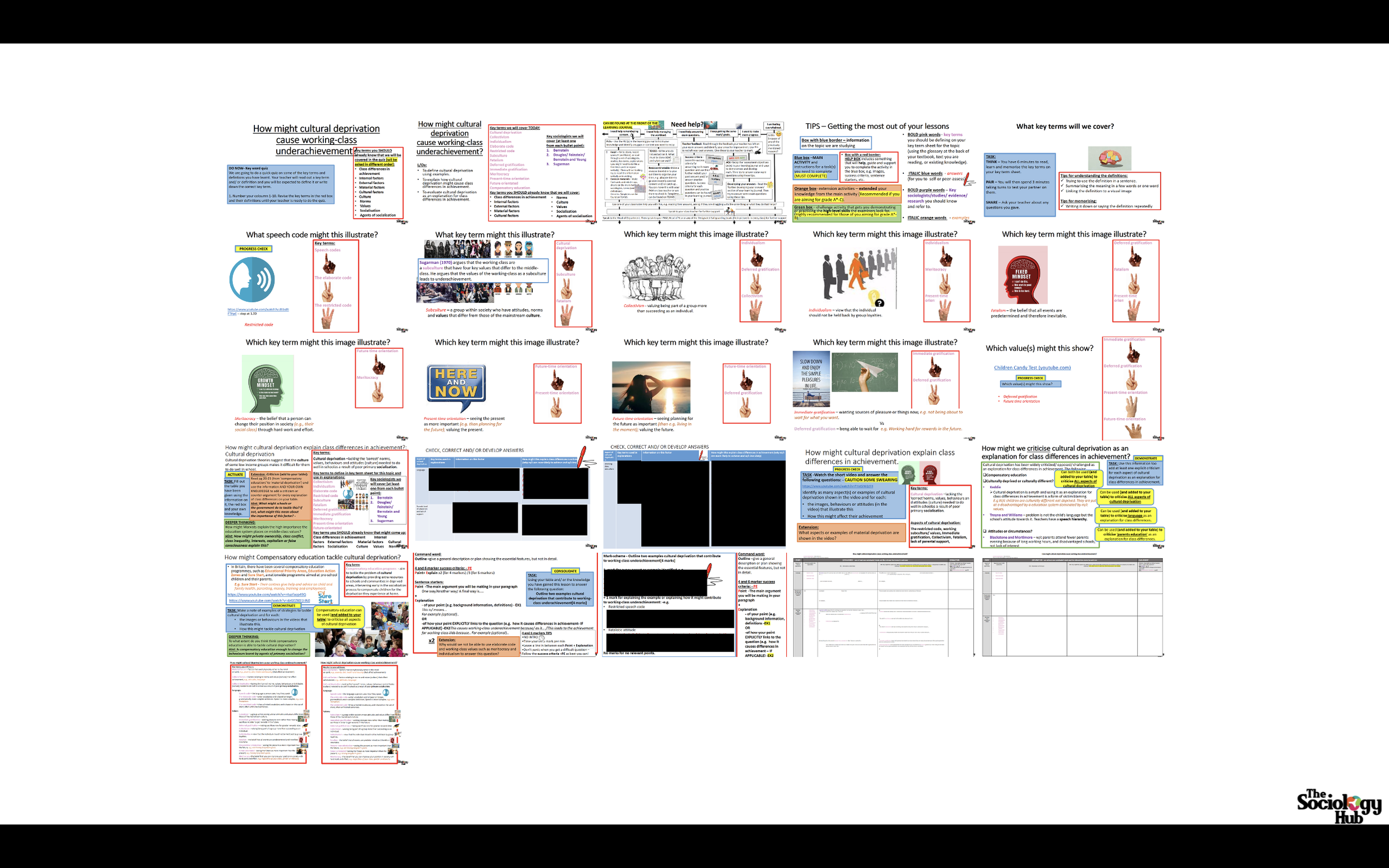 Image 2 of 2
•Detailed lesson with lots of scaffolding based on adaptive teaching that helps students define cultural deprivation using examples, explain how cultural deprivation might cause class differences in educational achievement
•Covers the following key terms: Cultural deprivation, Speech codes, The elaborate code, The restricted code, Subculture, Collectivism, Individualism, Immediate gratification, Deferred gratification, Fatalism, Meritocracy, Present-time orientation, Future-time orientation and Compensatory education.
•Covers the following sociologists: Bernstein, Douglas, Feinstein, Bernstein and Young, Sugarman, Keddie, Troyna and Williams, and Blackstone and Mortimore.
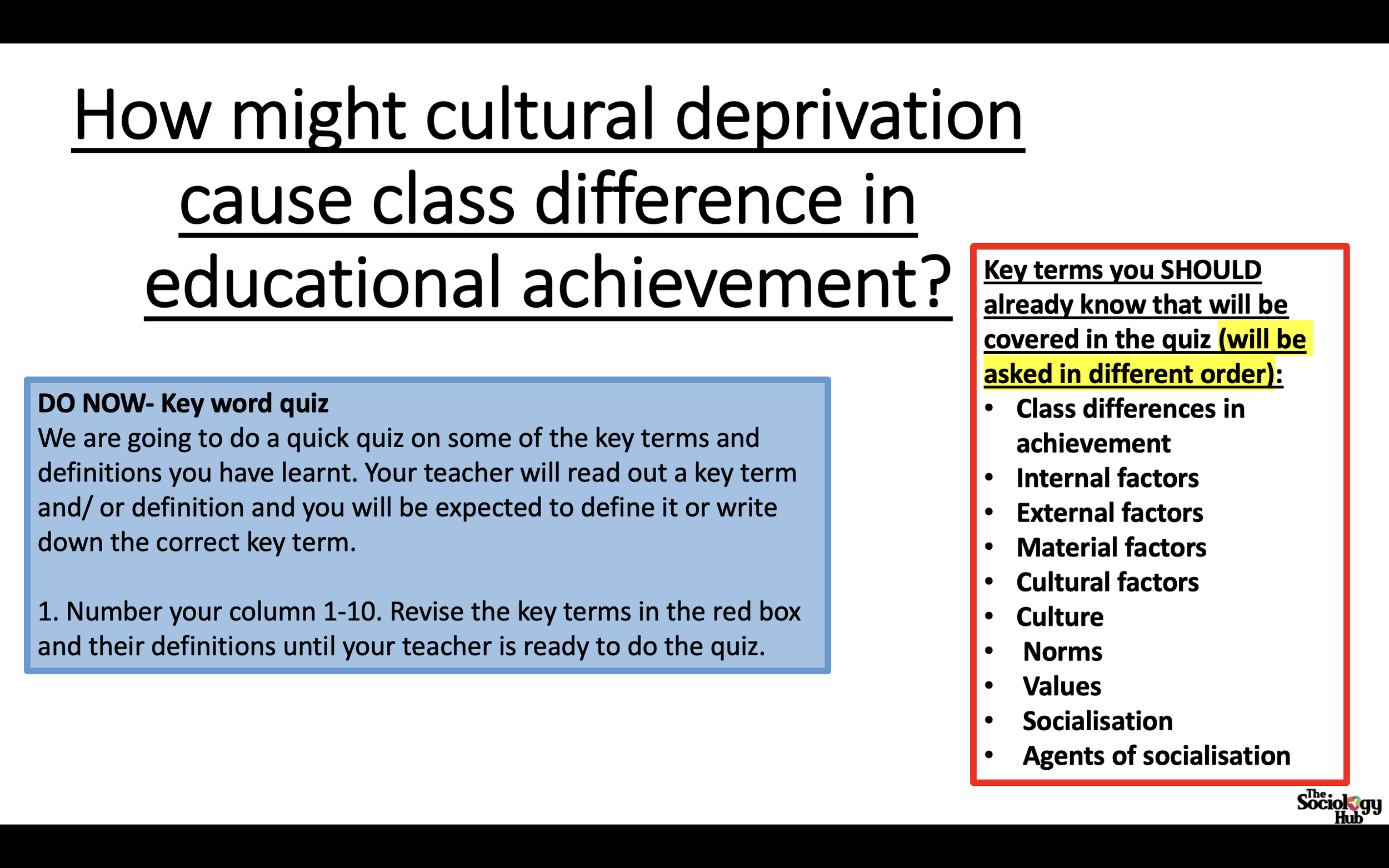
•Makes reference to the following key terms students should already know, to promote a spiral curriculum: Class differences in achievement – Internal factors – External factors – Material factors – Cultural factors – Culture – Norms – Values – Socialisation – Agents of socialisation.
•Starter activity uses retrieval practice: a key word quiz recapping prior knowledge of internal, external, material and cultural factors.
•Includes explicit vocabulary instruction through a THINK – PAIR – SHARE key term activity and a series of ‘which key term might this image illustrate?’ progress checks.
•Includes three videos as activities, covering speech codes, cultural deprivation in context and compensatory education.
•Includes a modelled and a blank explanation and evaluation table (Point, Explanation, Evaluation) to scaffold written answers.
•Includes extension, DEEPER THINKING and challenge tasks for stretch and challenge, plus a teaching to all activity.
•INCLUDES 4 MARKER WITH SUCCESS CRITERIA AND A MARK SCHEME.
•ANSWERS TO MAIN ACTIVITIES INCLUDED.
•INCLUDES KEY TERM SHEET WITH DEFINITIONS FOR THE LESSON.
•Activities require pages from the AQA A Level Sociology Book One Including AS Level by Rob Webb, Hal Westergaard, Keith Trobe and Annie Townend.
•RESOURCES CAN BE FOUND AT THE END OF THE PPT.