 Image 1 of 2
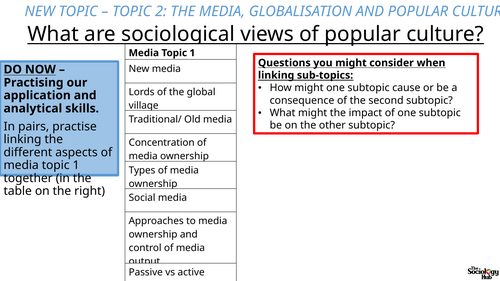 Image 2 of 2
•Detailed lesson with scaffolding based on adaptive teaching to help students define popular culture and high culture, and explain, analyse and evaluate sociological views of popular culture.
•Covers the following key terms: Popular culture, mass culture, high culture, low culture, cultural products, global culture, Critical Theory, social repression, social conformity, tabloidisation, infotainment, active audiences and passive audiences.
•Key sociologists covered: Marcuse, the Frankfurt School, Strinati, Livingstone and Curran et al.
•Makes reference to the following key terms students should know to promote a spiral curriculum: Norms, values, culture, socialisation, cultural capital, social control, false consciousness, ideology, hegemony, class inequality, Marxism, Neo-Marxism, pluralism, capitalism, bourgeoisie, proletariat, media ownership, media products, agenda-setting and gate-keeping.
•Includes retrieval practice linking media ownership and control, a scaffolded reading table, worked answers and analysis and evaluation prompts.
•INCLUDES TEACHING TO ALL ACTIVITIES: visual culture matching and whole-class stand-up/sit-down classification.
•Includes an active and passive audiences activity, a structured discussion with sentence starters, and stretch and challenge questions.
•INCLUDES A 10-MARK PLANNING TASK with success criteria and example plans.
•ANSWERS TO MAIN ACTIVITIES INCLUDED.
•REQUIRES textbook - 'SOCIOLOGY For AQA Volume 2 by Browne,
•RESOURCES AT THE END OF PPT