 Image 1 of 1
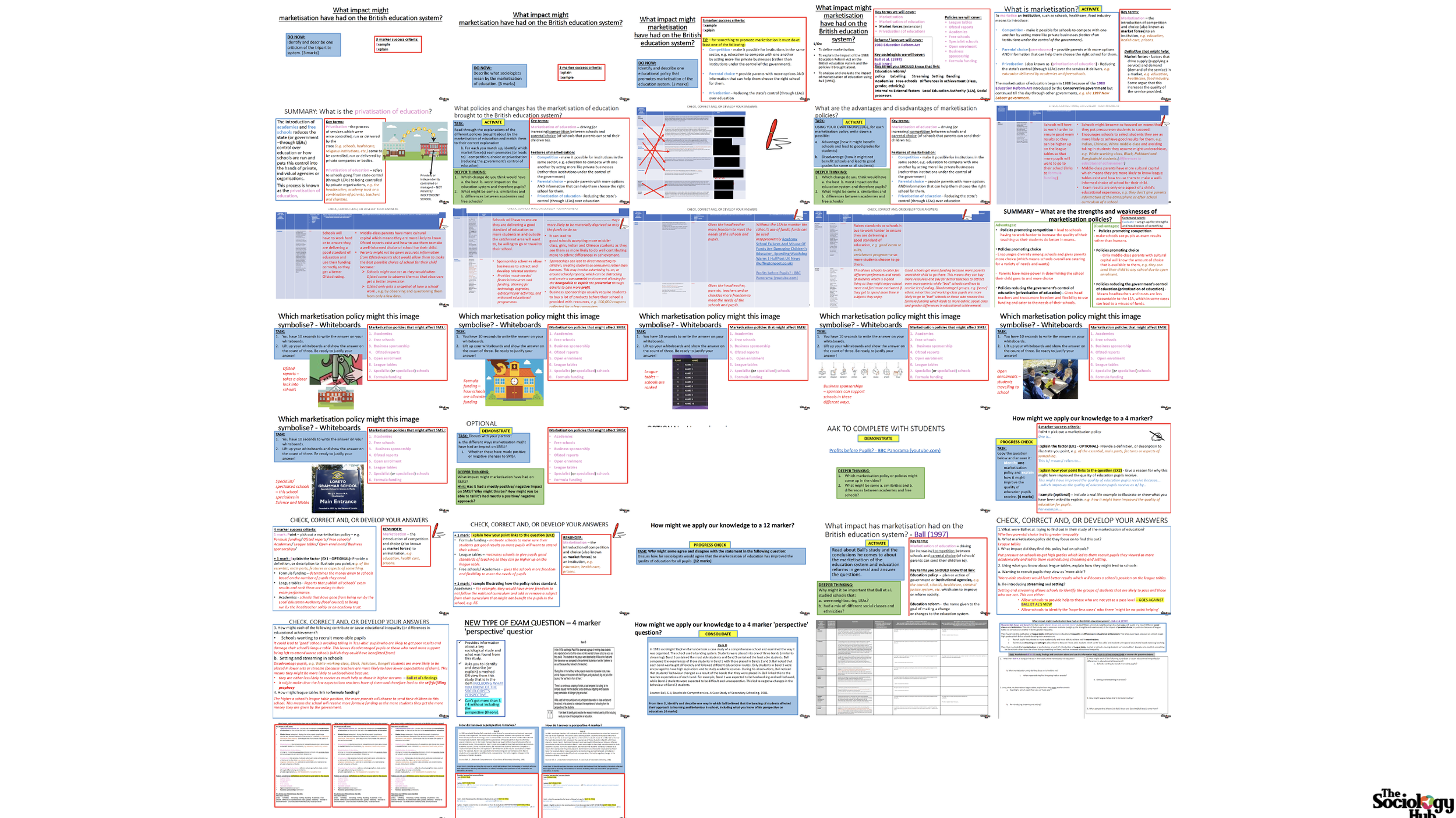
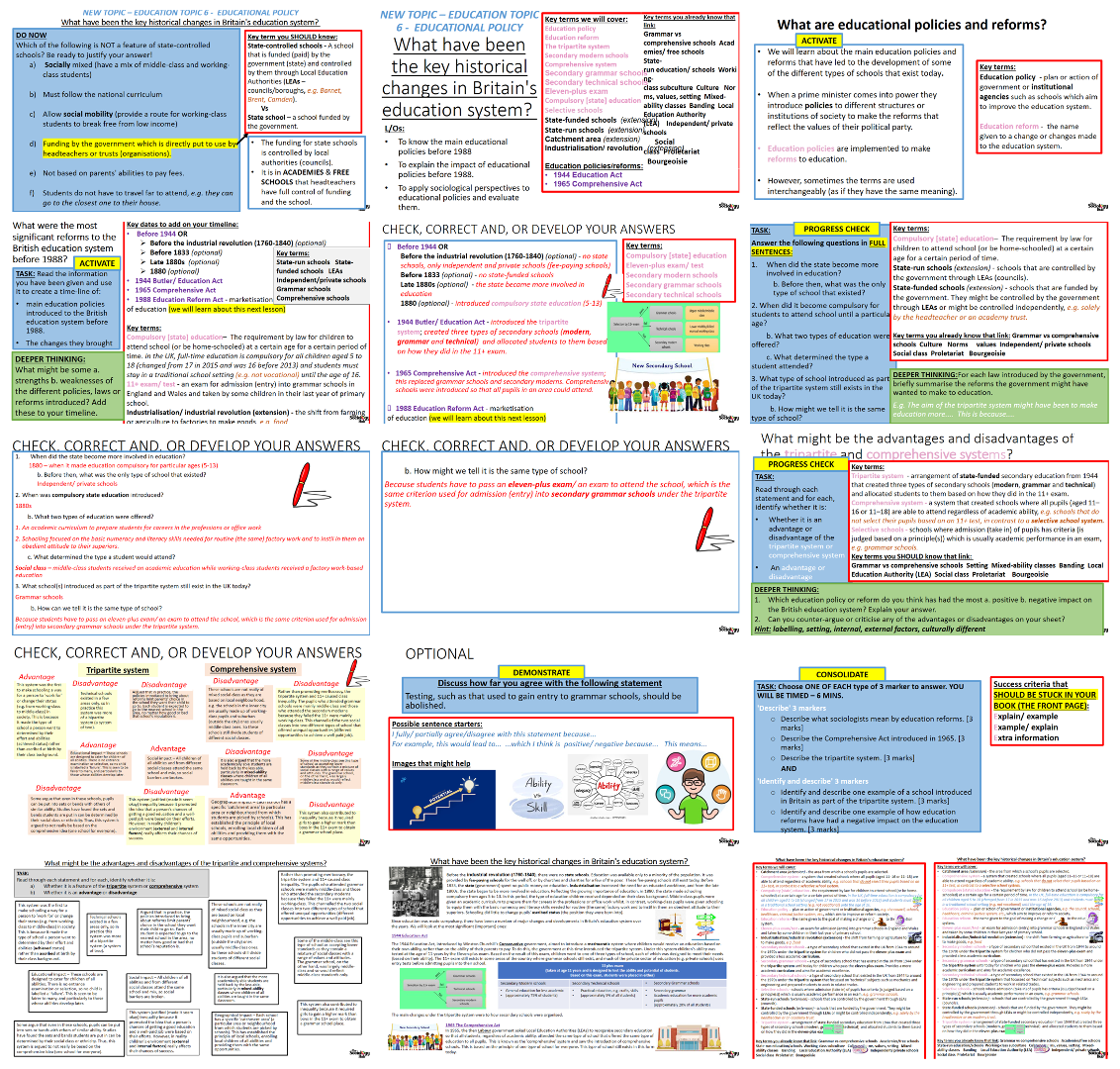
Detailed lesson with lots of scaffolding based on adaptive teaching that helps students know the main educational policies before 1988 and explain the impact of those policies, and apply and evaluate sociological perspectives on them (built around meritocracy, social mobility and class inequality arguments).
Covers the following key terms: Education policy, Education reform, The tripartite system, Secondary modern schools, Secondary grammar schools, Secondary technical schools, Comprehensive system, Eleven-plus exam, Compulsory [state] education, Selective schools, State-run schools (extension), State-funded schools (extension), Catchment area (extension), Industrialisation/industrial revolution (extension).
Makes reference to the following key terms students might know, to promote a spiral curriculum: Grammar vs comprehensive schools – Academies/free schools – State-run education/schools – Working-class subculture – Culture – Norms – Values – Setting – Mixed-ability classes – Banding – Local Education Authority (LEA) – Independent/private schools – Social class – Proletariat – Bourgeoisie.
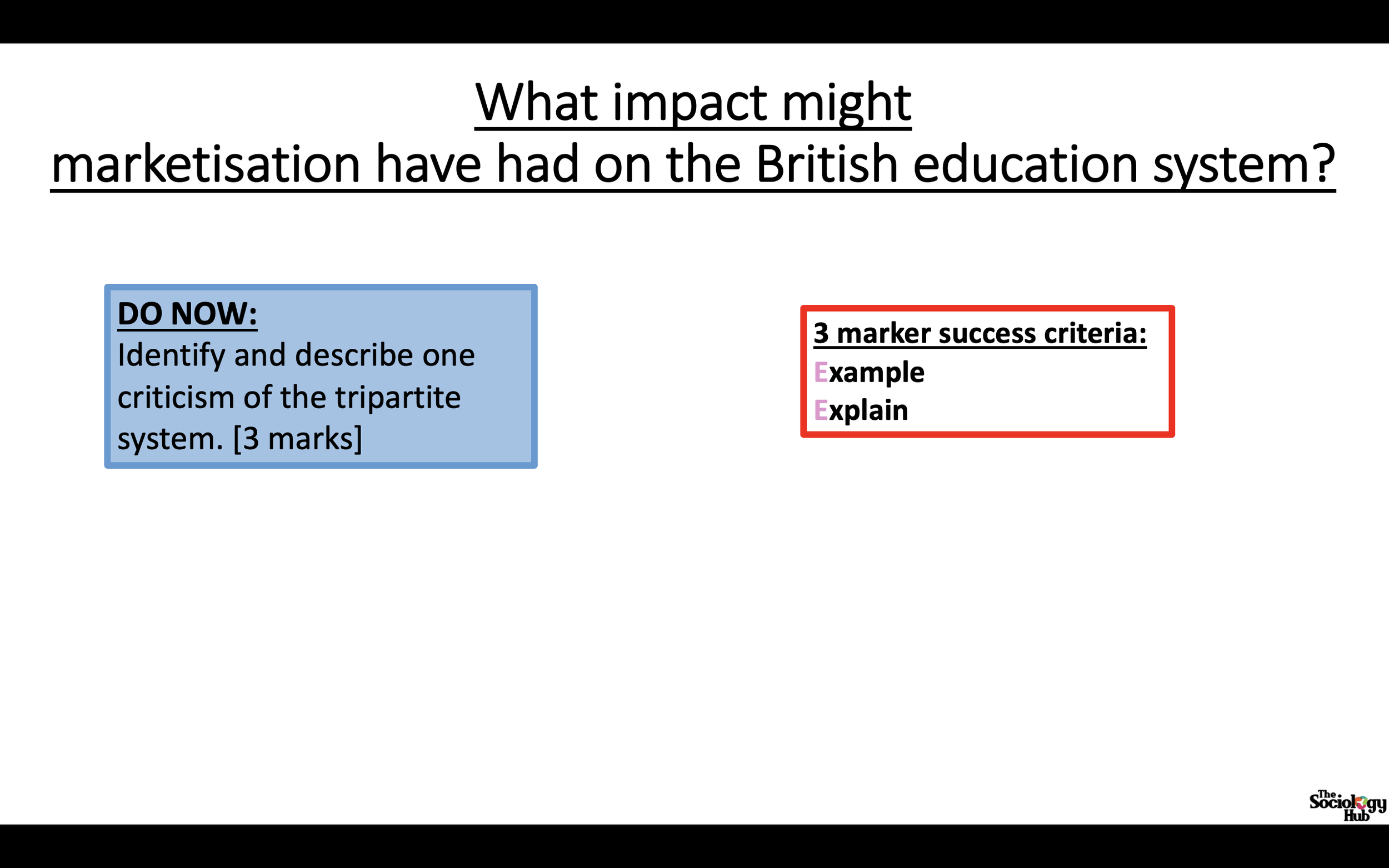
DO NOW retrieval starter on the features of state schools and state-controlled schools
Timeline-building activity covering the 1944 Education Act, the 1965 Comprehensive Act and the 1988 Education Reform Act
Advantages and disadvantages sorting activity on the tripartite and comprehensive systems, provided as a blank version and a fully modelled answer version
DEEPER THINKING stretch prompts throughout
Optional discussion task on whether selective testing should be abolished, with sentence starters
Exam practice: a choice of 'Describe' and 'Identify and describe' 3-mark questions.
INCLUDES A KEY TERM SHEET WITH DEFINITIONS FOR THE LESSON
ANSWERS FOR ACTIVITIES INCLUDED
Pedagogical strategies include: retrieval practice, explicit vocabulary instruction, modelling and worked answers, scaffolding, metacognitive prompts, adaptive teaching, stretch and challenge, and assessment opportunities.
RESOURCES CAN BE FOUND AT THE END OF THE PPT.
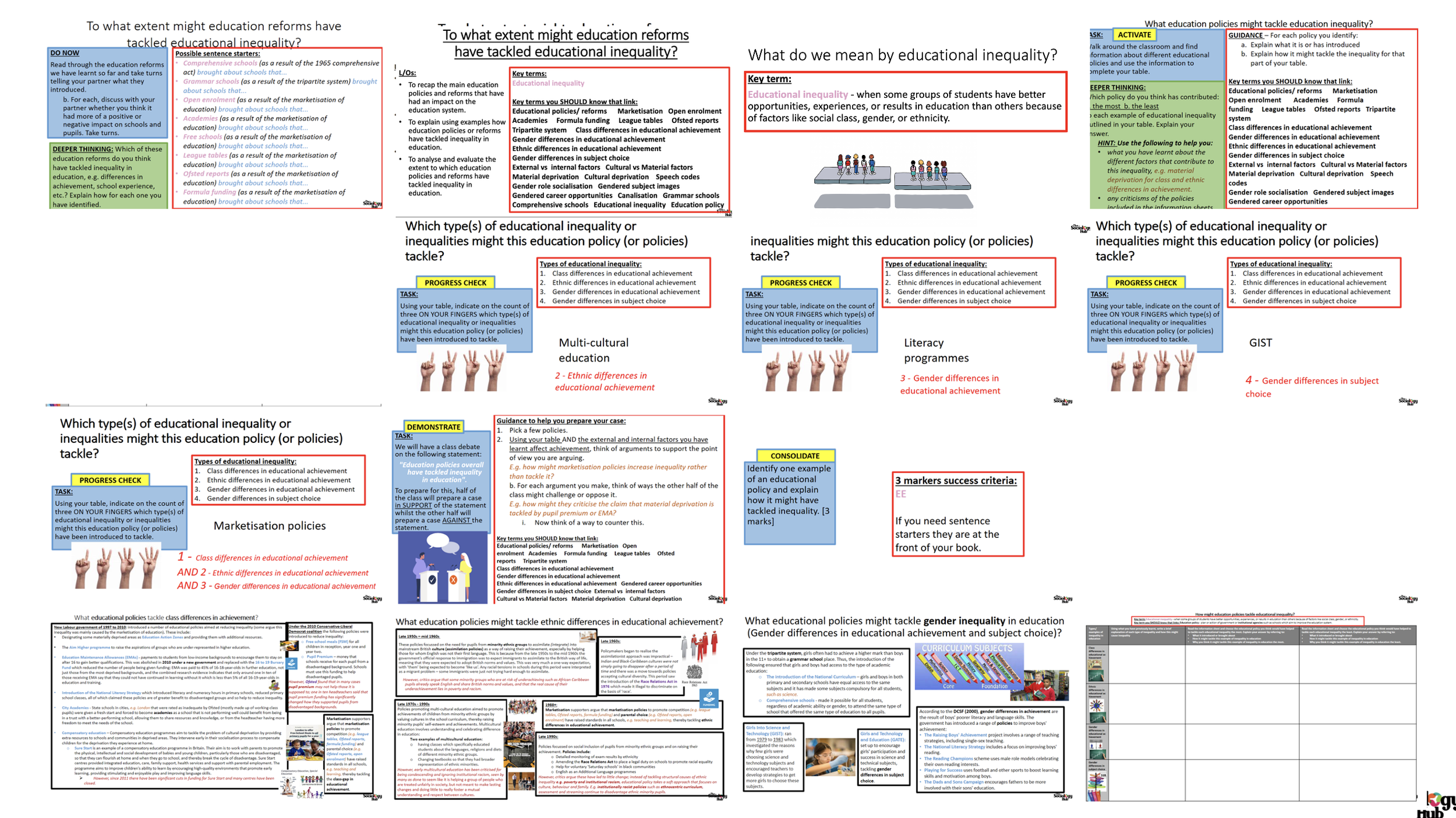
Detailed lesson with lots of scaffolding based on adaptive teaching that helps students know the main educational policies before 1988 and explain the impact of those policies, and apply and evaluate sociological perspectives on them (built around meritocracy, social mobility and class inequality arguments).
Covers the following key terms: Education policy, Education reform, The tripartite system, Secondary modern schools, Secondary grammar schools, Secondary technical schools, Comprehensive system, Eleven-plus exam, Compulsory [state] education, Selective schools, State-run schools (extension), State-funded schools (extension), Catchment area (extension), Industrialisation/industrial revolution (extension).
Makes reference to the following key terms students might know, to promote a spiral curriculum: Grammar vs comprehensive schools – Academies/free schools – State-run education/schools – Working-class subculture – Culture – Norms – Values – Setting – Mixed-ability classes – Banding – Local Education Authority (LEA) – Independent/private schools – Social class – Proletariat – Bourgeoisie.
DO NOW retrieval starter on the features of state schools and state-controlled schools
Timeline-building activity covering the 1944 Education Act, the 1965 Comprehensive Act and the 1988 Education Reform Act
Advantages and disadvantages sorting activity on the tripartite and comprehensive systems, provided as a blank version and a fully modelled answer version
DEEPER THINKING stretch prompts throughout
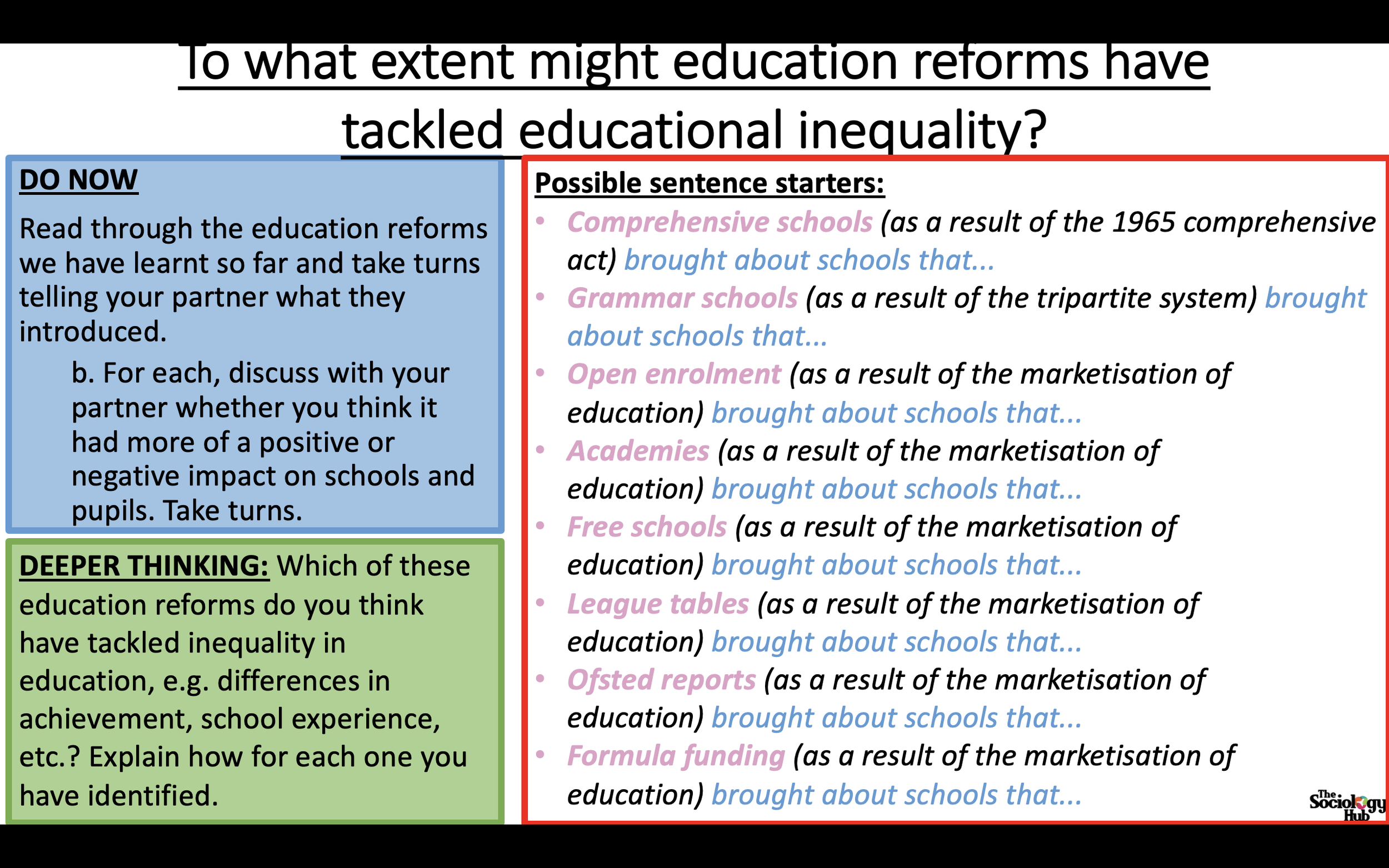
Optional discussion task on whether selective testing should be abolished, with sentence starters
Exam practice: a choice of 'Describe' and 'Identify and describe' 3-mark questions.
INCLUDES A KEY TERM SHEET WITH DEFINITIONS FOR THE LESSON
ANSWERS FOR ACTIVITIES INCLUDED
Pedagogical strategies include: retrieval practice, explicit vocabulary instruction, modelling and worked answers, scaffolding, metacognitive prompts, adaptive teaching, stretch and challenge, and assessment opportunities.
RESOURCES CAN BE FOUND AT THE END OF THE PPT.