Image 1 of 2
Image 2 of 2
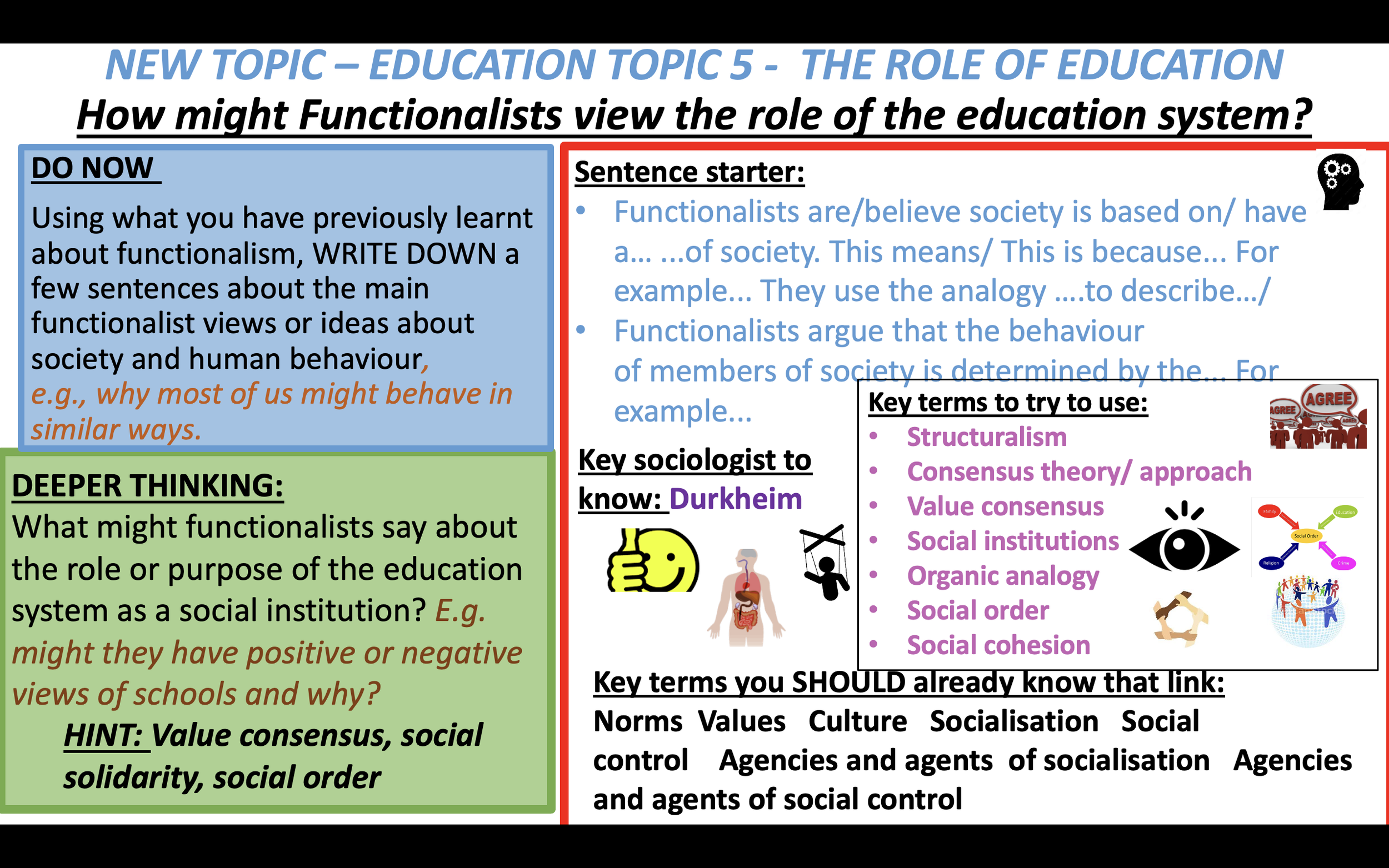
AQA GCSE Sociology Education: The Role of Education – Functionalism (Durkheim, Parsons, Davis & Moore)
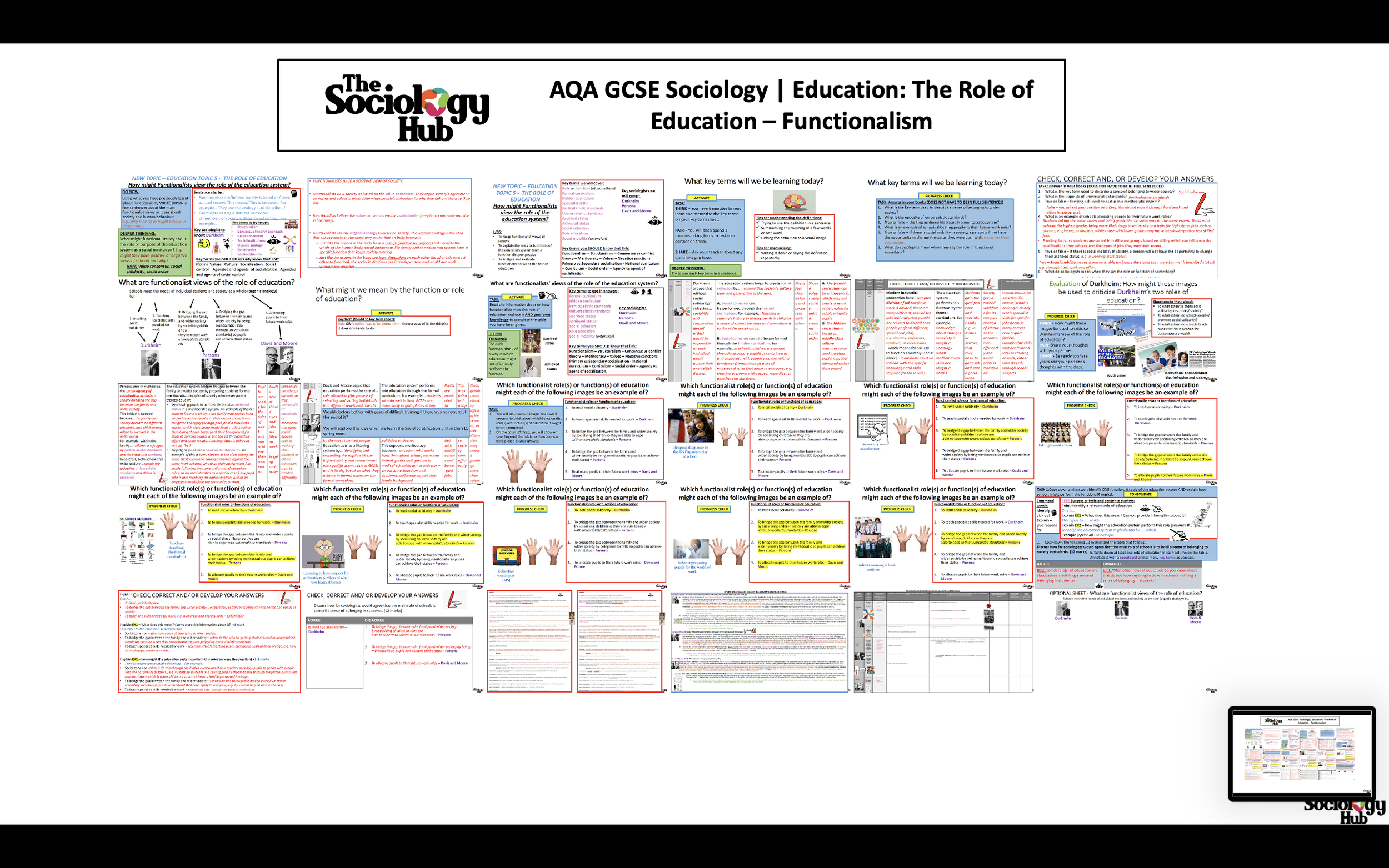
Detailed lesson with lots of scaffolding based on adaptive teaching that helps students identify, describe and explain the functionalist roles of education, and analyse and evaluate how far education performs them.
Covers the five functionalist roles: instilling social solidarity/cohesion, teaching specialist skills for work, bridging the gap between the family and wider society, meritocracy and achieved status, and role allocation.
Covers the following key terms: Role/function, Formal curriculum, Hidden curriculum, Specialist skills, Social cohesion/solidarity, Particularistic standards, Universalistic standards, Ascribed status, Achieved status, Role allocation, Meritocracy, Social mobility (extension).
Covers the following sociologists: Durkheim, Parsons, Davis and Moore.
Makes reference to the following key terms students might know to promote a spiral curriculum: Functionalism – Structuralism – Consensus vs conflict theory – Value consensus – Organic analogy – Social order – Norms – Values – Culture – Socialisation – Primary vs secondary socialisation – Agencies and agents of socialisation – Social control – Curriculum – National curriculum.
RESOURCES CAN BE FOUND AT THE END OF PPT - print table and info sheet in A3
ANSWERS INCLUDED for the main activities, exam questions and progress checks (model answers highlighted in red).
INCLUDES A KEY TERM SHEET WITH DEFINITIONS FOR THE LESSON.
Do Now retrieval starter; explicit key term instruction with Think-Pair-Share memorisation
a fully scaffolded activity table with sentence starters and structured explanation stems
dual coding image-based application rounds (whole-class finger-response AFL); DEEPER THINKING analysis prompts on every function
live marking prompts (Check, Correct and/or Develop your answers)
PEE writing structure with success criteria for 4 makers
spiral curriculum links to prior learning.
Includes 12-mark Discuss question, with an AGREE/DISAGREE planning grid and command word support.
Detailed lesson with lots of scaffolding based on adaptive teaching that helps students identify, describe and explain the functionalist roles of education, and analyse and evaluate how far education performs them.
Covers the five functionalist roles: instilling social solidarity/cohesion, teaching specialist skills for work, bridging the gap between the family and wider society, meritocracy and achieved status, and role allocation.
Covers the following key terms: Role/function, Formal curriculum, Hidden curriculum, Specialist skills, Social cohesion/solidarity, Particularistic standards, Universalistic standards, Ascribed status, Achieved status, Role allocation, Meritocracy, Social mobility (extension).
Covers the following sociologists: Durkheim, Parsons, Davis and Moore.
Makes reference to the following key terms students might know to promote a spiral curriculum: Functionalism – Structuralism – Consensus vs conflict theory – Value consensus – Organic analogy – Social order – Norms – Values – Culture – Socialisation – Primary vs secondary socialisation – Agencies and agents of socialisation – Social control – Curriculum – National curriculum.
RESOURCES CAN BE FOUND AT THE END OF PPT - print table and info sheet in A3
ANSWERS INCLUDED for the main activities, exam questions and progress checks (model answers highlighted in red).
INCLUDES A KEY TERM SHEET WITH DEFINITIONS FOR THE LESSON.
Do Now retrieval starter; explicit key term instruction with Think-Pair-Share memorisation
a fully scaffolded activity table with sentence starters and structured explanation stems
dual coding image-based application rounds (whole-class finger-response AFL); DEEPER THINKING analysis prompts on every function
live marking prompts (Check, Correct and/or Develop your answers)
PEE writing structure with success criteria for 4 makers
spiral curriculum links to prior learning.
Includes 12-mark Discuss question, with an AGREE/DISAGREE planning grid and command word support.