 Image 1 of 2
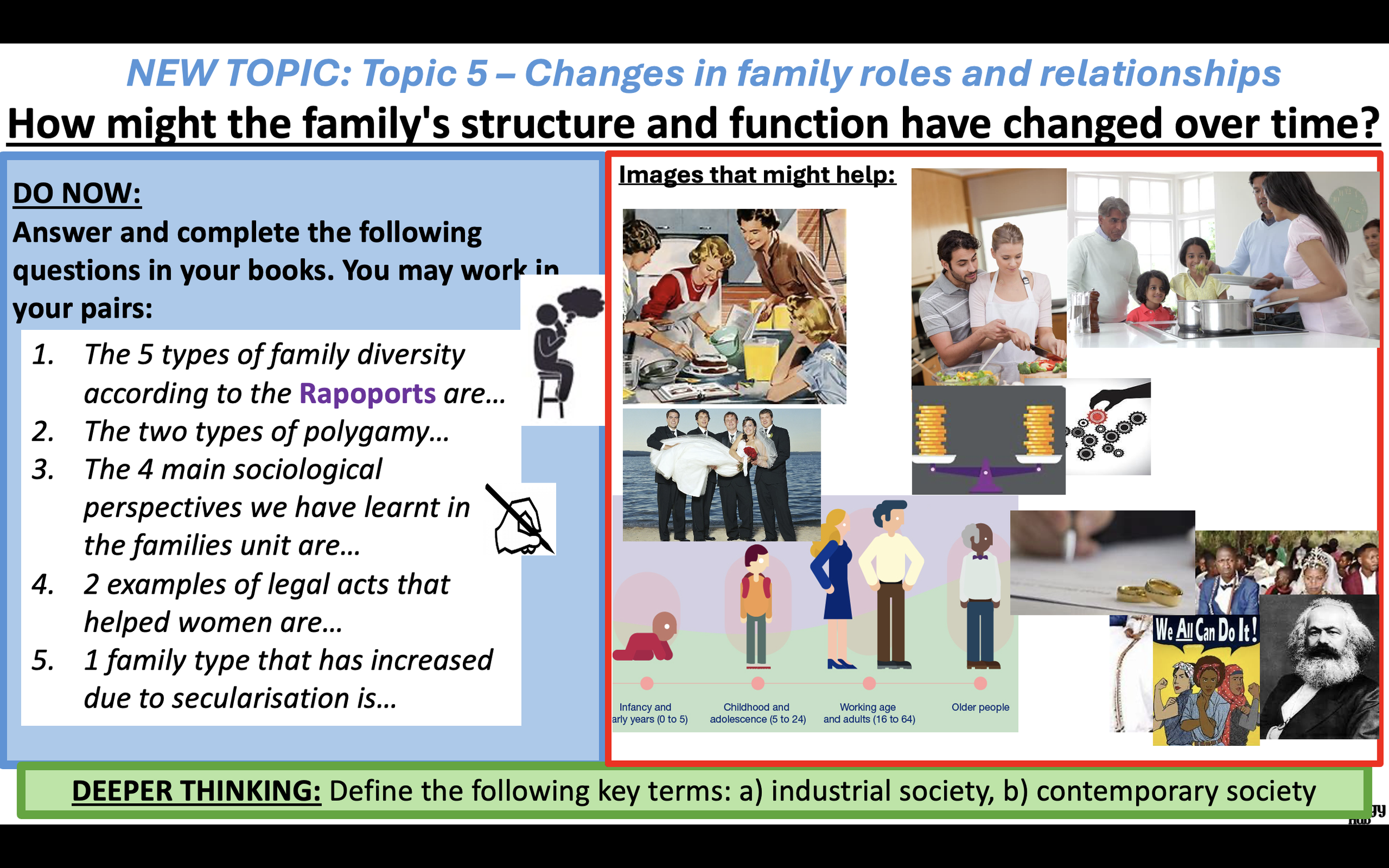 Image 2 of 2
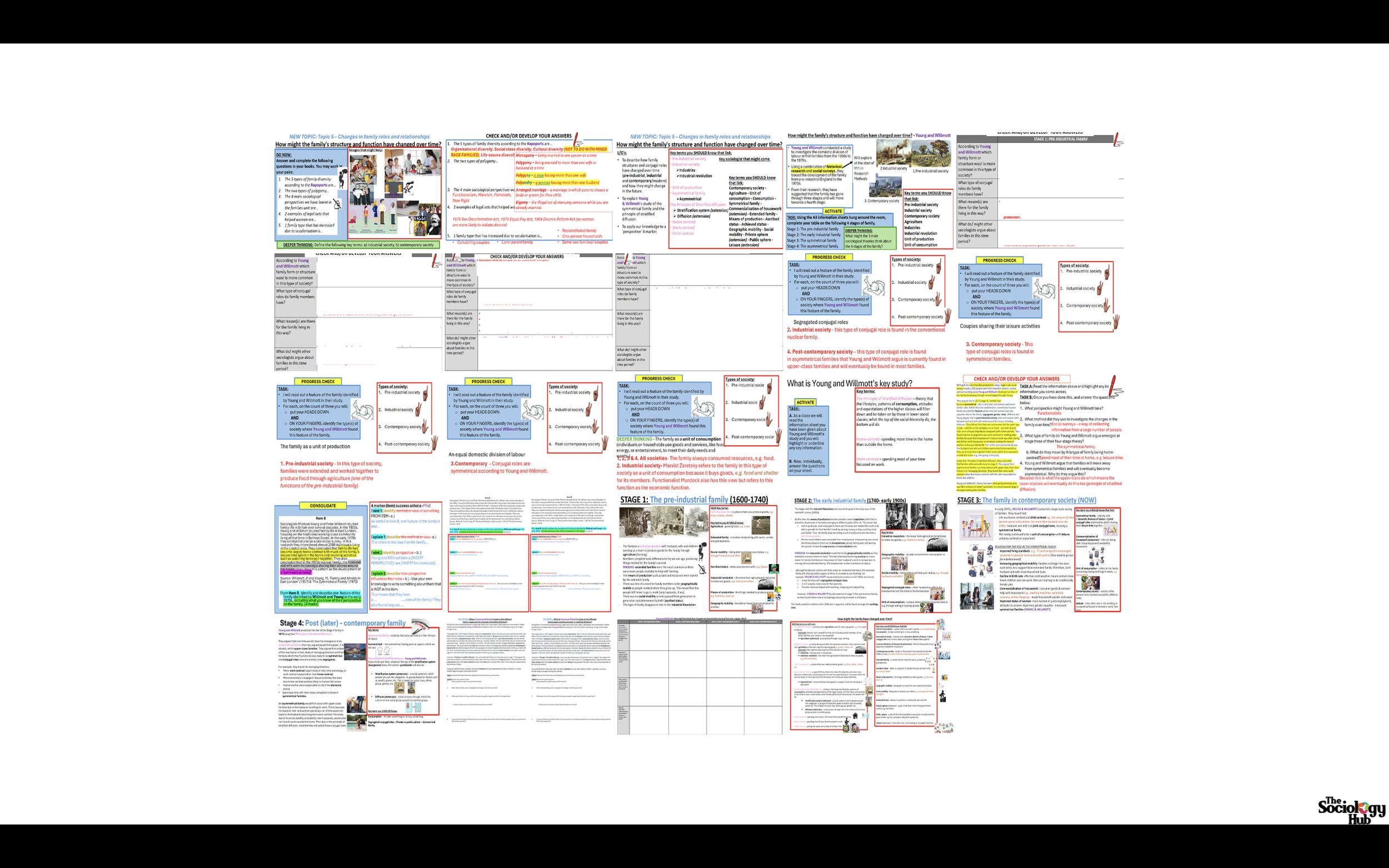
•Detailed lesson with lots of scaffolding based on adaptive teaching that help students describe how family structures and conjugal roles have changed over time (pre-industrial, industrial and contemporary) and explain how they might change in the future.
•Covers Young and Willmott's four-stage theory of the family, the symmetrical family and the principle of stratified diffusion.
•Covers the following key terms: Pre-industrial society, Industrial society, Contemporary society, Industries, Industrial revolution, Unit of production, Unit of consumption, Symmetrical family, Asymmetrical family, Asymmetrical, The principle of stratified diffusion, Home-centred, Work-centred, Child-centred. Agriculture (extension), Stratification system (extension) and Diffusion (extension)
•Covers the following sociologists: Young and Willmott, Parsons, Zaretsky, Murdock and the Rapoports
•Makes reference to the following key terms students might know to promote a spiral curriculum: Consumption - Extended family - Nuclear family - Joint and segregated conjugal roles - Commercialisation of housework (extension) - Means of production - Geographic mobility - Social mobility - Ascribed status - Achieved status - Private sphere (extension) - Public sphere - Leisure (extension) - Family diversity - Polygamy
•Includes perspective 4 marker with detailed scaffolding.
•Includes a teaching to all activity
•Resources can be found at the end of the PPT
•Starter is a retrieval activity on the Rappoports and family diversity
•ANSWERS FOR MAIN ACTIVITIES AND STARTER INCLUDED
•Key term sheet for the lesson included
•Detailed lesson with lots of scaffolding based on adaptive teaching that help students describe how family structures and conjugal roles have changed over time (pre-industrial, industrial and contemporary) and explain how they might change in the future.
•Covers Young and Willmott's four-stage theory of the family, the symmetrical family and the principle of stratified diffusion.
•Covers the following key terms: Pre-industrial society, Industrial society, Contemporary society, Industries, Industrial revolution, Unit of production, Unit of consumption, Symmetrical family, Asymmetrical family, Asymmetrical, The principle of stratified diffusion, Home-centred, Work-centred, Child-centred. Agriculture (extension), Stratification system (extension) and Diffusion (extension)
•Covers the following sociologists: Young and Willmott, Parsons, Zaretsky, Murdock and the Rapoports
•Makes reference to the following key terms students might know to promote a spiral curriculum: Consumption - Extended family - Nuclear family - Joint and segregated conjugal roles - Commercialisation of housework (extension) - Means of production - Geographic mobility - Social mobility - Ascribed status - Achieved status - Private sphere (extension) - Public sphere - Leisure (extension) - Family diversity - Polygamy
•Includes perspective 4 marker with detailed scaffolding.
•Includes a teaching to all activity
•Resources can be found at the end of the PPT
•Starter is a retrieval activity on the Rappoports and family diversity
•ANSWERS FOR MAIN ACTIVITIES AND STARTER INCLUDED
•Key term sheet for the lesson included