 Image 1 of 2
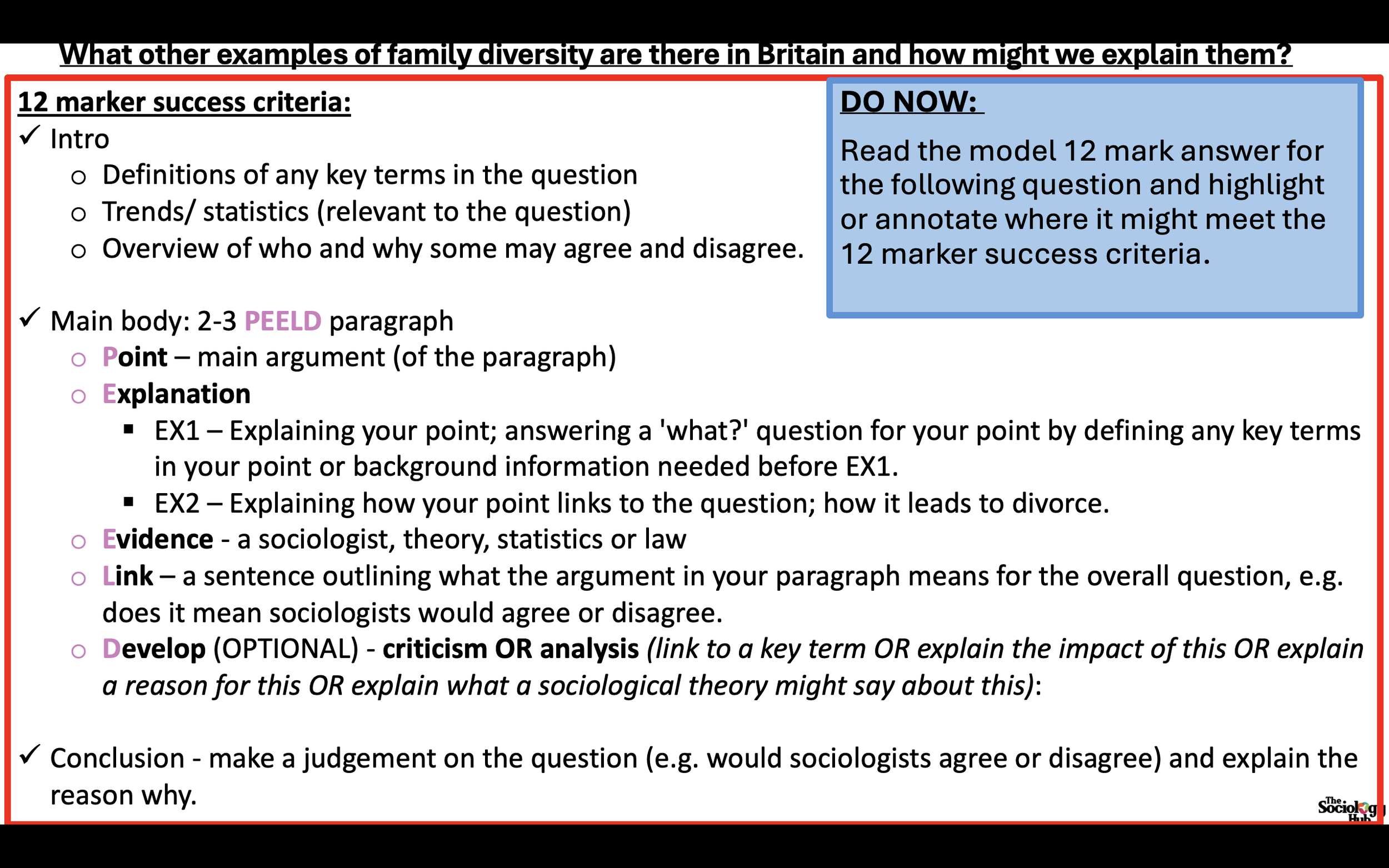 Image 2 of 2
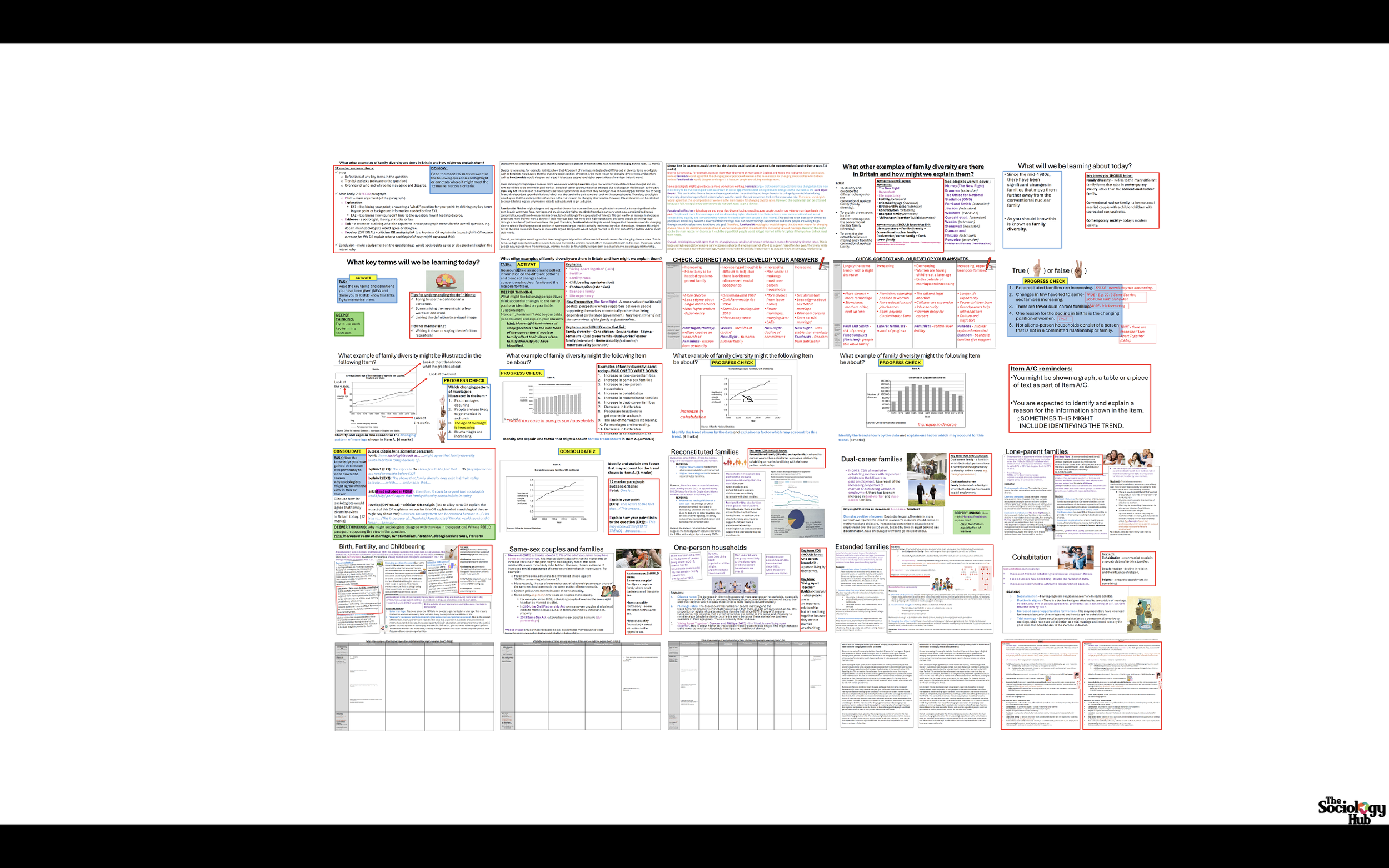
•Detailed lesson with lots of scaffolding based on adaptive teaching that helps students identify and describe the different changes to the conventional nuclear family, explain the reasons for these changes and consider the extent to which families are moving away from the conventional nuclear family.
•Covers the following examples of family diversity: lone-parent families, same-sex couples and families, one-person households, cohabitation, reconstituted families, dual-career families, birth, fertility and childbearing, and extended (beanpole) families.
•Covers the following key terms: The New Right, Dependent, Life expectancy, Fertility (extension), Childbearing age (extension), Birth/Fertility rates (extension), Contraception (extension), Beanpole family (extension), 'Living Apart Together' (LATs) (extension).
•Covers the following sociologists: Murray, Brannen, the Office for National Statistics (ONS), Ferri and Smith, Jewson, Williams, Qureshi et al., Weeks, Stonewall, Duncan and Phillips, Renvoize, Fletcher and Parsons.
•Makes reference to the following key terms students should know, to promote a spiral curriculum: Family diversity - Conventional nuclear family - Contemporary society - Life expectancy - Cohabitation - Secularisation - Stigma - Feminism - Dual-career family - Dual-worker/earner family - Homosexuality (extension) - Heterosexuality (extension).
•Adaptive teaching throughout: scaffolded tasks, sentence stems and success criteria, modelling and worked examples, and stretch and challenge through extension key terms and sociologists.
•Deeper Thinking' prompts
•INCLUDES A KEY TERM SHEET WITH DEFINITIONS FOR THE LESSON.
•Includes retrieval practice, progress checks (true or false) and a teaching to all information-gathering activity with a completed answer grid.
•Includes exam practice: 4-mark Item A/C questions and 12 marker with scaffolded success criteria
•INCLUDES A MODEL 12 MARK ANSWER WITH ANNOTATION ACTIVITY.
•ANSWERS TO MAIN ACTIVITIES INCLUDED.
•RESOURCES CAN BE FOUND AT THE END OF THE PPT.
•Detailed lesson with lots of scaffolding based on adaptive teaching that helps students identify and describe the different changes to the conventional nuclear family, explain the reasons for these changes and consider the extent to which families are moving away from the conventional nuclear family.
•Covers the following examples of family diversity: lone-parent families, same-sex couples and families, one-person households, cohabitation, reconstituted families, dual-career families, birth, fertility and childbearing, and extended (beanpole) families.
•Covers the following key terms: The New Right, Dependent, Life expectancy, Fertility (extension), Childbearing age (extension), Birth/Fertility rates (extension), Contraception (extension), Beanpole family (extension), 'Living Apart Together' (LATs) (extension).
•Covers the following sociologists: Murray, Brannen, the Office for National Statistics (ONS), Ferri and Smith, Jewson, Williams, Qureshi et al., Weeks, Stonewall, Duncan and Phillips, Renvoize, Fletcher and Parsons.
•Makes reference to the following key terms students should know, to promote a spiral curriculum: Family diversity - Conventional nuclear family - Contemporary society - Life expectancy - Cohabitation - Secularisation - Stigma - Feminism - Dual-career family - Dual-worker/earner family - Homosexuality (extension) - Heterosexuality (extension).
•Adaptive teaching throughout: scaffolded tasks, sentence stems and success criteria, modelling and worked examples, and stretch and challenge through extension key terms and sociologists.
•Deeper Thinking' prompts
•INCLUDES A KEY TERM SHEET WITH DEFINITIONS FOR THE LESSON.
•Includes retrieval practice, progress checks (true or false) and a teaching to all information-gathering activity with a completed answer grid.
•Includes exam practice: 4-mark Item A/C questions and 12 marker with scaffolded success criteria
•INCLUDES A MODEL 12 MARK ANSWER WITH ANNOTATION ACTIVITY.
•ANSWERS TO MAIN ACTIVITIES INCLUDED.
•RESOURCES CAN BE FOUND AT THE END OF THE PPT.