Image 1 of 2
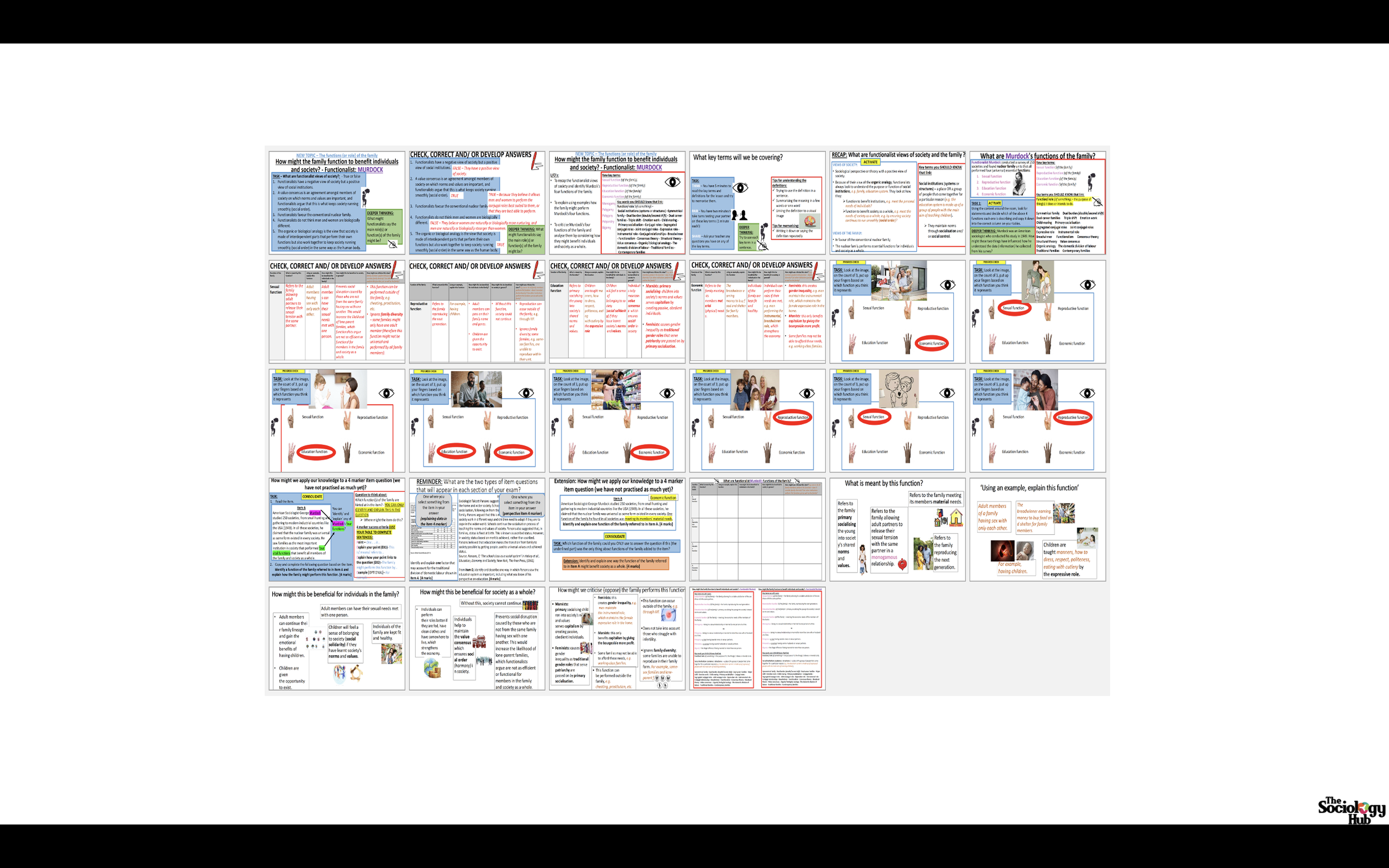 Image 2 of 2
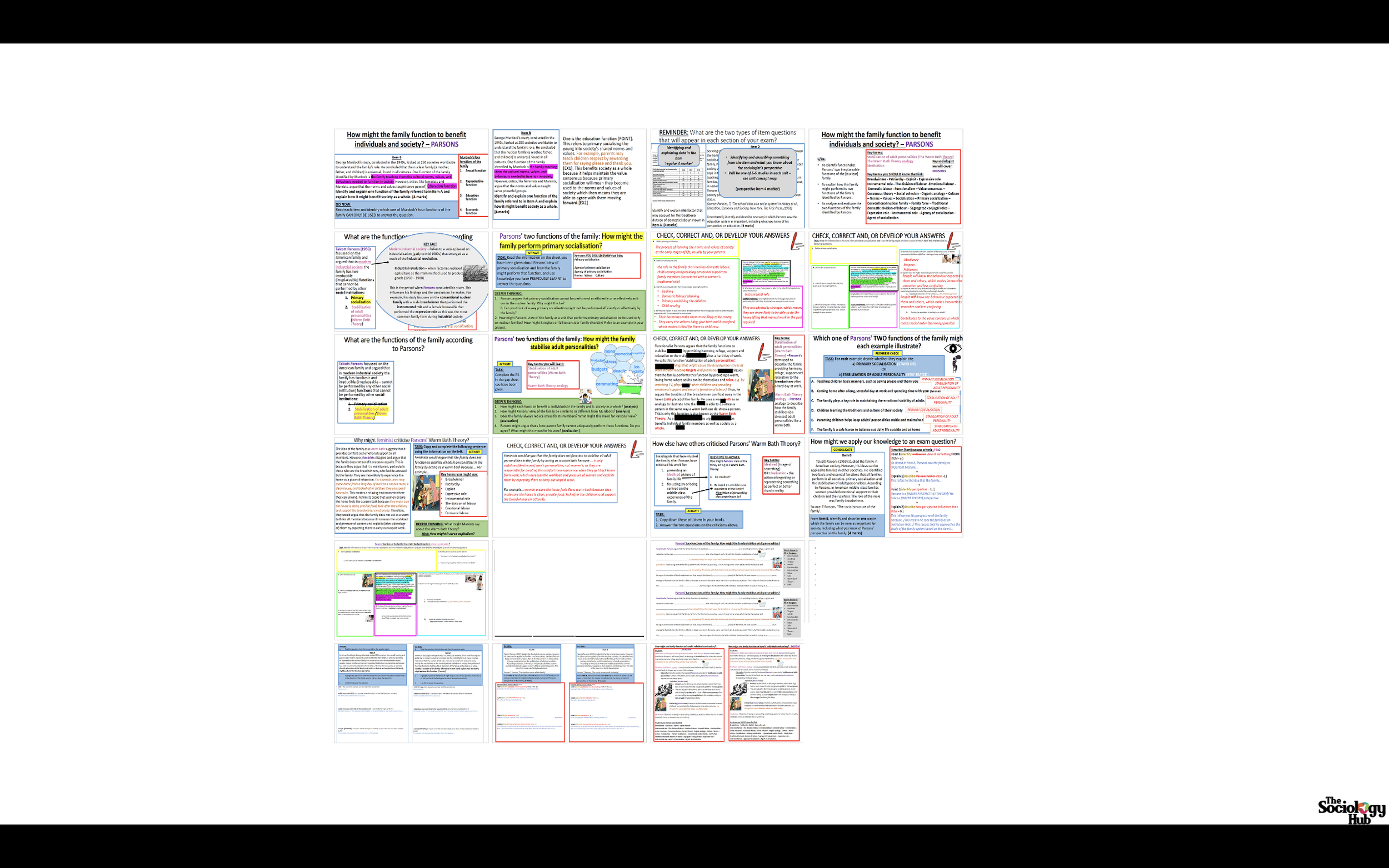
Detailed lesson with lots of scaffolding based on adaptive teaching that helps students recap functionalist views of society and identify Murdock’s four functions of the family, explain using examples how the family might perform each function, and criticise and analyse them by considering how they might benefit individuals and society as a whole.
Covers the following key terms: Sexual function (of the family), Reproductive function (of the family), Education function (of the family), Economic function (of the family), Monogamy, Polygamy, Polygyny, Polyandry, Bigamy
Covers the following sociologists: Murdock and his key study
Makes reference to the following key terms students might know, to promote a spiral curriculum: Function/role (of something) – Social institutions (systems or structures) – Symmetrical family – Dual burden (double/second shift) – Dual career families – Triple shift – Emotion work – Child-rearing – Primary socialisation – Conjugal roles – Segregated conjugal roles – Joint conjugal roles – Expressive role – Instrumental role – Conjugal relationships – Breadwinner – Functionalism – Consensus theory – Structural theory – Value consensus – Organic/biological analogy – The domestic division of labour – Traditional families – Contemporary families
Starter activity recaps functionalist views of society with a true or false retrieval task, with answers.
Includes a key term sheet with definitions for the lesson.
Includes an around the room card sort on Murdock’s four functions
Includes eight image based progress checks for whole class assessment for learning.
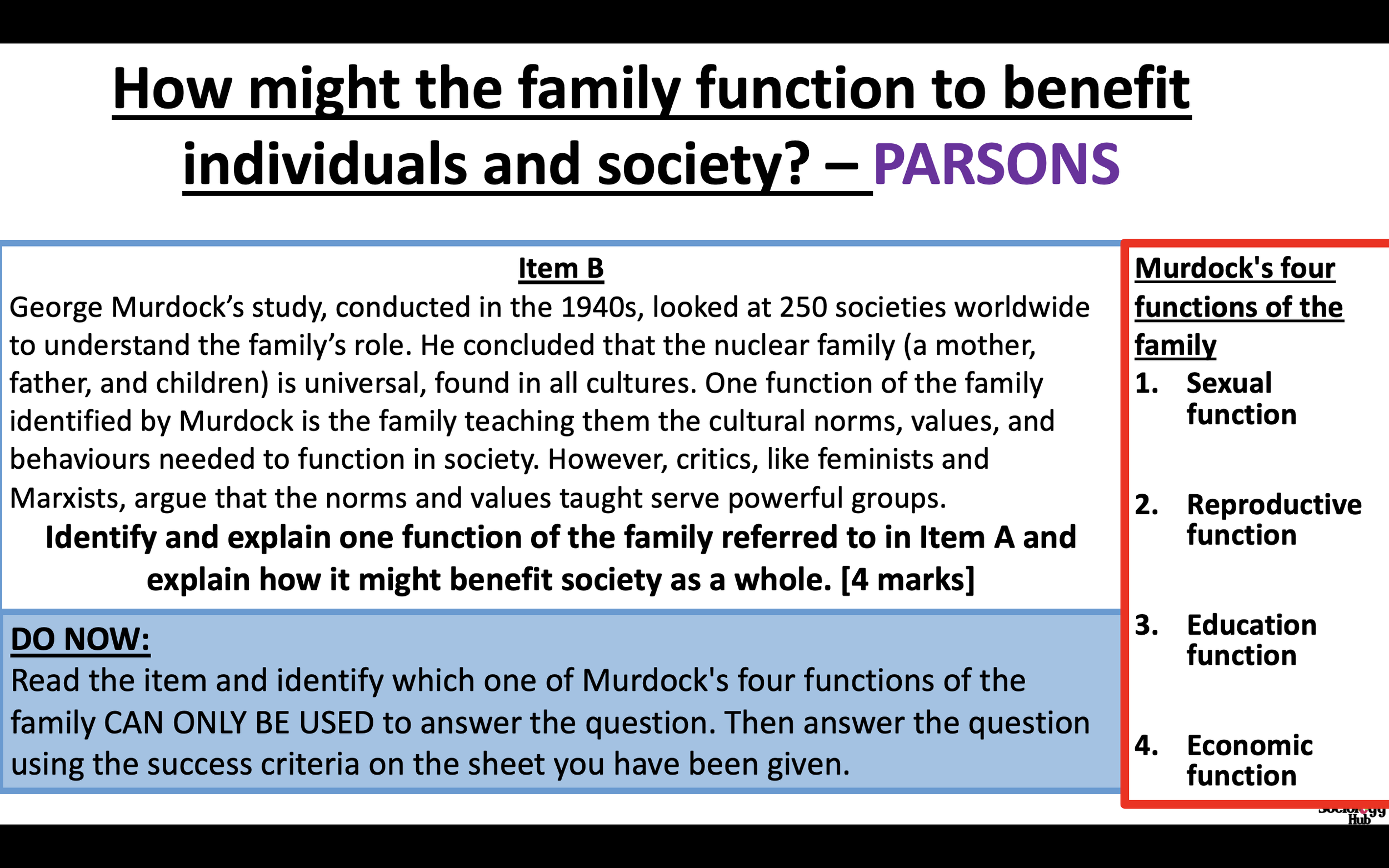
Includes 4 marker item question practice with success criteria, sentence starters and an extension question.
Includes deeper thinking prompts and stretch and challenge tasks throughout to support adaptive teaching.
ANSWERS TO MAIN ACTIVITY AND DO NOW INCLUDED
RESOURCES CAN BE FOUND AT THE END OF PPT
Detailed lesson with lots of scaffolding based on adaptive teaching that helps students recap functionalist views of society and identify Murdock’s four functions of the family, explain using examples how the family might perform each function, and criticise and analyse them by considering how they might benefit individuals and society as a whole.
Covers the following key terms: Sexual function (of the family), Reproductive function (of the family), Education function (of the family), Economic function (of the family), Monogamy, Polygamy, Polygyny, Polyandry, Bigamy
Covers the following sociologists: Murdock and his key study
Makes reference to the following key terms students might know, to promote a spiral curriculum: Function/role (of something) – Social institutions (systems or structures) – Symmetrical family – Dual burden (double/second shift) – Dual career families – Triple shift – Emotion work – Child-rearing – Primary socialisation – Conjugal roles – Segregated conjugal roles – Joint conjugal roles – Expressive role – Instrumental role – Conjugal relationships – Breadwinner – Functionalism – Consensus theory – Structural theory – Value consensus – Organic/biological analogy – The domestic division of labour – Traditional families – Contemporary families
Starter activity recaps functionalist views of society with a true or false retrieval task, with answers.
Includes a key term sheet with definitions for the lesson.
Includes an around the room card sort on Murdock’s four functions
Includes eight image based progress checks for whole class assessment for learning.
Includes 4 marker item question practice with success criteria, sentence starters and an extension question.
Includes deeper thinking prompts and stretch and challenge tasks throughout to support adaptive teaching.
ANSWERS TO MAIN ACTIVITY AND DO NOW INCLUDED
RESOURCES CAN BE FOUND AT THE END OF PPT