 Image 1 of 1
L1 AQA GCSE Sociology: Families Topic 6 - Contemporary family issues
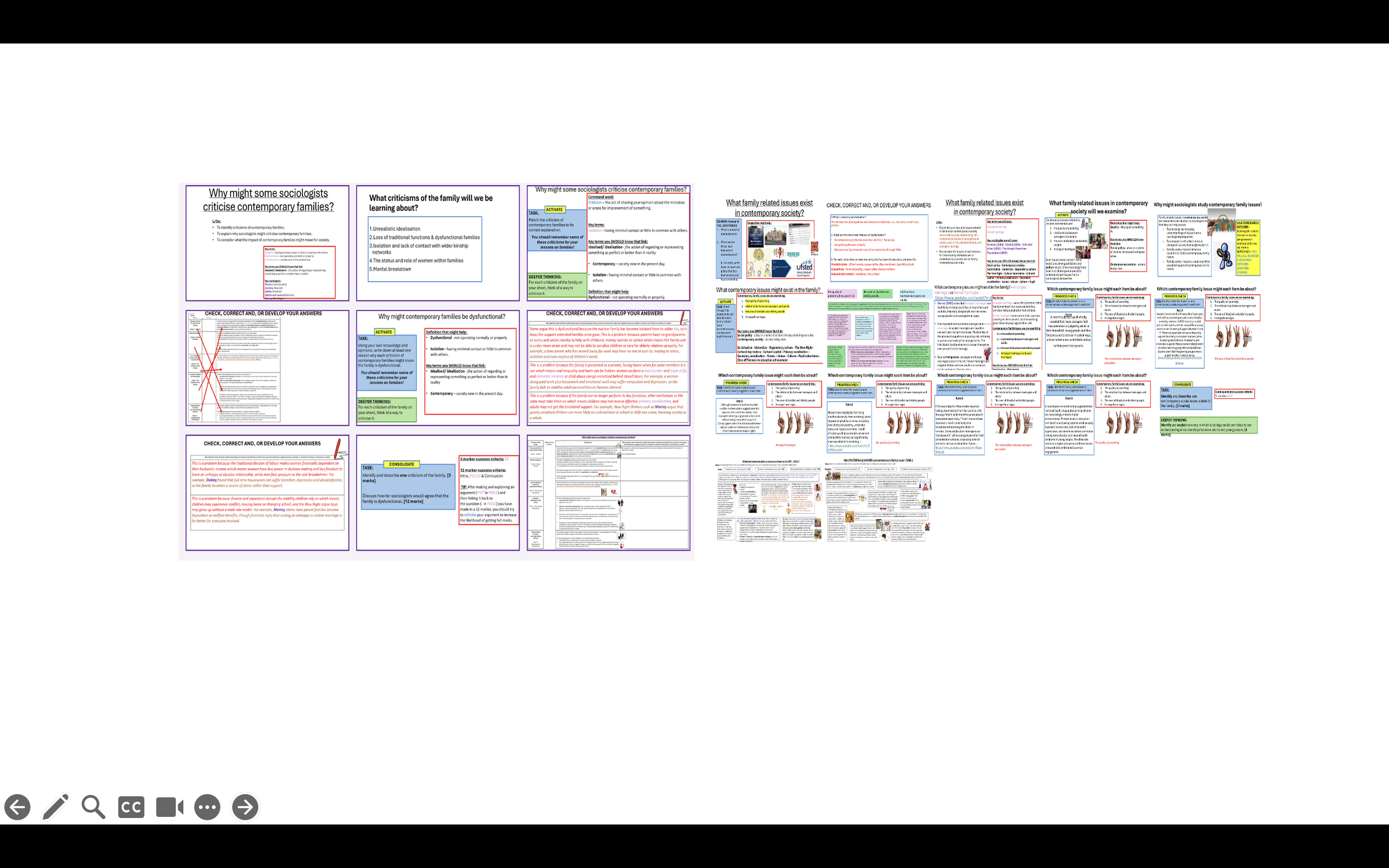
- Detailed lesson with lots of scaffolding based on adaptive teaching that help students identify and describe issues related to families in contemporary society, such as the quality of parenting, the relationships between teenagers and adults, care of the disabled/elderly and arranged marriage.
- Helps students consider the impact of and reasons for these family related issues in contemporary society on family relationships and roles.
- Covers the difference between arranged marriage and forced marriage and why forced marriage is illegal in Britain.
- Includes a teaching to all activity
-Includes three videos
-ANSWERS FOR SOME ACTIVITIES INCLUDED
- Includes ‘identify and describe’ 3 marker and ‘identify and explain’ 4 marker
- Covers the following key terms: Arranged marriage, Forced marriage
-Covers the following sociologists: Duncan (2006), Garrod (2005), Ginn and Arber (1992), The Joseph Rowntree Foundation (2007)
- Makes reference to the following key terms students might know to promote a spiral curriculum: Social policy - Contemporary society - Socialisation - Underclass - Dependency culture - The New Right - Cultural deprivation - Cultural capital - Primary socialisation - Secondary socialisation - Norms - Values - Culture - Pupil subcultures - Class differences in education achievement - Immigration - Monogamy
- Starter activity recaps marketisation from the education unit, with a full check, correct and develop answer slide.
-Item-based progress checks with instant answer reveals
-Extension task on the factors that might cause each contemporary family issue.
- Resources can be found at the end of the PPT
L2 AQA GCSE Sociology: Family- Criticisms of families in contemporary society
•Detailed lesson with lots of scaffolding based on adaptive teaching that helps students identify and describe criticisms of contemporary families, explain why sociologists might criticise them and consider what this might mean for society.
•Helps students explain why contemporary families might be considered dysfunctional.
•Includes a matching activity linking each criticism of the family to its correct explanation.
•Includes a teaching to all activity.
•Includes Deeper Thinking tasks that ask students to criticise each criticism.
•INCLUDES 3 MARKER AND 12 MARKER EXAM QUESTIONS WITH BRIEF SUCCESS CRITERIA.
•ANSWERS TO ALL ACTIVITIES INCLUDED.
•NO STARTER ACTIVITY
•Covers the following key terms: Isolation, Dysfunctional, Contemporary, Idealised / idealisation.
•Covers the following sociologists’ critique of the family: Parsons, Zaretsky, Oakley, Delphy and Leonard, Murray.
•Makes reference to the following key terms students might know to promote a spiral curriculum: Idealised/ idealisation - Contemporary - Nuclear family - Extended family - Conventional family - Family diversity - Primary socialisation - Stabilisation of adult personalities - Conjugal roles - Dual burden - Triple shift - Domestic labour - Emotional labour - Geographic and social mobility - Secularisation - Lone-parent families - Exploitation
•Makes links to Topic 2 Couples, Topic 3 The functions of the family, Topic 4 Family diversity and Topic 5 Changing family relationships.
•ANSWERS TO ALL ACTIVITIES INCLUDED
•RESOURCES CAN BE FOUND AT THE END OF THE PPT.
L1 AQA GCSE Sociology: Families Topic 6 - Contemporary family issues
- Detailed lesson with lots of scaffolding based on adaptive teaching that help students identify and describe issues related to families in contemporary society, such as the quality of parenting, the relationships between teenagers and adults, care of the disabled/elderly and arranged marriage.
- Helps students consider the impact of and reasons for these family related issues in contemporary society on family relationships and roles.
- Covers the difference between arranged marriage and forced marriage and why forced marriage is illegal in Britain.
- Includes a teaching to all activity
-Includes three videos
-ANSWERS FOR SOME ACTIVITIES INCLUDED
- Includes ‘identify and describe’ 3 marker and ‘identify and explain’ 4 marker
- Covers the following key terms: Arranged marriage, Forced marriage
-Covers the following sociologists: Duncan (2006), Garrod (2005), Ginn and Arber (1992), The Joseph Rowntree Foundation (2007)
- Makes reference to the following key terms students might know to promote a spiral curriculum: Social policy - Contemporary society - Socialisation - Underclass - Dependency culture - The New Right - Cultural deprivation - Cultural capital - Primary socialisation - Secondary socialisation - Norms - Values - Culture - Pupil subcultures - Class differences in education achievement - Immigration - Monogamy
- Starter activity recaps marketisation from the education unit, with a full check, correct and develop answer slide.
-Item-based progress checks with instant answer reveals
-Extension task on the factors that might cause each contemporary family issue.
- Resources can be found at the end of the PPT
L2 AQA GCSE Sociology: Family- Criticisms of families in contemporary society
•Detailed lesson with lots of scaffolding based on adaptive teaching that helps students identify and describe criticisms of contemporary families, explain why sociologists might criticise them and consider what this might mean for society.
•Helps students explain why contemporary families might be considered dysfunctional.
•Includes a matching activity linking each criticism of the family to its correct explanation.
•Includes a teaching to all activity.
•Includes Deeper Thinking tasks that ask students to criticise each criticism.
•INCLUDES 3 MARKER AND 12 MARKER EXAM QUESTIONS WITH BRIEF SUCCESS CRITERIA.
•ANSWERS TO ALL ACTIVITIES INCLUDED.
•NO STARTER ACTIVITY
•Covers the following key terms: Isolation, Dysfunctional, Contemporary, Idealised / idealisation.
•Covers the following sociologists’ critique of the family: Parsons, Zaretsky, Oakley, Delphy and Leonard, Murray.
•Makes reference to the following key terms students might know to promote a spiral curriculum: Idealised/ idealisation - Contemporary - Nuclear family - Extended family - Conventional family - Family diversity - Primary socialisation - Stabilisation of adult personalities - Conjugal roles - Dual burden - Triple shift - Domestic labour - Emotional labour - Geographic and social mobility - Secularisation - Lone-parent families - Exploitation
•Makes links to Topic 2 Couples, Topic 3 The functions of the family, Topic 4 Family diversity and Topic 5 Changing family relationships.
•ANSWERS TO ALL ACTIVITIES INCLUDED
•RESOURCES CAN BE FOUND AT THE END OF THE PPT.