 Image 1 of 1
L1 AQA A-level Sociology Education Topic 1: Class differences in achievement (ex) – Material deprivation
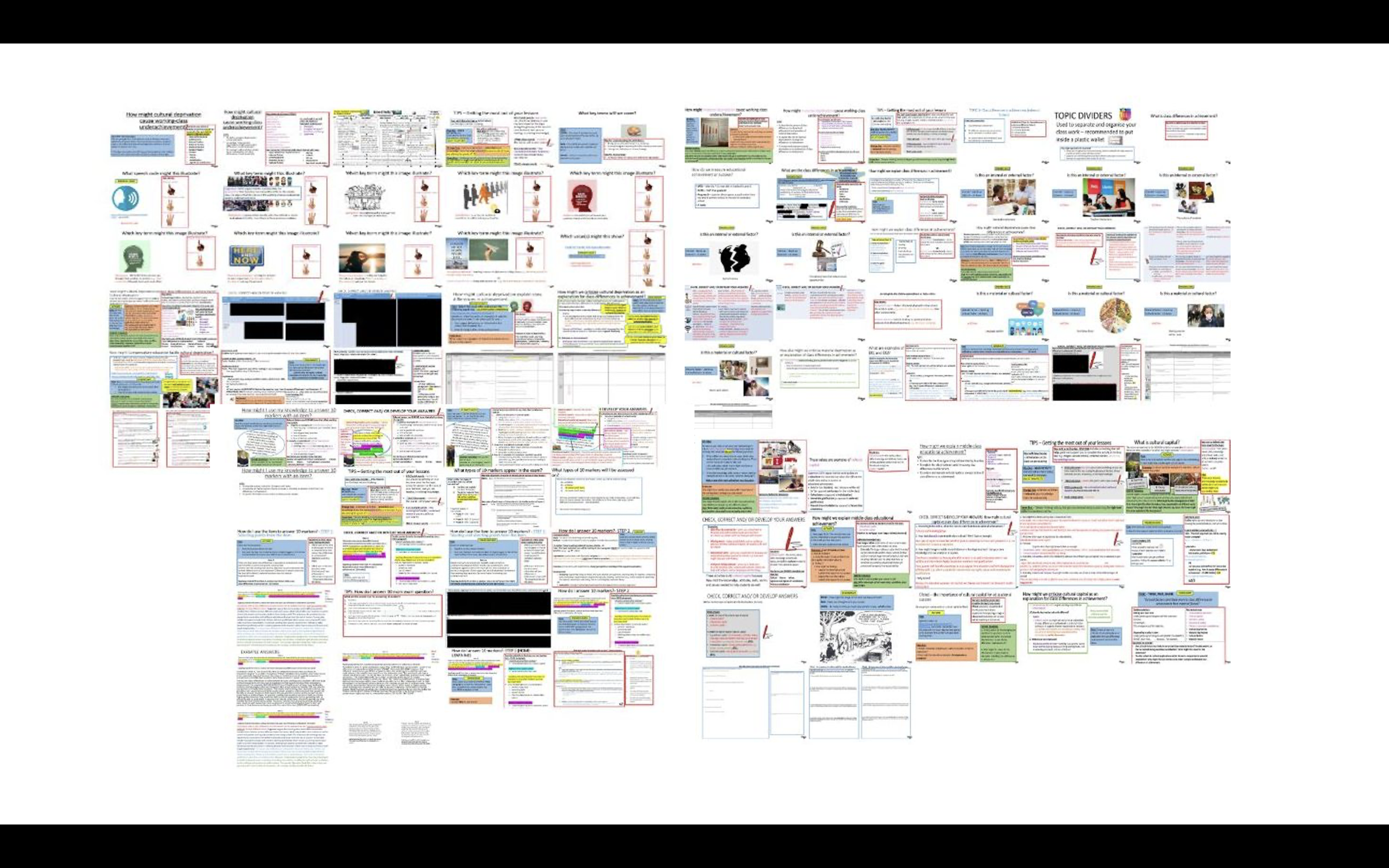
•Detailed lesson with lots of scaffolding based on adaptive teaching that helps students describe the pattern of class differences in educational achievement, explain, analyse and evaluate the role of material deprivation in causing working-class underachievement.
•Covers the following key terms: Class differences in achievement, Internal factors, External factors, Material factors, Cultural factors, Material deprivation, Pupil premium (extension).
•Covers the following sociologists: Department for Education (DfE), Flaherty, Howard, Wilkinson, Blanden and Machin, Tanner et al, Bull, Smith and Noble, Ridge, Callender and Jackson, UCAS.
•Makes reference to the following key terms students should already know, to promote a spiral curriculum: Social class, Norms, Values, Culture.
•Includes progress check activities on internal versus external factors and material versus cultural factors.
•TWO VERSIONS OF MAIN ACTIVITY TABLE (SENTENCE STARTERS AND NO SENTENCE STARTERS - PRINT TABLE IN A3
•INCLUDES 4 MARKER EXAM PRACTICE detailed scaffolding and student friendly mark-scheme
•ANSWERS TO MAIN ACTIVITIES INCLUDED.
•DO NOW and main activities require the AQA A Level Sociology Book One Including AS Level (3rd Revised Edition) by Rob Webb, Hal Westergaard, Keith Trobe and Annie Townend.
•RESOURCES CAN BE FOUND AT THE END OF THE PPT.
L2 AQA A-level Sociology: Education Topic 1 Class differences in achievement (external) - Cultural deprivation
•Detailed lesson with lots of scaffolding based on adaptive teaching that helps students define cultural deprivation using examples, explain how cultural deprivation might cause class differences in educational achievement
•Covers the following key terms: Cultural deprivation, Speech codes, The elaborate code, The restricted code, Subculture, Collectivism, Individualism, Immediate gratification, Deferred gratification, Fatalism, Meritocracy, Present-time orientation, Future-time orientation and Compensatory education.
•Covers the following sociologists: Bernstein, Douglas, Feinstein, Bernstein and Young, Sugarman, Keddie, Troyna and Williams, and Blackstone and Mortimore.
•Makes reference to the following key terms students should already know, to promote a spiral curriculum: Class differences in achievement – Internal factors – External factors – Material factors – Cultural factors – Culture – Norms – Values – Socialisation – Agents of socialisation.
•Starter activity uses retrieval practice: a key word quiz recapping prior knowledge of internal, external, material and cultural factors.
•Includes explicit vocabulary instruction through a THINK – PAIR – SHARE key term activity and a series of ‘which key term might this image illustrate?’ progress checks.
•Includes three videos as activities, covering speech codes, cultural deprivation in context and compensatory education.
•Includes a modelled and a blank explanation and evaluation table (Point, Explanation, Evaluation) to scaffold written answers.
•Includes extension, DEEPER THINKING and challenge tasks for stretch and challenge, plus a teaching to all activity.
•INCLUDES 4 MARKER WITH SUCCESS CRITERIA AND A MARK SCHEME.
•ANSWERS TO MAIN ACTIVITIES INCLUDED.
•INCLUDES KEY TERM SHEET WITH DEFINITIONS FOR THE LESSON.
•Activities require pages from the AQA A Level Sociology Book One Including
AS Level by Rob Webb, Hal Westergaard, Keith Trobe and Annie Townend.
•RESOURCES CAN BE FOUND AT THE END OF THE PPT.
L3 AQA A-level Sociology Education: Class Differences in Achievement – Cultural, Economic and Educational Capital
Detailed lesson with lots of scaffolding based on adaptive teaching that helps students describe the three types of capital identified by Bourdieu, explain them, particularly cultural capital in causing middle-class achievement achievement, and analyse and evaluate cultural capital as an explanation of class differences in achievement.
Covers the following key terms: Capital, Cultural capital, Educational capital, Economic capital, Compensatory education, Selection by mortgage (extension), Exam league tables (extension) and Ofsted (extension).
Covers the following sociologists: Bourdieu, Sugarman, Keddie, Blackstone and Mortimore, Leech and Campos (optional) and Sullivan (extension).
Makes reference to the following key terms students should already know to promote a spiral curriculum: Cultural vs Material factors – External vs Internal factors – Primary socialisation – Secondary socialisation – Meritocracy – Culture – Norms – Values – Agencies and agents of socialisation – Cultural deprivation – Material deprivation.
Retrieval-based DO NOW activity recapping Sugarman's work on working-class values from cultural deprivation lesson.
Includes a video activity on cultural capital (Ofsted) with an active listening sheet.
Includes a 6-mark exam question with scaffolding and student friendly markscheme
Activities require the AQA A Level Sociology Book One Including AS Level by Rob Webb, Hal Westergaard, Keith Trobe and Annie Townend.
RESOURCES CAN BE FOUND AT THE END OF THE PPT.
L4 AQA A-level Sociology: Education Topic 1 Class differences in achievement (external) - Answering Item 10 Markers
•Detailed lesson with lots of scaffolding based on adaptive teaching that helps students know the success criteria for 10 markers with an item, apply that success criteria to a 10 marker on external factors causing class differences in achievement, and self-assess their answer.
•Provides overview of the two types of 10 marker ('outline and explain' and 'applying material from the item'), where each appears across Papers 1, 2 and 3, and how to select and quote points from an item.
•Includes three model paragraphs
•Includes one student friendly mark-scheme
•Includes two item 10 markers
•Includes activities to develop the skills needed to use items.
•Covers PEED success criteria
•ANSWERS TO MAIN ACTIVITIES INCLUDED.
•Resources can be found at the end of the PPT.
L1 AQA A-level Sociology Education Topic 1: Class differences in achievement (ex) – Material deprivation
•Detailed lesson with lots of scaffolding based on adaptive teaching that helps students describe the pattern of class differences in educational achievement, explain, analyse and evaluate the role of material deprivation in causing working-class underachievement.
•Covers the following key terms: Class differences in achievement, Internal factors, External factors, Material factors, Cultural factors, Material deprivation, Pupil premium (extension).
•Covers the following sociologists: Department for Education (DfE), Flaherty, Howard, Wilkinson, Blanden and Machin, Tanner et al, Bull, Smith and Noble, Ridge, Callender and Jackson, UCAS.
•Makes reference to the following key terms students should already know, to promote a spiral curriculum: Social class, Norms, Values, Culture.
•Includes progress check activities on internal versus external factors and material versus cultural factors.
•TWO VERSIONS OF MAIN ACTIVITY TABLE (SENTENCE STARTERS AND NO SENTENCE STARTERS - PRINT TABLE IN A3
•INCLUDES 4 MARKER EXAM PRACTICE detailed scaffolding and student friendly mark-scheme
•ANSWERS TO MAIN ACTIVITIES INCLUDED.
•DO NOW and main activities require the AQA A Level Sociology Book One Including AS Level (3rd Revised Edition) by Rob Webb, Hal Westergaard, Keith Trobe and Annie Townend.
•RESOURCES CAN BE FOUND AT THE END OF THE PPT.
L2 AQA A-level Sociology: Education Topic 1 Class differences in achievement (external) - Cultural deprivation
•Detailed lesson with lots of scaffolding based on adaptive teaching that helps students define cultural deprivation using examples, explain how cultural deprivation might cause class differences in educational achievement
•Covers the following key terms: Cultural deprivation, Speech codes, The elaborate code, The restricted code, Subculture, Collectivism, Individualism, Immediate gratification, Deferred gratification, Fatalism, Meritocracy, Present-time orientation, Future-time orientation and Compensatory education.
•Covers the following sociologists: Bernstein, Douglas, Feinstein, Bernstein and Young, Sugarman, Keddie, Troyna and Williams, and Blackstone and Mortimore.
•Makes reference to the following key terms students should already know, to promote a spiral curriculum: Class differences in achievement – Internal factors – External factors – Material factors – Cultural factors – Culture – Norms – Values – Socialisation – Agents of socialisation.
•Starter activity uses retrieval practice: a key word quiz recapping prior knowledge of internal, external, material and cultural factors.
•Includes explicit vocabulary instruction through a THINK – PAIR – SHARE key term activity and a series of ‘which key term might this image illustrate?’ progress checks.
•Includes three videos as activities, covering speech codes, cultural deprivation in context and compensatory education.
•Includes a modelled and a blank explanation and evaluation table (Point, Explanation, Evaluation) to scaffold written answers.
•Includes extension, DEEPER THINKING and challenge tasks for stretch and challenge, plus a teaching to all activity.
•INCLUDES 4 MARKER WITH SUCCESS CRITERIA AND A MARK SCHEME.
•ANSWERS TO MAIN ACTIVITIES INCLUDED.
•INCLUDES KEY TERM SHEET WITH DEFINITIONS FOR THE LESSON.
•Activities require pages from the AQA A Level Sociology Book One Including
AS Level by Rob Webb, Hal Westergaard, Keith Trobe and Annie Townend.
•RESOURCES CAN BE FOUND AT THE END OF THE PPT.
L3 AQA A-level Sociology Education: Class Differences in Achievement – Cultural, Economic and Educational Capital
Detailed lesson with lots of scaffolding based on adaptive teaching that helps students describe the three types of capital identified by Bourdieu, explain them, particularly cultural capital in causing middle-class achievement achievement, and analyse and evaluate cultural capital as an explanation of class differences in achievement.
Covers the following key terms: Capital, Cultural capital, Educational capital, Economic capital, Compensatory education, Selection by mortgage (extension), Exam league tables (extension) and Ofsted (extension).
Covers the following sociologists: Bourdieu, Sugarman, Keddie, Blackstone and Mortimore, Leech and Campos (optional) and Sullivan (extension).
Makes reference to the following key terms students should already know to promote a spiral curriculum: Cultural vs Material factors – External vs Internal factors – Primary socialisation – Secondary socialisation – Meritocracy – Culture – Norms – Values – Agencies and agents of socialisation – Cultural deprivation – Material deprivation.
Retrieval-based DO NOW activity recapping Sugarman's work on working-class values from cultural deprivation lesson.
Includes a video activity on cultural capital (Ofsted) with an active listening sheet.
Includes a 6-mark exam question with scaffolding and student friendly markscheme
Activities require the AQA A Level Sociology Book One Including AS Level by Rob Webb, Hal Westergaard, Keith Trobe and Annie Townend.
RESOURCES CAN BE FOUND AT THE END OF THE PPT.
L4 AQA A-level Sociology: Education Topic 1 Class differences in achievement (external) - Answering Item 10 Markers
•Detailed lesson with lots of scaffolding based on adaptive teaching that helps students know the success criteria for 10 markers with an item, apply that success criteria to a 10 marker on external factors causing class differences in achievement, and self-assess their answer.
•Provides overview of the two types of 10 marker ('outline and explain' and 'applying material from the item'), where each appears across Papers 1, 2 and 3, and how to select and quote points from an item.
•Includes three model paragraphs
•Includes one student friendly mark-scheme
•Includes two item 10 markers
•Includes activities to develop the skills needed to use items.
•Covers PEED success criteria
•ANSWERS TO MAIN ACTIVITIES INCLUDED.
•Resources can be found at the end of the PPT.