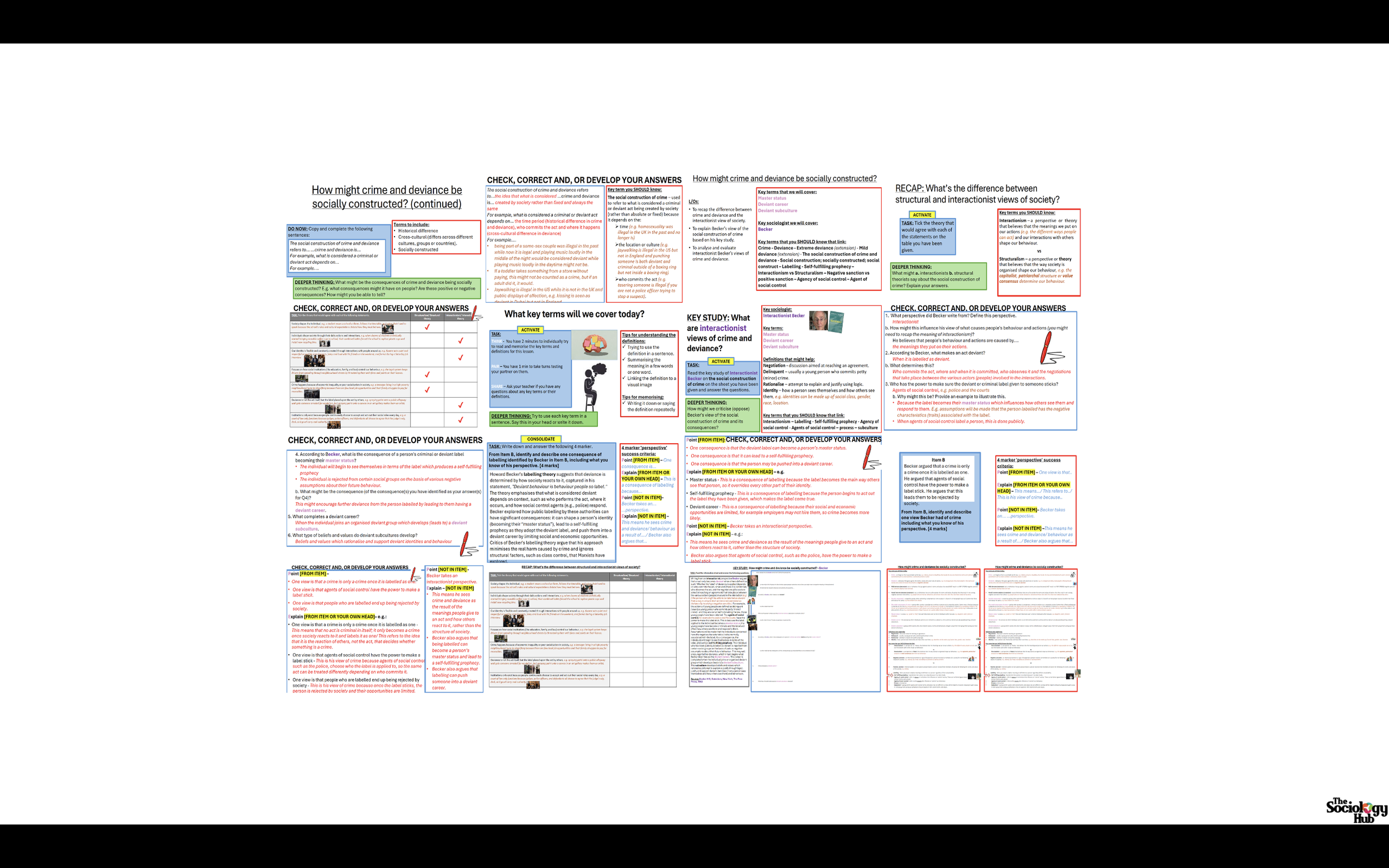
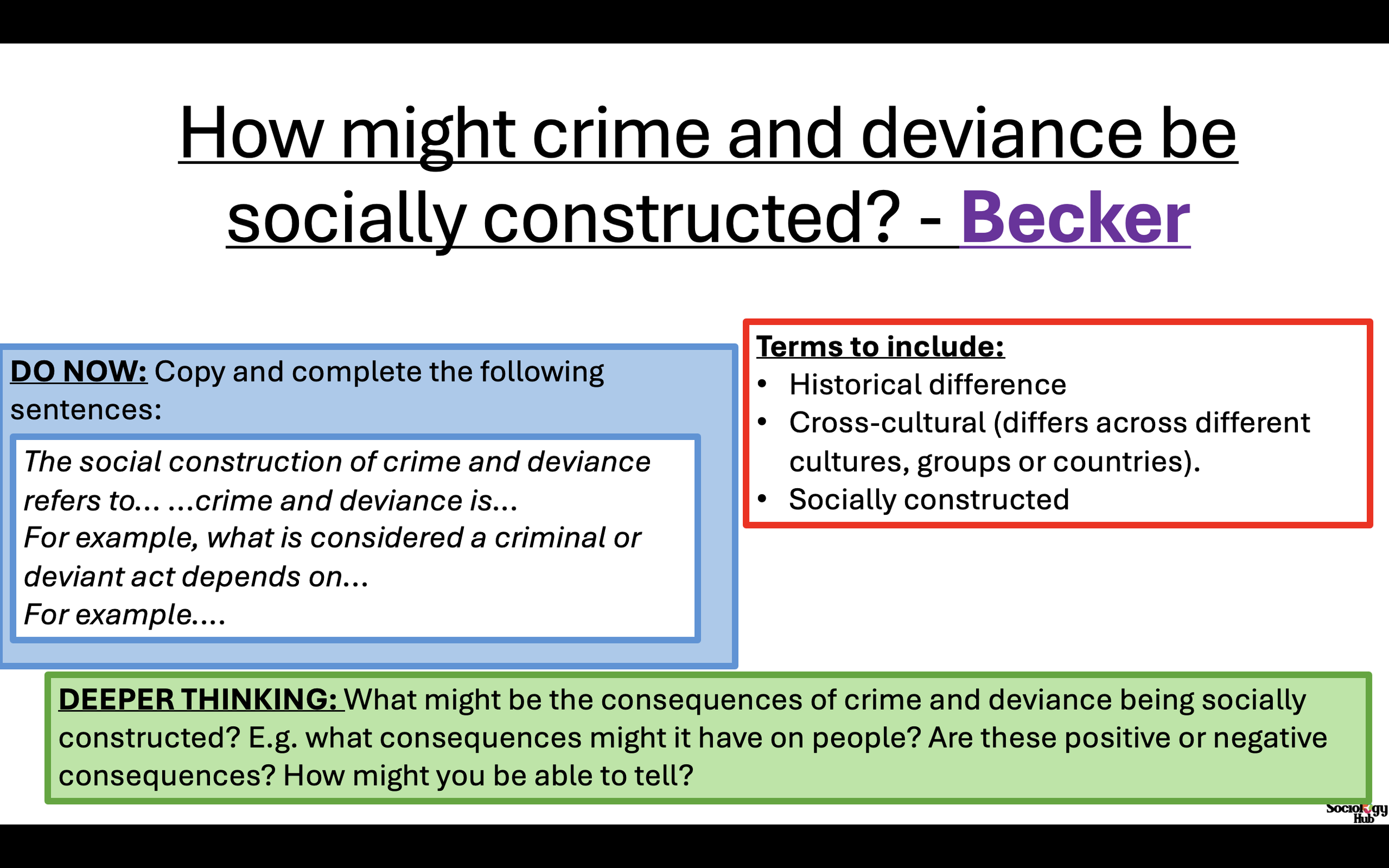
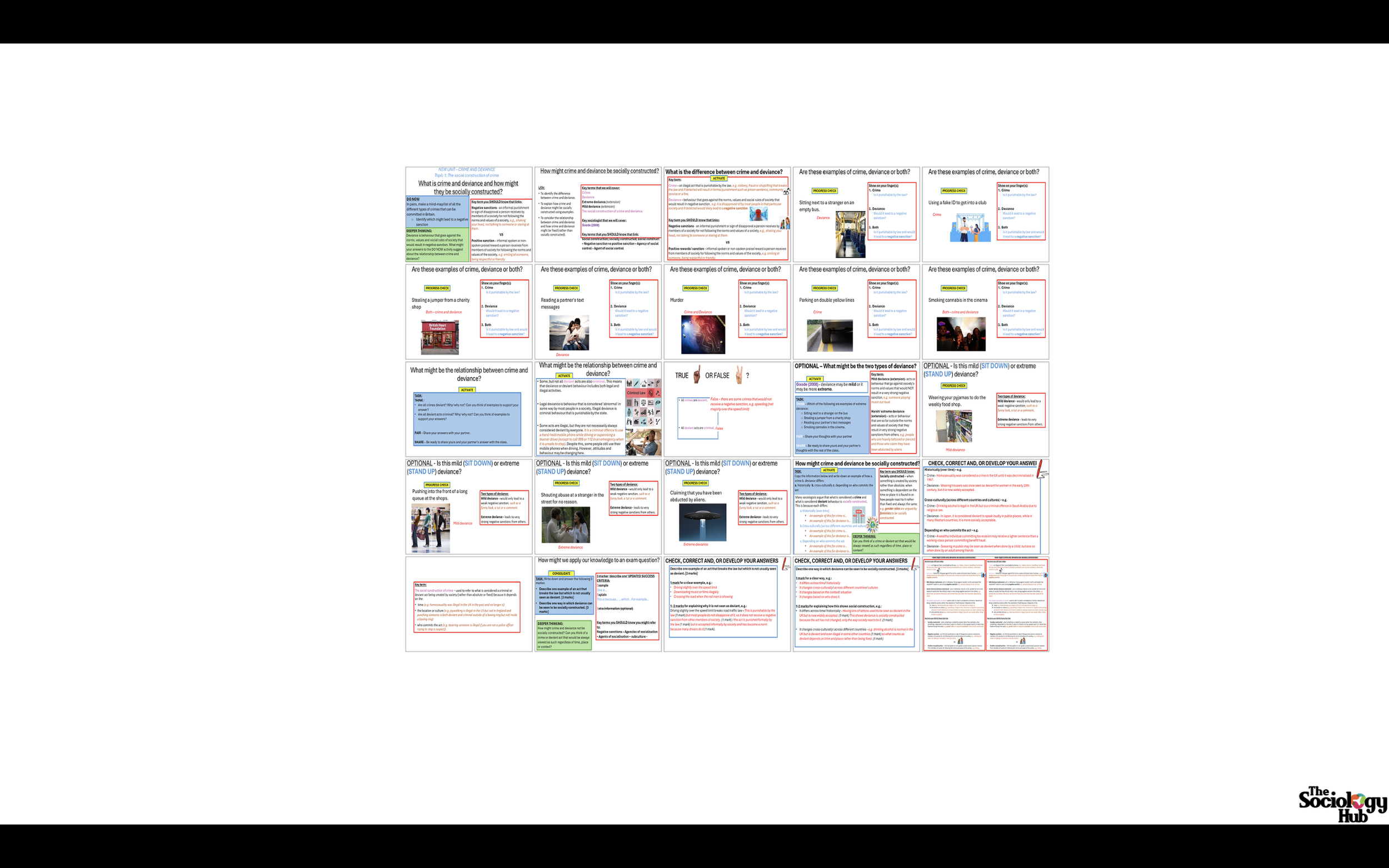
 Image 1 of 2
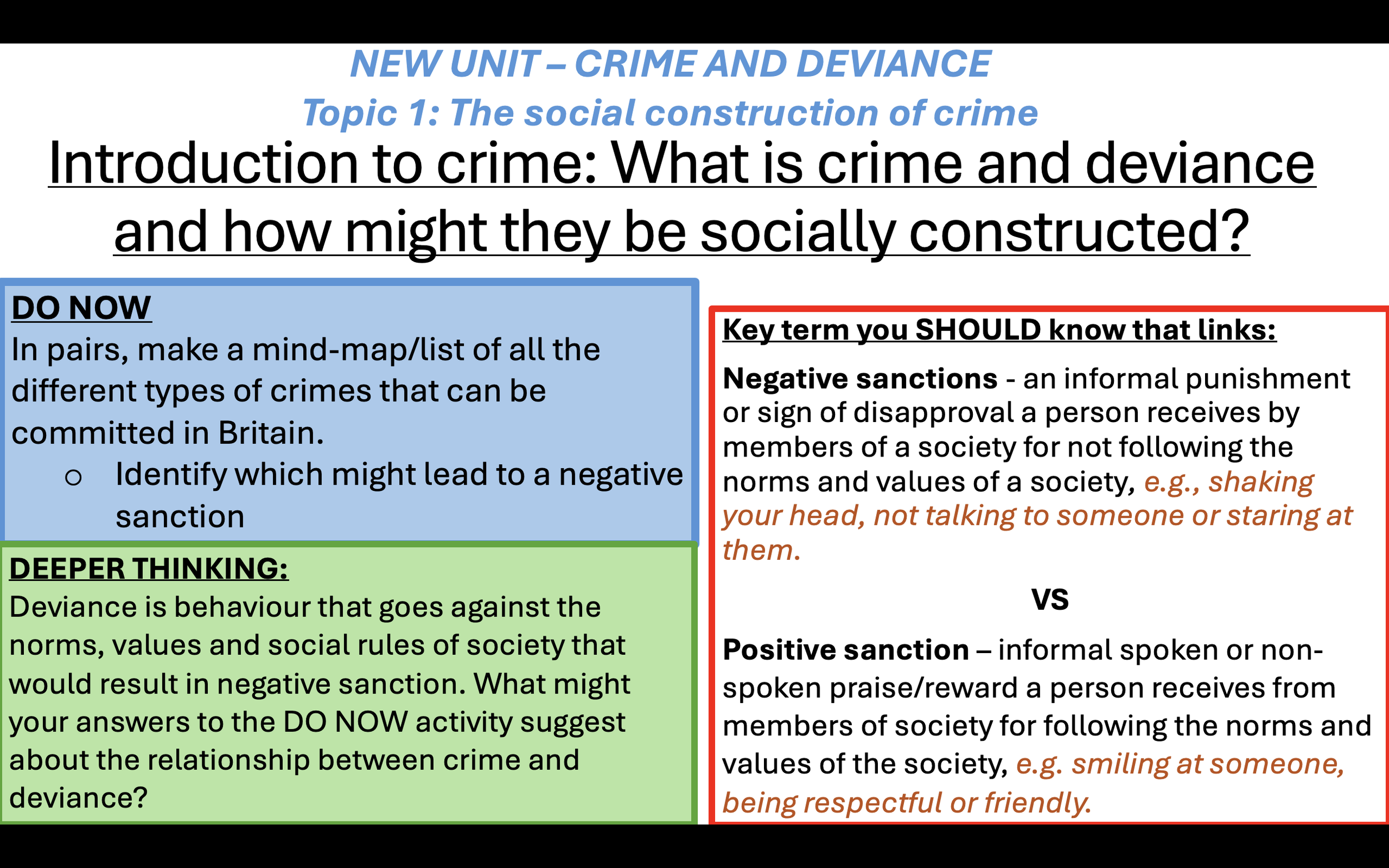 Image 2 of 2
•Detailed lesson with lots of scaffolding based on adaptive teaching that helps students identify the difference between crime and deviance and explain how crime and deviance might be socially constructed using examples.
•Considers the relationship between crime and deviance, and whether crime and deviance might be fixed rather than socially constructed.
•Covers the following key terms: Crime, Deviance, Mild deviance (extension), Extreme deviance (extension) and The social construction of crime and deviance.
•Covers the following sociologists: Goode (2008).
•Makes reference to the following key terms students should know to promote a spiral curriculum: Social construction; socially constructed; social construct – Negative sanction vs positive rewards/sanction – Agency of social control – Agent of social control.
•Includes retrieval practice, explicit vocabulary instruction, Think-Pair-Share, progress checks, modelling and worked examples, deeper thinking prompts and optional extension tasks for stretch and challenge.
•Includes whole-class participation activities: finger-voting progress checks, true or false and a sit down/stand up mild or extreme deviance task.
•INCLUDES TWO 3 MARKERS WITH UPDATED SUCCESS CRITERIA AND MODEL ANSWERS.
•ANSWERS TO MAIN ACTIVITIES INCLUDED.
•INCLUDES A KEY TERM SHEET WITH DEFINITIONS FOR THE LESSON.
•RESOURCES CAN BE FOUND AT THE END OF THE PPT.
•Detailed lesson with lots of scaffolding based on adaptive teaching that helps students identify the difference between crime and deviance and explain how crime and deviance might be socially constructed using examples.
•Considers the relationship between crime and deviance, and whether crime and deviance might be fixed rather than socially constructed.
•Covers the following key terms: Crime, Deviance, Mild deviance (extension), Extreme deviance (extension) and The social construction of crime and deviance.
•Covers the following sociologists: Goode (2008).
•Makes reference to the following key terms students should know to promote a spiral curriculum: Social construction; socially constructed; social construct – Negative sanction vs positive rewards/sanction – Agency of social control – Agent of social control.
•Includes retrieval practice, explicit vocabulary instruction, Think-Pair-Share, progress checks, modelling and worked examples, deeper thinking prompts and optional extension tasks for stretch and challenge.
•Includes whole-class participation activities: finger-voting progress checks, true or false and a sit down/stand up mild or extreme deviance task.
•INCLUDES TWO 3 MARKERS WITH UPDATED SUCCESS CRITERIA AND MODEL ANSWERS.
•ANSWERS TO MAIN ACTIVITIES INCLUDED.
•INCLUDES A KEY TERM SHEET WITH DEFINITIONS FOR THE LESSON.
•RESOURCES CAN BE FOUND AT THE END OF THE PPT.