 Image 1 of 1
L1 AQA GCSE Sociology Crime and Deviance: Public Debates – Punishment (Prisons) vs Rehabilitation
•Detailed lesson with lots of scaffolding based on adaptive teaching that helps students describe the public debate over the use of the prison system vs community sentences (rehabilitation), explain the arguments for and against its use, and consider how useful those arguments are.
•Covers the following key terms: Prison system, Rehabilitation, Community service, Anti-social behaviourMinimum security prison (extension), Maximum security prison (extension).
•Makes reference to the following key terms students should already know, to promote a spiral curriculum: Youth crime – Social control – Formal vs informal social control – Written vs unwritten rules – Formal vs informal methods of social control – Conformity – Agencies and agents of social control vs socialisation – The criminal justice system – Official crime statistics – Socially constructed – Deterrent.
•DO NOW retrieval practice recapping social control, patterns of crime, formal methods of social control, the social construction of crime and criticisms of official crime statistics – with answers.
• Think–Pair–Share key term activity with tips for understanding and memorising definitions.
• Includes three video clips as activities on prisons.
• Statistics activity more using up-to-date official data on reoffending by sentence length and under-18s in custody in England and Wales compared with Finland.
• Case studies of prisons in Finland, Bastoy Prison (Norway) and Justizzentrum Leoben (Austria).
• Initial class vote and oracy activity with sentence starters for discussion and debate.
• Exam practice: a 3-mark 'identify and describe' question and a 12-marker planning activity and a conclusion success criteria.
• Includes deeper thinking questions
• Includes a key term sheet with definitions for the lesson.
• Trigger warnings included where sensitive crimes are referenced.
•ANSWERS TO SOME ACTIVITIES INCLUDED.
•RESOURCES CAN BE FOUND AT THE END OF PPT
L2 AQA GCSE Sociology Crime and Deviance: Public Debates – Treatment of young offenders
•Detailed lesson with lots of scaffolding based on adaptive teaching that helps students describe the public debate over the sentencing of young offenders, explain the arguments for and against the sentencing of young offenders, and consider the usefulness of those arguments.
•Covers the following key terms: Fine (extension), Referral order (extension), Youth rehabilitation order (extension), Custodial sentences (extension), Civil injunctions, Community Protection Notices (CPNs) and Criminal Behaviour Orders (CBOs) (extension)
•Makes reference to the following key terms students might know, to promote a spiral curriculum: Prison system vs rehabilitation - Youth crime - Juvenile - Adolescent – Delinquent – Case study – Representative sample – to generalise findings – qualitative vs quantitative methods – mixed methods approach – triangulation – Social control – Formal vs informal social control – Formal vs informal methods of social control – Written vs unwritten rules – Conformity – Agencies and agents of social control vs socialisation – The criminal justice system - Anti-social behaviour
•Uses the murder of James Bulger as a case study to illustrate the arguments for and against sentencing young people, and to revisit the case study research method.
•Includes a starter using official crime statistics, with sentence starters, plus ACTIVATE, PROGRESS CHECK and CONSOLIDATE activities and DEEPER THINKING stretch and challenge questions throughout.
•Includes a relevant research methods 4-marker with scaffolding
•Includes a video on the youth criminal law in the UK and a matching task on the punishments available to the youth courts.
•ANSWERS TO THE MAIN ACTIVITIES INCLUDED.
•RESOURCES CAN BE FOUND AT THE END OF THE PPT.
•Please note: this lesson carries a trigger warning, as it makes reference to murder, sexual assault and self-harm.
L3 AQA GCSE Sociology Crime and Deviance: Public Debates – Sentencing of violent offenders
• Detailed lesson with lots of scaffolding based on adaptive teaching that helps students describe the public debate over the life sentencing of violent criminals, explain the arguments for and against life or longer sentences, and consider how useful those arguments are.
• Covers the changes in the law made by the Legal Aid, Sentencing and Punishment of Offenders Act (LASPO, 2012) involving the two-strike rule and changes to the release of dangerous offenders.
• Covers the following key terms: Violent crime, Moral panic (extension), Theft (extension), Robbery (extension)
• Makes reference to the following key terms students should already know, to promote a spiral curriculum: Crime - Deviance - Official crime statistics - Crime Survey for England and Wales (CSEW) - Victim - Offender - Sentencing - Prison - Rehabilitation - Deterrence - Restorative justice - Moral panic - Media representation of crime.
• Includes a DO NOW retrieval activity using up-to-date ONS crime data (year ending March 2026) with two graphs and full answers.
• Includes a for-and-against longer sentences for violent criminals
• Deeper thinking questions
• 12-mark question with detailed success criteria to write a paragraph
• ANSWERS TO MAIN ACTIVITIES INCLUDED.
• RESOURCES CAN BE FOUND AT THE END OF THE PPT.
L4 AQA GCSE Sociology Crime and Deviance: Public Debates – Media coverage of crime
•Detailed lesson with lots of scaffolding based on adaptive teaching that helps students describe the two public debates over the media coverage of crime (whether the media its biased in its depiction of crime and where the media leads to crime) explain the arguments for and against these.
•Covers the following key terms: Mass media, Agenda-setting, News Value, Moral Panic, Sensationalist reporting (extension) and Deviancy amplification spiral.
•Covers the following sociologists and studies: Marxists, Ditton and Duffy (extension), Anderson (extension) and Ferguson (extension).
•Makes reference to the following key terms students should know, to promote a spiral curriculum: Crime – Deviance – Social control – Secondary socialisation – Agents of socialisation – Agency of socialisation – Labelling – Self-fulfilling prophecy – Folk devils – Relative deprivation – Youth subcultures – Criminal justice system – Official crime statistics.
•Includes a Think, Pair, Share retrieval starter on the key terms and definitions, with strategies for understanding and memorising them.
•Includes a NEWS VALUES APPLICATION TASK using five real, up-to-date news reports, where students identify the news values that might have influenced each story (answers included).
•Includes a visual explanation of the deviancy amplification spiral.
•Deeper Thinking prompts
•Includes three 3 markers ‘identify and describe’
•ANSWERS TO THE MAIN ACTIVITIES INCLUDED
•Includes key term and definitions sheet for the lesson (including the eleven news values with examples).
•RESOURCES CAN BE FOUND AT THE END OF THE PPT
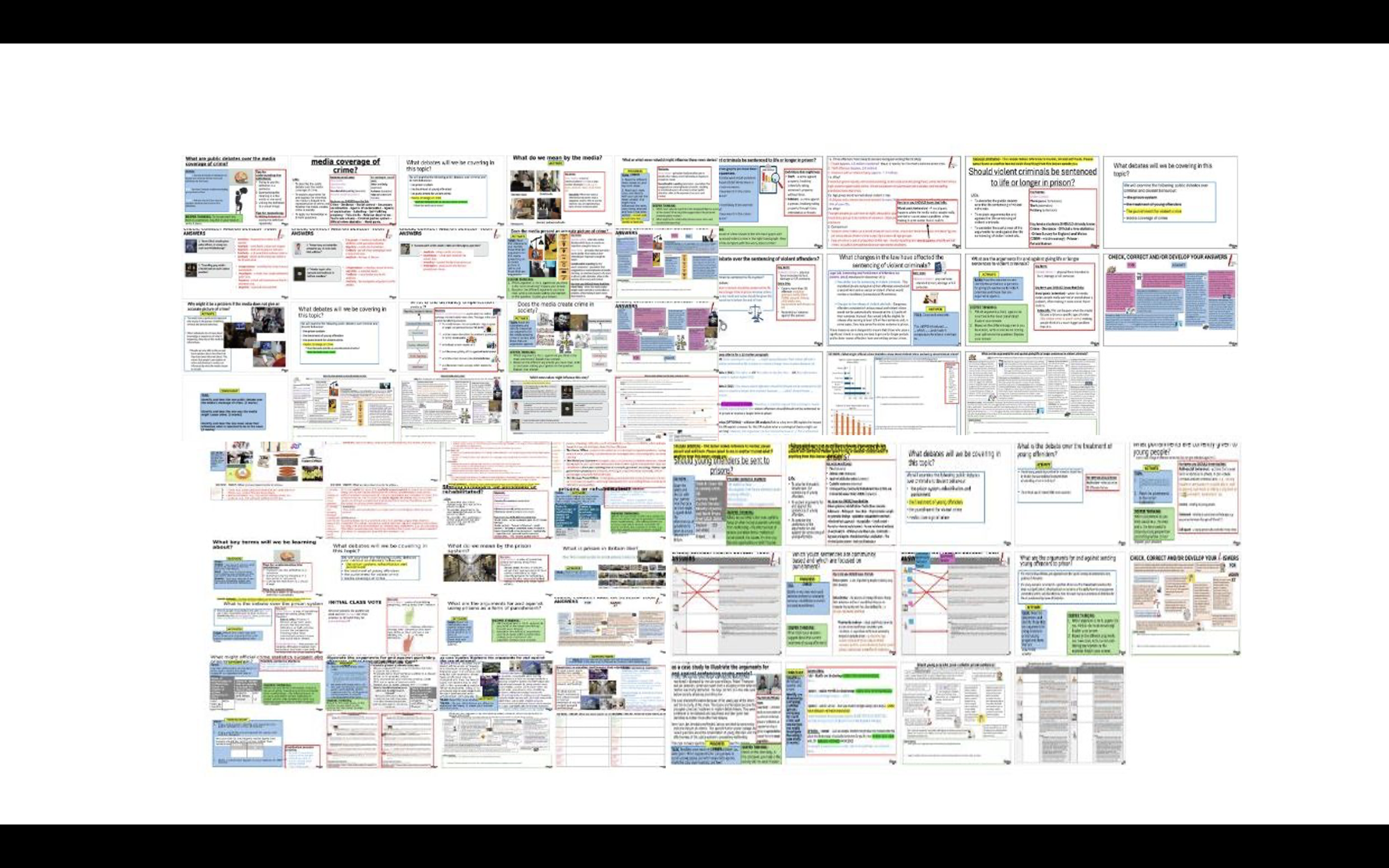
L1 AQA GCSE Sociology Crime and Deviance: Public Debates – Punishment (Prisons) vs Rehabilitation
•Detailed lesson with lots of scaffolding based on adaptive teaching that helps students describe the public debate over the use of the prison system vs community sentences (rehabilitation), explain the arguments for and against its use, and consider how useful those arguments are.
•Covers the following key terms: Prison system, Rehabilitation, Community service, Anti-social behaviourMinimum security prison (extension), Maximum security prison (extension).
•Makes reference to the following key terms students should already know, to promote a spiral curriculum: Youth crime – Social control – Formal vs informal social control – Written vs unwritten rules – Formal vs informal methods of social control – Conformity – Agencies and agents of social control vs socialisation – The criminal justice system – Official crime statistics – Socially constructed – Deterrent.
•DO NOW retrieval practice recapping social control, patterns of crime, formal methods of social control, the social construction of crime and criticisms of official crime statistics – with answers.
• Think–Pair–Share key term activity with tips for understanding and memorising definitions.
• Includes three video clips as activities on prisons.
• Statistics activity more using up-to-date official data on reoffending by sentence length and under-18s in custody in England and Wales compared with Finland.
• Case studies of prisons in Finland, Bastoy Prison (Norway) and Justizzentrum Leoben (Austria).
• Initial class vote and oracy activity with sentence starters for discussion and debate.
• Exam practice: a 3-mark 'identify and describe' question and a 12-marker planning activity and a conclusion success criteria.
• Includes deeper thinking questions
• Includes a key term sheet with definitions for the lesson.
• Trigger warnings included where sensitive crimes are referenced.
•ANSWERS TO SOME ACTIVITIES INCLUDED.
•RESOURCES CAN BE FOUND AT THE END OF PPT
L2 AQA GCSE Sociology Crime and Deviance: Public Debates – Treatment of young offenders
•Detailed lesson with lots of scaffolding based on adaptive teaching that helps students describe the public debate over the sentencing of young offenders, explain the arguments for and against the sentencing of young offenders, and consider the usefulness of those arguments.
•Covers the following key terms: Fine (extension), Referral order (extension), Youth rehabilitation order (extension), Custodial sentences (extension), Civil injunctions, Community Protection Notices (CPNs) and Criminal Behaviour Orders (CBOs) (extension)
•Makes reference to the following key terms students might know, to promote a spiral curriculum: Prison system vs rehabilitation - Youth crime - Juvenile - Adolescent – Delinquent – Case study – Representative sample – to generalise findings – qualitative vs quantitative methods – mixed methods approach – triangulation – Social control – Formal vs informal social control – Formal vs informal methods of social control – Written vs unwritten rules – Conformity – Agencies and agents of social control vs socialisation – The criminal justice system - Anti-social behaviour
•Uses the murder of James Bulger as a case study to illustrate the arguments for and against sentencing young people, and to revisit the case study research method.
•Includes a starter using official crime statistics, with sentence starters, plus ACTIVATE, PROGRESS CHECK and CONSOLIDATE activities and DEEPER THINKING stretch and challenge questions throughout.
•Includes a relevant research methods 4-marker with scaffolding
•Includes a video on the youth criminal law in the UK and a matching task on the punishments available to the youth courts.
•ANSWERS TO THE MAIN ACTIVITIES INCLUDED.
•RESOURCES CAN BE FOUND AT THE END OF THE PPT.
•Please note: this lesson carries a trigger warning, as it makes reference to murder, sexual assault and self-harm.
L3 AQA GCSE Sociology Crime and Deviance: Public Debates – Sentencing of violent offenders
• Detailed lesson with lots of scaffolding based on adaptive teaching that helps students describe the public debate over the life sentencing of violent criminals, explain the arguments for and against life or longer sentences, and consider how useful those arguments are.
• Covers the changes in the law made by the Legal Aid, Sentencing and Punishment of Offenders Act (LASPO, 2012) involving the two-strike rule and changes to the release of dangerous offenders.
• Covers the following key terms: Violent crime, Moral panic (extension), Theft (extension), Robbery (extension)
• Makes reference to the following key terms students should already know, to promote a spiral curriculum: Crime - Deviance - Official crime statistics - Crime Survey for England and Wales (CSEW) - Victim - Offender - Sentencing - Prison - Rehabilitation - Deterrence - Restorative justice - Moral panic - Media representation of crime.
• Includes a DO NOW retrieval activity using up-to-date ONS crime data (year ending March 2026) with two graphs and full answers.
• Includes a for-and-against longer sentences for violent criminals
• Deeper thinking questions
• 12-mark question with detailed success criteria to write a paragraph
• ANSWERS TO MAIN ACTIVITIES INCLUDED.
• RESOURCES CAN BE FOUND AT THE END OF THE PPT.
L4 AQA GCSE Sociology Crime and Deviance: Public Debates – Media coverage of crime
•Detailed lesson with lots of scaffolding based on adaptive teaching that helps students describe the two public debates over the media coverage of crime (whether the media its biased in its depiction of crime and where the media leads to crime) explain the arguments for and against these.
•Covers the following key terms: Mass media, Agenda-setting, News Value, Moral Panic, Sensationalist reporting (extension) and Deviancy amplification spiral.
•Covers the following sociologists and studies: Marxists, Ditton and Duffy (extension), Anderson (extension) and Ferguson (extension).
•Makes reference to the following key terms students should know, to promote a spiral curriculum: Crime – Deviance – Social control – Secondary socialisation – Agents of socialisation – Agency of socialisation – Labelling – Self-fulfilling prophecy – Folk devils – Relative deprivation – Youth subcultures – Criminal justice system – Official crime statistics.
•Includes a Think, Pair, Share retrieval starter on the key terms and definitions, with strategies for understanding and memorising them.
•Includes a NEWS VALUES APPLICATION TASK using five real, up-to-date news reports, where students identify the news values that might have influenced each story (answers included).
•Includes a visual explanation of the deviancy amplification spiral.
•Deeper Thinking prompts
•Includes three 3 markers ‘identify and describe’
•ANSWERS TO THE MAIN ACTIVITIES INCLUDED
•Includes key term and definitions sheet for the lesson (including the eleven news values with examples).
•RESOURCES CAN BE FOUND AT THE END OF THE PPT