 Image 1 of 2
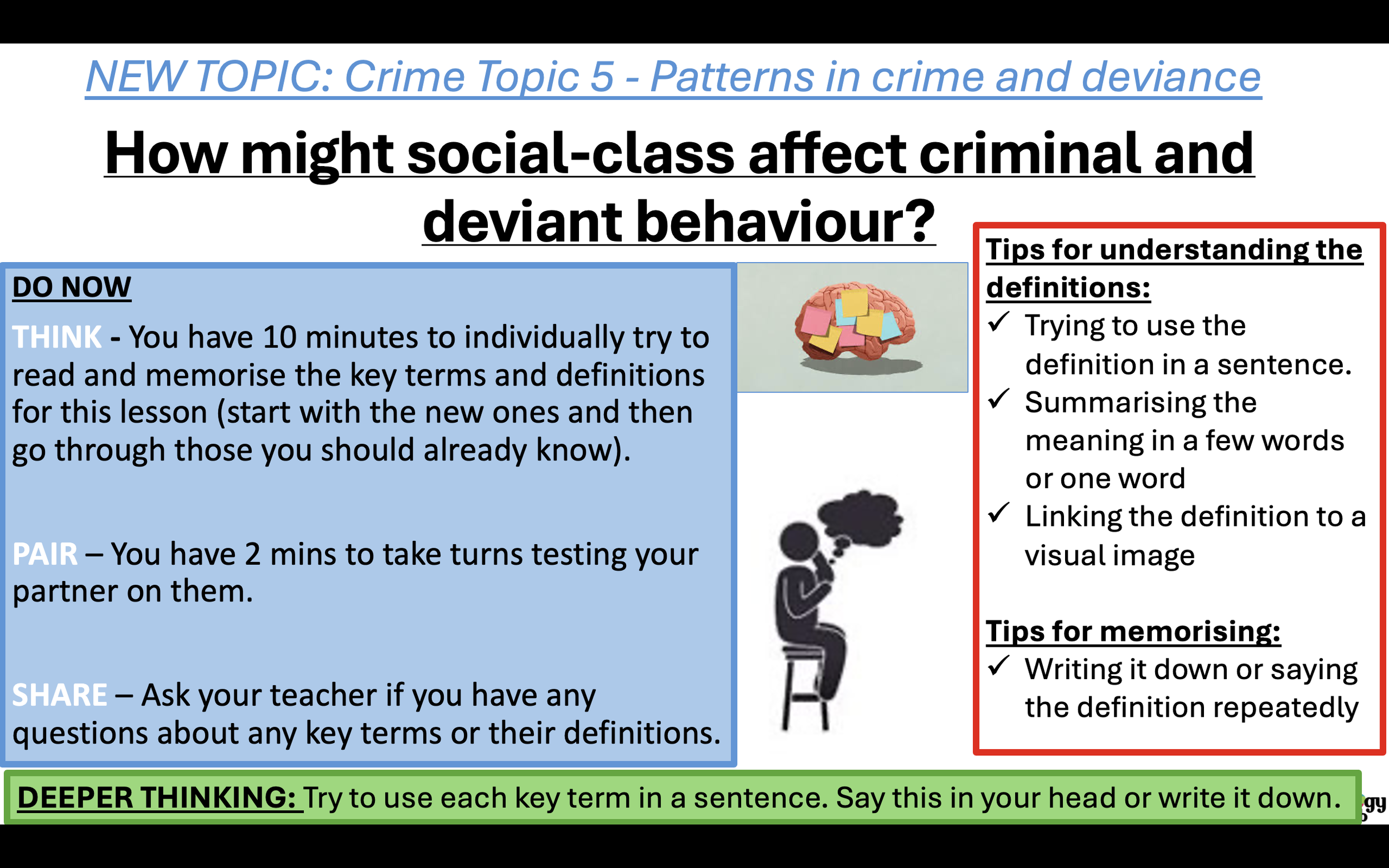 Image 2 of 2
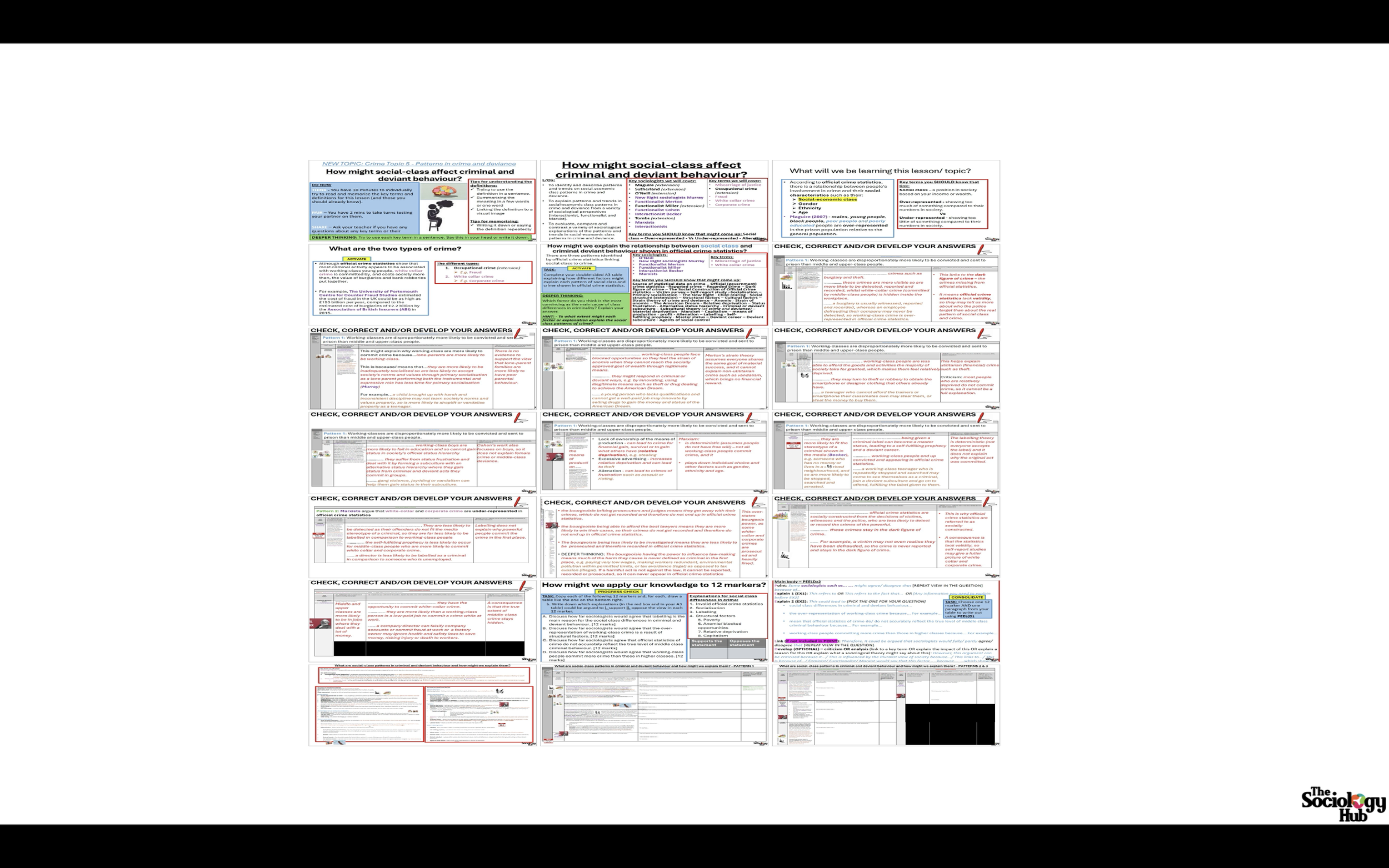
•Detailed lesson with lots of scaffolding based on adaptive teaching that helps students identify and describe social class patterns and trends in crime and deviance, explain them from interactionist, functionalist and Marxist perspectives, and evaluate these explanations.
•Covers these three main social class patterns in crime: working-class committing more crime than middle class, white collar and corporate crime being under-represented and middle-class being more likely to commit white-collar and corporate crime.
•Covers the following key terms: Miscarriage of justice, Occupational crime (extension), Fraud, White collar crime and Corporate crime.
•Covers the following sociologists: New Right sociologist Murray, functionalist Merton, functionalist Cohen, interactionist Becker, Marxists and interactionists, plus the following extension sociologists: Maguire, Sutherland, O'Neill, functionalist Miller and Tombs.
•Makes reference to the following key terms students should know, to promote a spiral curriculum: Social class – Over-represented vs Under-represented – Alienation – Source of statistical data on crime – Official (government) crime statistics – Reported crime – Recorded crime – Dark figure of crime – The social construction of official crime statistics – Victim survey – Self-report study – Socialisation – Primary socialisation – The New Right – Child-rearing – Social structure (extension) – Structural factors vs Cultural factors – Strain theory of crime and deviance – Anomie – Strain of anomie – The American Dream – Relative deprivation – Status frustration – Alternative status hierarchy – Criminal or deviant subculture – Subcultural theory – Material deprivation – Marxism – Capitalism – Means of production – Profit – Labelling – Self-fulfilling prophecy – Master status – Deviant career – Deviant subculture – Agents of social control.
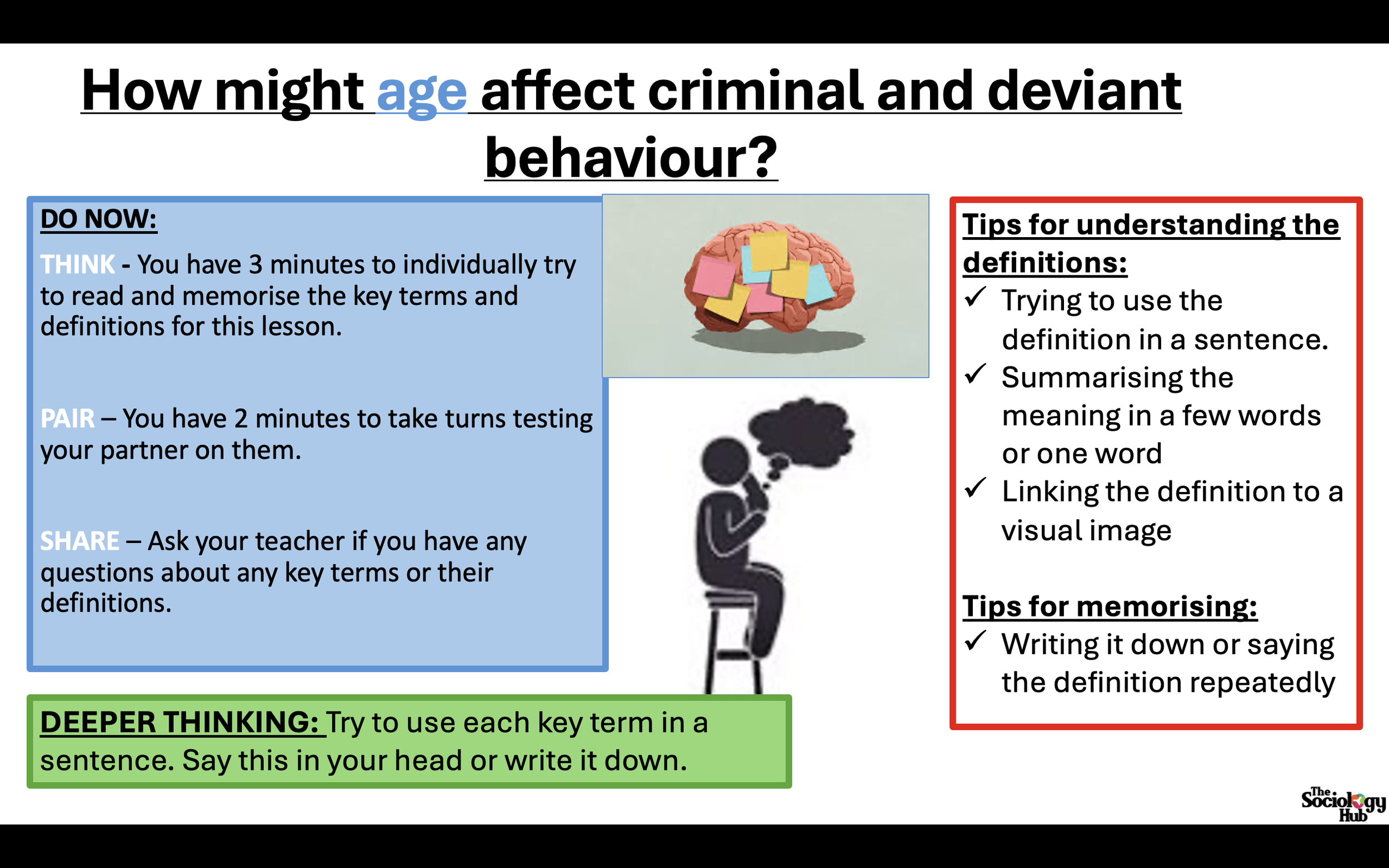
•Includes a Think, Pair, Share retrieval practice starter on the lesson's key terms and definitions, with explicit strategies for understanding and memorising definitions.
•Covers the difference between occupational, white collar and corporate crime
•Uses fraud and burglary cost statistics to challenge assumptions about who commits crime.
•Includes a scaffolded double-sided A3 explanation table covering all three social class patterns in official crime statistics.
•Includes a progress check applying knowledge to four 12-mark questions, with a supports/opposes table to structure evaluation.
•Includes PEEL(D) modelling and sentence stems to scaffold extended writing for 12-mark responses.
•Includes deeper thinking throughout.
•ANSWERS TO MAIN ACTIVITIES INCLUDED
•Includes a key term sheet with definitions for the lesson (and key terms and definitions associated with the main explanations of crime, e.g. labelling, strain theory, subcultural theory etc.
•RESOURCE CAN BE FOUND AT THE END OF PPT
•Detailed lesson with lots of scaffolding based on adaptive teaching that helps students identify and describe social class patterns and trends in crime and deviance, explain them from interactionist, functionalist and Marxist perspectives, and evaluate these explanations.
•Covers these three main social class patterns in crime: working-class committing more crime than middle class, white collar and corporate crime being under-represented and middle-class being more likely to commit white-collar and corporate crime.
•Covers the following key terms: Miscarriage of justice, Occupational crime (extension), Fraud, White collar crime and Corporate crime.
•Covers the following sociologists: New Right sociologist Murray, functionalist Merton, functionalist Cohen, interactionist Becker, Marxists and interactionists, plus the following extension sociologists: Maguire, Sutherland, O'Neill, functionalist Miller and Tombs.
•Makes reference to the following key terms students should know, to promote a spiral curriculum: Social class – Over-represented vs Under-represented – Alienation – Source of statistical data on crime – Official (government) crime statistics – Reported crime – Recorded crime – Dark figure of crime – The social construction of official crime statistics – Victim survey – Self-report study – Socialisation – Primary socialisation – The New Right – Child-rearing – Social structure (extension) – Structural factors vs Cultural factors – Strain theory of crime and deviance – Anomie – Strain of anomie – The American Dream – Relative deprivation – Status frustration – Alternative status hierarchy – Criminal or deviant subculture – Subcultural theory – Material deprivation – Marxism – Capitalism – Means of production – Profit – Labelling – Self-fulfilling prophecy – Master status – Deviant career – Deviant subculture – Agents of social control.
•Includes a Think, Pair, Share retrieval practice starter on the lesson's key terms and definitions, with explicit strategies for understanding and memorising definitions.
•Covers the difference between occupational, white collar and corporate crime
•Uses fraud and burglary cost statistics to challenge assumptions about who commits crime.
•Includes a scaffolded double-sided A3 explanation table covering all three social class patterns in official crime statistics.
•Includes a progress check applying knowledge to four 12-mark questions, with a supports/opposes table to structure evaluation.
•Includes PEEL(D) modelling and sentence stems to scaffold extended writing for 12-mark responses.
•Includes deeper thinking throughout.
•ANSWERS TO MAIN ACTIVITIES INCLUDED
•Includes a key term sheet with definitions for the lesson (and key terms and definitions associated with the main explanations of crime, e.g. labelling, strain theory, subcultural theory etc.
•RESOURCE CAN BE FOUND AT THE END OF PPT