 Image 1 of 2
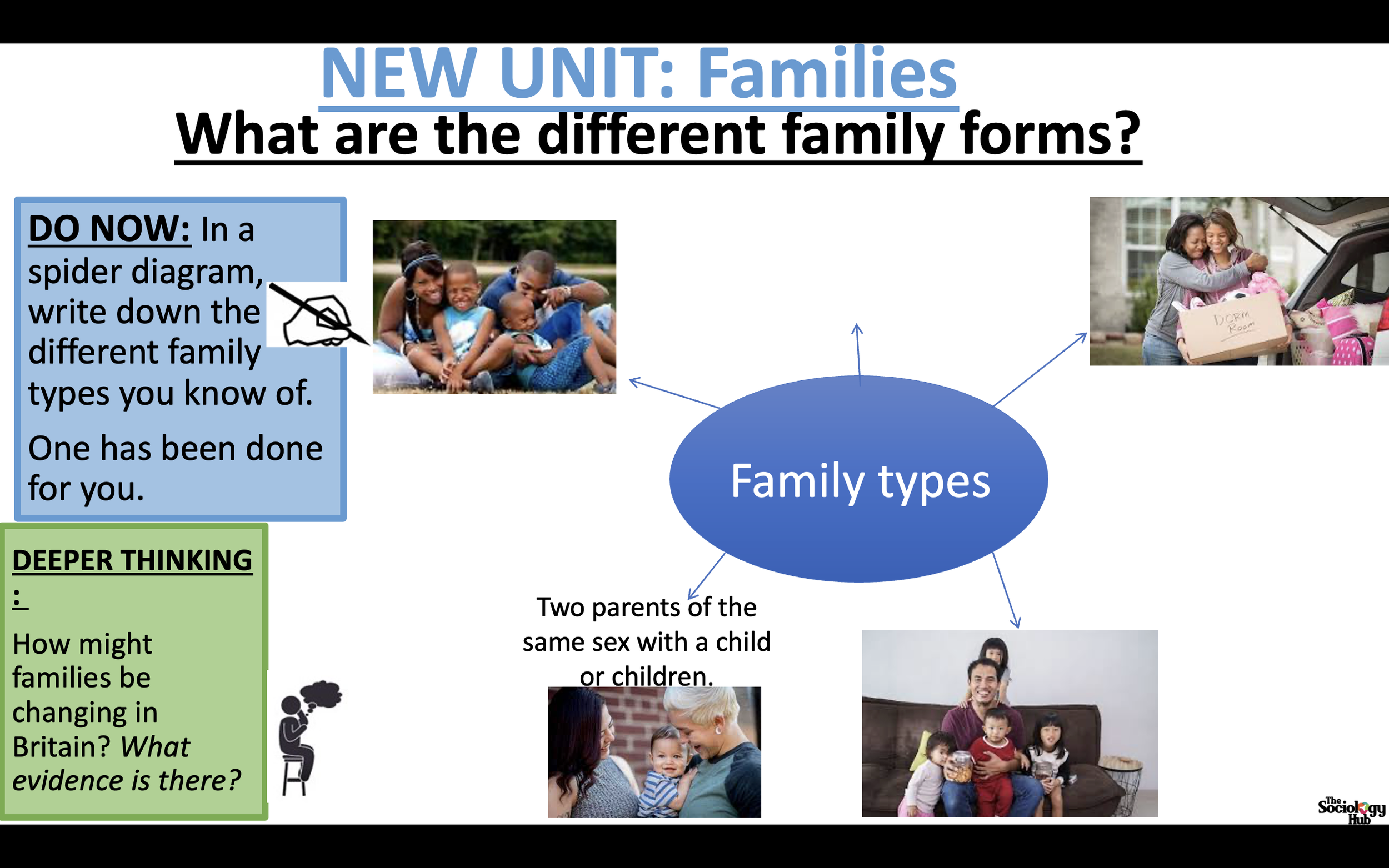 Image 2 of 2
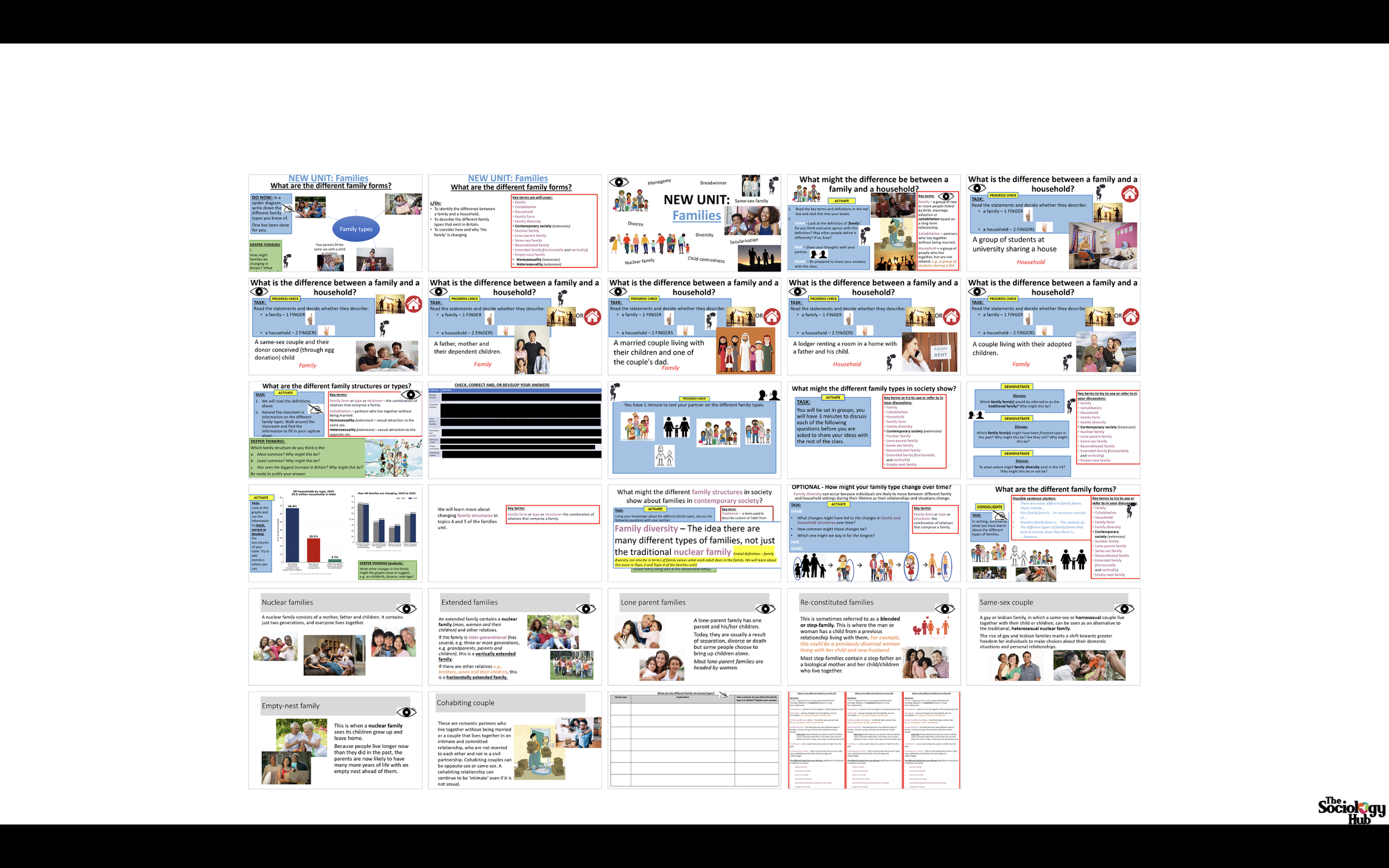
•Detailed lesson with lots of scaffolding based on adaptive teaching that helps students identify the difference between a family and a household, describe the different family types that exist in Britain and consider how and why ‘the family’ is changing.
•Covers the following key terms: Family, Household, Cohabitation, Family form, Family diversity, Nuclear family, Lone-parent family, Same-sex family, Reconstituted family, Extended family (horizontally and vertically), Empty-nest family, Traditional, Contemporary society (extension), Homosexuality (extension) and Heterosexuality (extension)
•Makes reference to the following key terms students might know: Gender - Sex
•Includes a teaching to all activity
•ANSWERS FOR SOME ACTIVITIES INCLUDED
•Includes a carousel activity with a capture sheet on the different family forms
•Includes up-to-date ONS graphs (Families and households in the UK, 2025) as a statistics activity
•Includes think, pair, share discussion tasks and deeper thinking analysis questions
•No key sociologists are covered in this lesson
•INCLUDES KEY TERM SHEET WITH DEFINITIONS FOR THE LESSON
•Pedagogical approaches used: retrieval practice, explicit vocabulary instruction, modelling, worked examples, scaffolding, metacognitive prompts (think, pair, share), adaptive teaching through extension terms, and stretch and challenge deeper thinking questions
•Resources can be found at the end of the PPT.
•Detailed lesson with lots of scaffolding based on adaptive teaching that helps students identify the difference between a family and a household, describe the different family types that exist in Britain and consider how and why ‘the family’ is changing.
•Covers the following key terms: Family, Household, Cohabitation, Family form, Family diversity, Nuclear family, Lone-parent family, Same-sex family, Reconstituted family, Extended family (horizontally and vertically), Empty-nest family, Traditional, Contemporary society (extension), Homosexuality (extension) and Heterosexuality (extension)
•Makes reference to the following key terms students might know: Gender - Sex
•Includes a teaching to all activity
•ANSWERS FOR SOME ACTIVITIES INCLUDED
•Includes a carousel activity with a capture sheet on the different family forms
•Includes up-to-date ONS graphs (Families and households in the UK, 2025) as a statistics activity
•Includes think, pair, share discussion tasks and deeper thinking analysis questions
•No key sociologists are covered in this lesson
•INCLUDES KEY TERM SHEET WITH DEFINITIONS FOR THE LESSON
•Pedagogical approaches used: retrieval practice, explicit vocabulary instruction, modelling, worked examples, scaffolding, metacognitive prompts (think, pair, share), adaptive teaching through extension terms, and stretch and challenge deeper thinking questions
•Resources can be found at the end of the PPT.