 Image 1 of 2
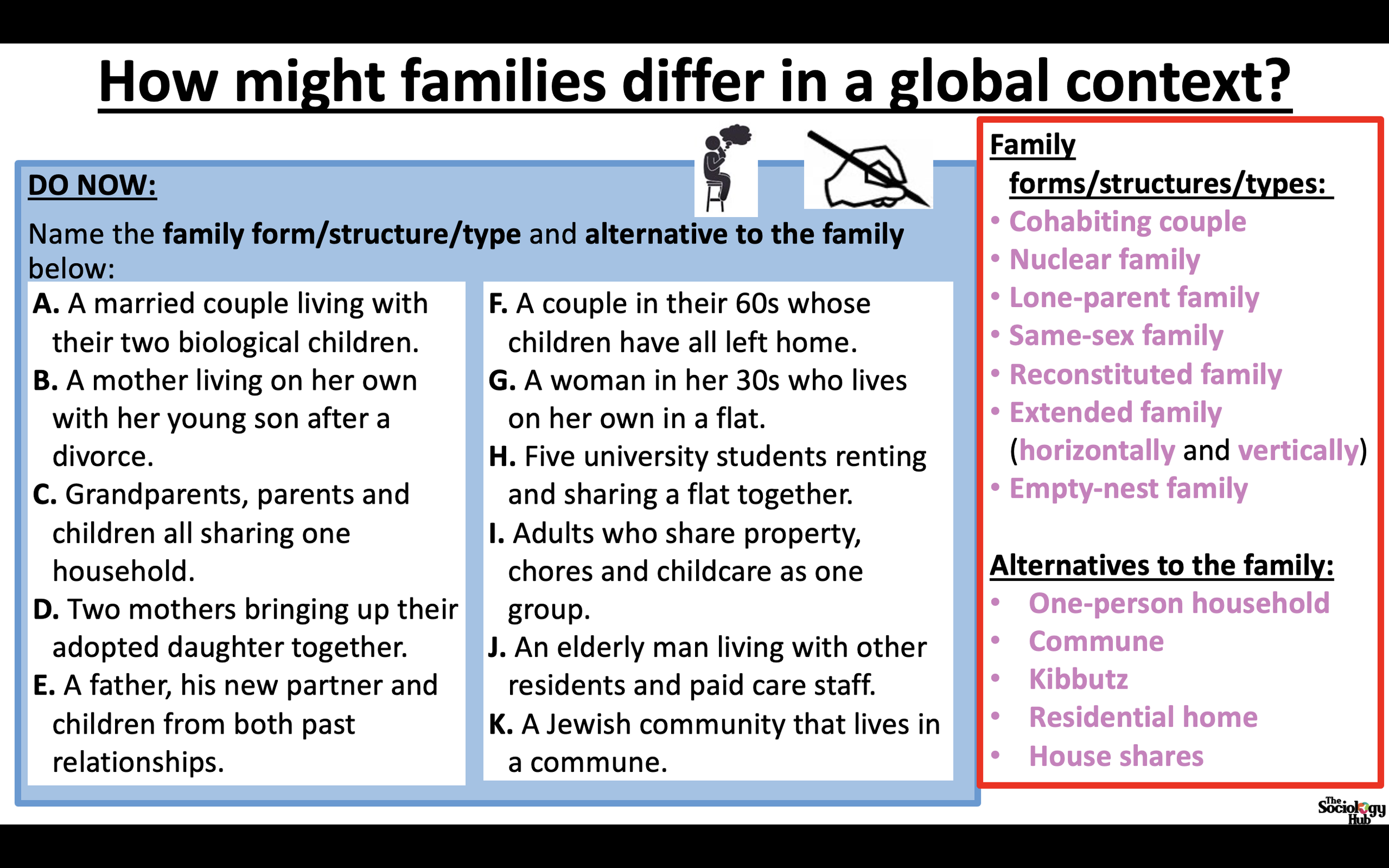 Image 2 of 2
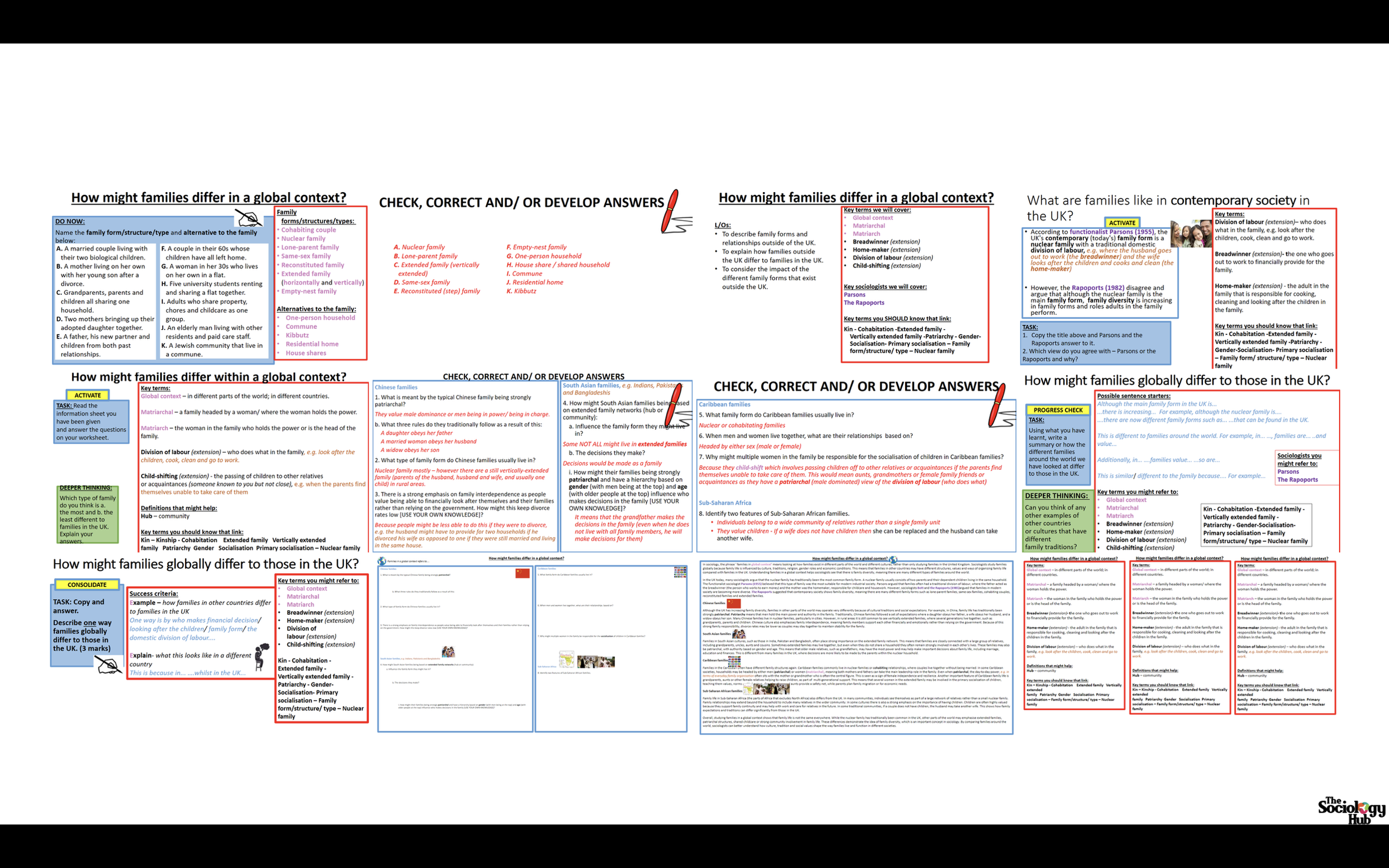
•Detailed lesson with lots of scaffolding based on adaptive teaching that helps students describe family forms and relationships outside of the UK, explain how families outside the UK differ to families in the UK, and consider the impact of the different family forms that exist outside the UK.
•Compares contemporary family diversity in the UK with family life in China, South Asia, the Caribbean and Sub-Saharan Africa.
•Covers the following key terms: Global context, Matriarchal, Matriarch. Breadwinner (extension), Home-maker (extension), Division of labour (extension)
•Covers the following sociologists: Parsons, Bott and the Rapoports
•Makes reference to the following key terms students might know to promote a spiral curriculum: Kin - Kinship - Cohabitation - Extended family - Vertically extended family - Patriarchy - Gender - Socialisation - Primary socialisation - Family form/structure/type - Nuclear family - Lone-parent family - Same-sex family - Reconstituted family - Empty-nest family - Alternatives to the family
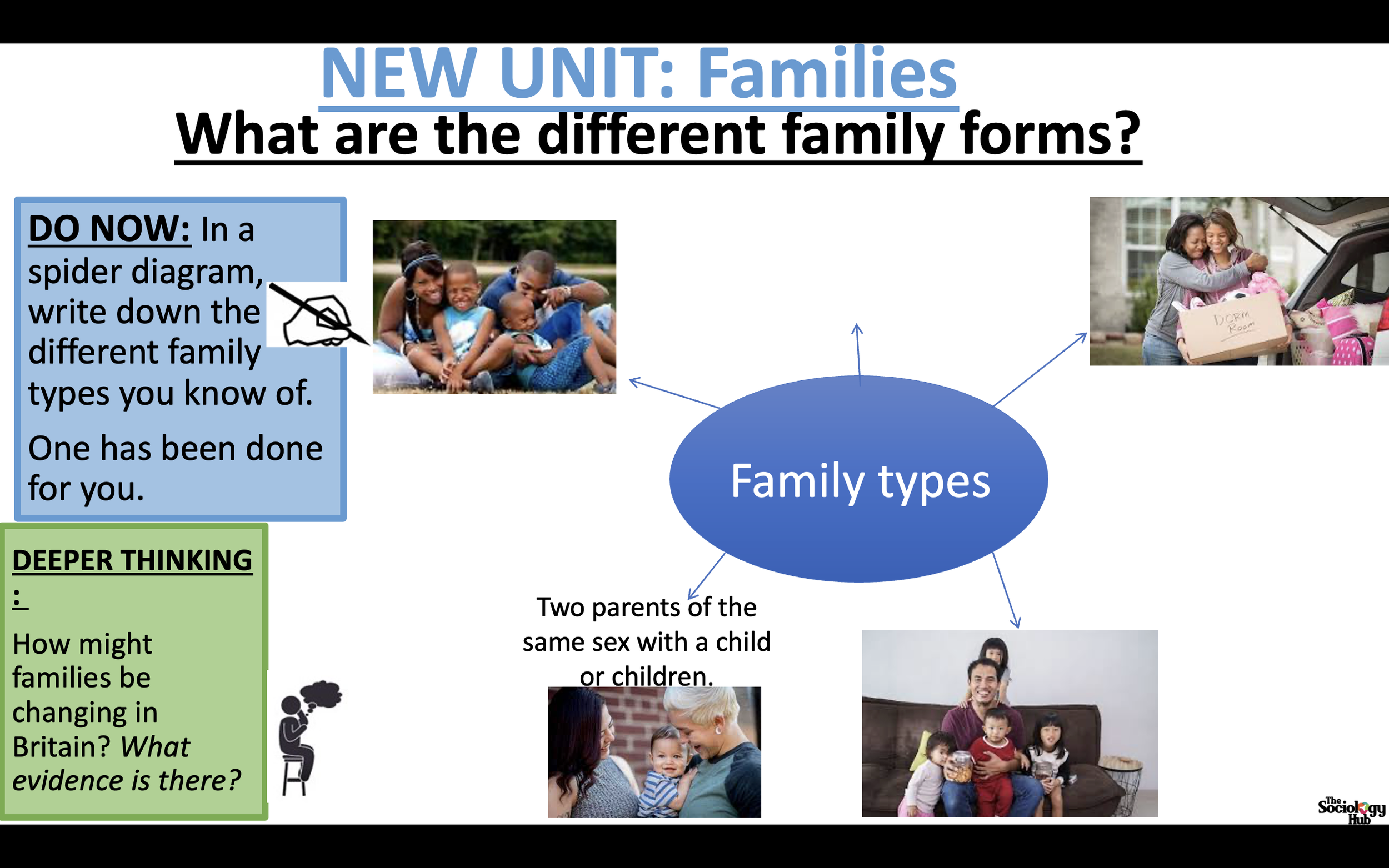
•Includes a DO NOW retrieval task on family forms and alternatives to the family, with animated answers
•Includes explicit vocabulary instruction with key terms
•Includes an ACTIVATE task using an information sheet, with worksheet questions, and modelled sentence starters and success criteria for extended writing
•Includes DEEPER THINKING prompts for stretch and challenge throughout
•Teaching and learning strategies used: retrieval practice, explicit vocabulary instruction, modelling and worked examples, scaffolding, adaptive teaching, metacognitive prompts, stretch and challenge, and a spiral curriculum approach that revisits prior key terms
•Assessment for learning built in through CHECK, CORRECT AND/OR DEVELOP ANSWERS slides, success criteria and an exam-style question
•INCLUDES ‘DESCRIBE’ 3 MARKER
•INCLUDES FULL INFORMATION TEXT ON FAMILIES IN A GLOBAL CONTEXT FOR READING AND REFERENCE
•ANSWERS TO MAIN ACTIVITY AND STARTER INCLUDED
•Resources can be found at the end of the PPT
•Detailed lesson with lots of scaffolding based on adaptive teaching that helps students describe family forms and relationships outside of the UK, explain how families outside the UK differ to families in the UK, and consider the impact of the different family forms that exist outside the UK.
•Compares contemporary family diversity in the UK with family life in China, South Asia, the Caribbean and Sub-Saharan Africa.
•Covers the following key terms: Global context, Matriarchal, Matriarch. Breadwinner (extension), Home-maker (extension), Division of labour (extension)
•Covers the following sociologists: Parsons, Bott and the Rapoports
•Makes reference to the following key terms students might know to promote a spiral curriculum: Kin - Kinship - Cohabitation - Extended family - Vertically extended family - Patriarchy - Gender - Socialisation - Primary socialisation - Family form/structure/type - Nuclear family - Lone-parent family - Same-sex family - Reconstituted family - Empty-nest family - Alternatives to the family
•Includes a DO NOW retrieval task on family forms and alternatives to the family, with animated answers
•Includes explicit vocabulary instruction with key terms
•Includes an ACTIVATE task using an information sheet, with worksheet questions, and modelled sentence starters and success criteria for extended writing
•Includes DEEPER THINKING prompts for stretch and challenge throughout
•Teaching and learning strategies used: retrieval practice, explicit vocabulary instruction, modelling and worked examples, scaffolding, adaptive teaching, metacognitive prompts, stretch and challenge, and a spiral curriculum approach that revisits prior key terms
•Assessment for learning built in through CHECK, CORRECT AND/OR DEVELOP ANSWERS slides, success criteria and an exam-style question
•INCLUDES ‘DESCRIBE’ 3 MARKER
•INCLUDES FULL INFORMATION TEXT ON FAMILIES IN A GLOBAL CONTEXT FOR READING AND REFERENCE
•ANSWERS TO MAIN ACTIVITY AND STARTER INCLUDED
•Resources can be found at the end of the PPT