 Image 1 of 1
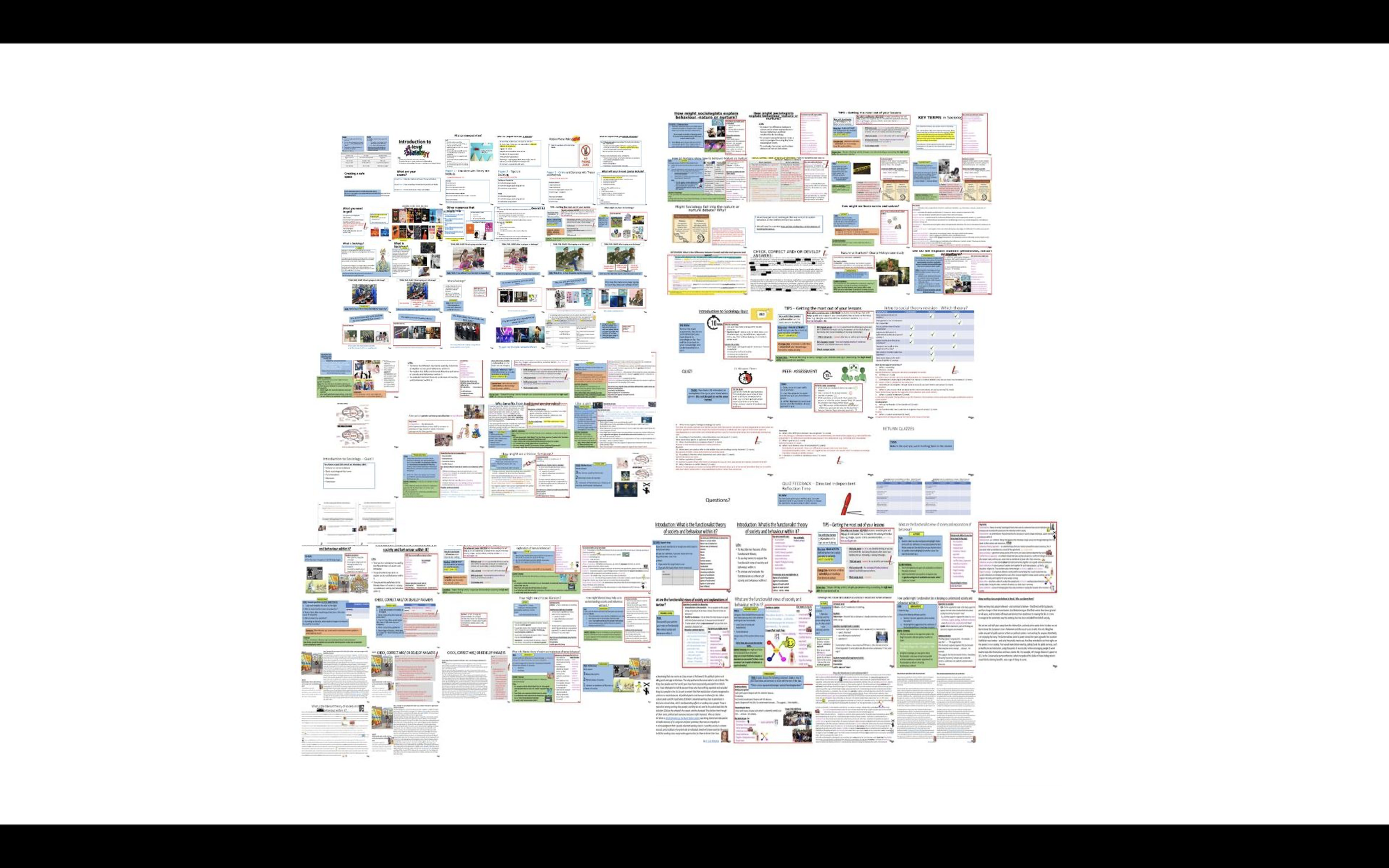
6 lesson bundle including:
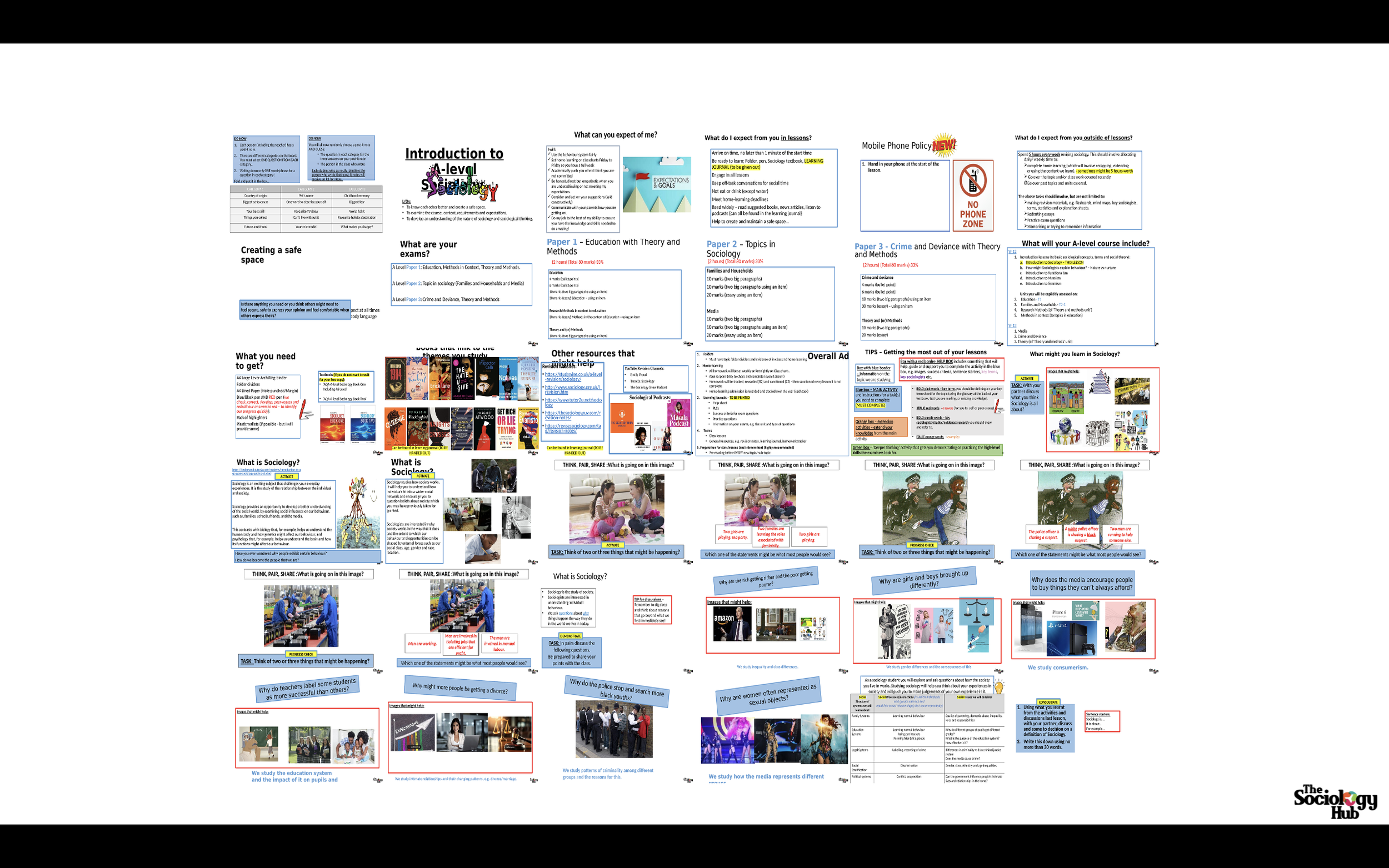
L1 A-Level Sociology - Introduction to Sociology & What is Sociology?
• Detailed introductory lesson with lots of scaffolding based on adaptive teaching that helps students understand the nature of sociology and sociological thinking, and examine the A-level course, its content, requirements and expectations.
• No prior sociological knowledge is required; the lesson builds understanding from students' own everyday experiences to promote a spiral curriculum into Education, Families and Households, Media, and Crime and Deviance.
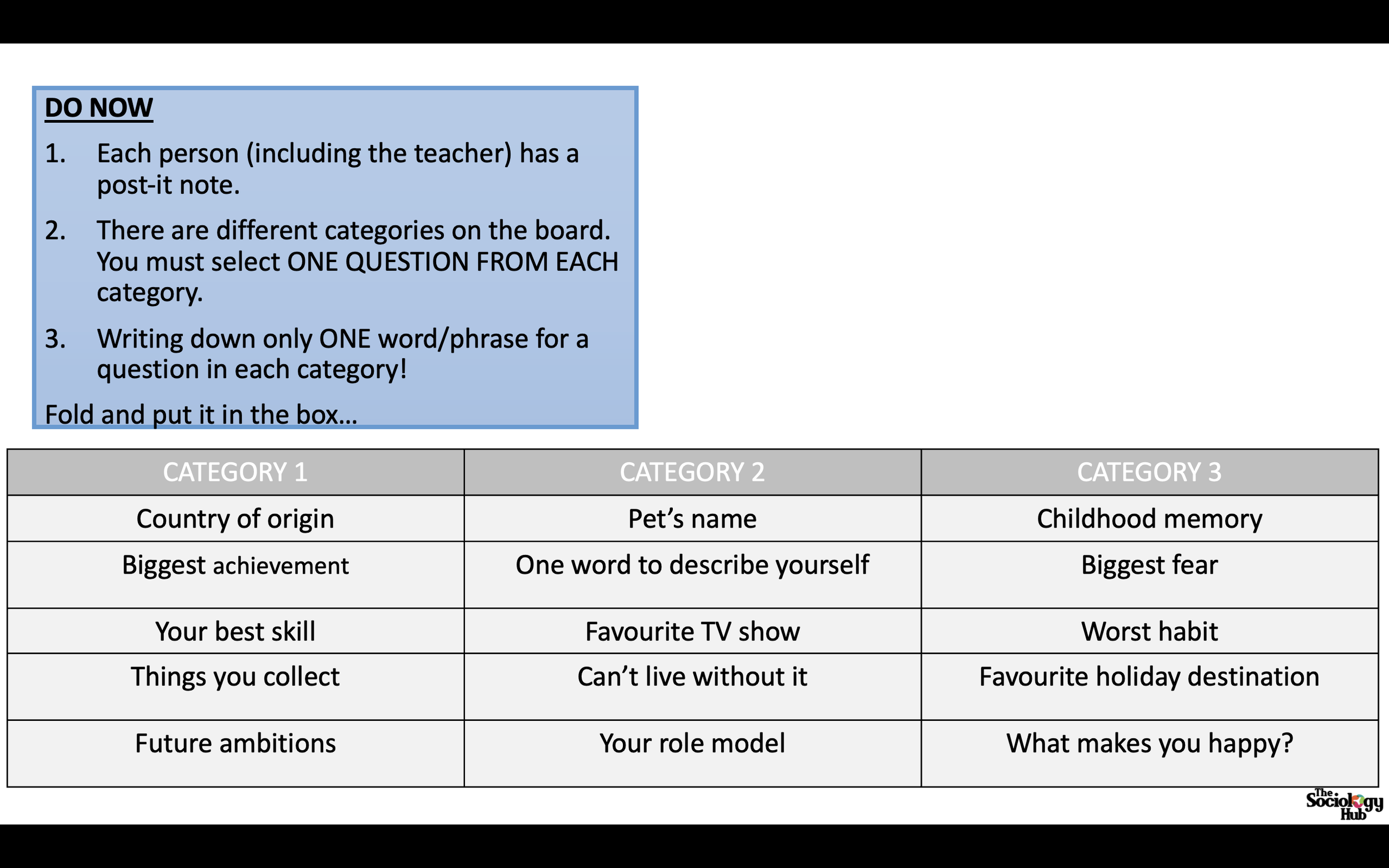
• Includes a 'Do Now' ice-breaker and retrieval activity that builds a safe classroom culture.
• Includes THINK, PAIR, SHARE image-analysis activities that model sociological interpretation.
• Includes sentence starters and a scaffolded 30-word definition task for the final consolidation activity.
• Includes a full breakdown of AQA A-level Papers 1, 2 and 3, with question types, mark allocations and weightings - can be easily edited for other exam boards
• Includes guidance on equipment, folders, home learning, learning journals and independent revision routines.
• Includes a curated list of revision websites, YouTube revision channels and sociology podcasts.
• Links to 'AQA A-Level Sociology Book One Including AS Level' and 'AQA A-Level Sociology Book Two'.
• ANSWERS TO SOME ACTIVITIES INCLUDED
L2 A-level Sociology – How do sociologists explain behaviour (Nature vs Nurture)?
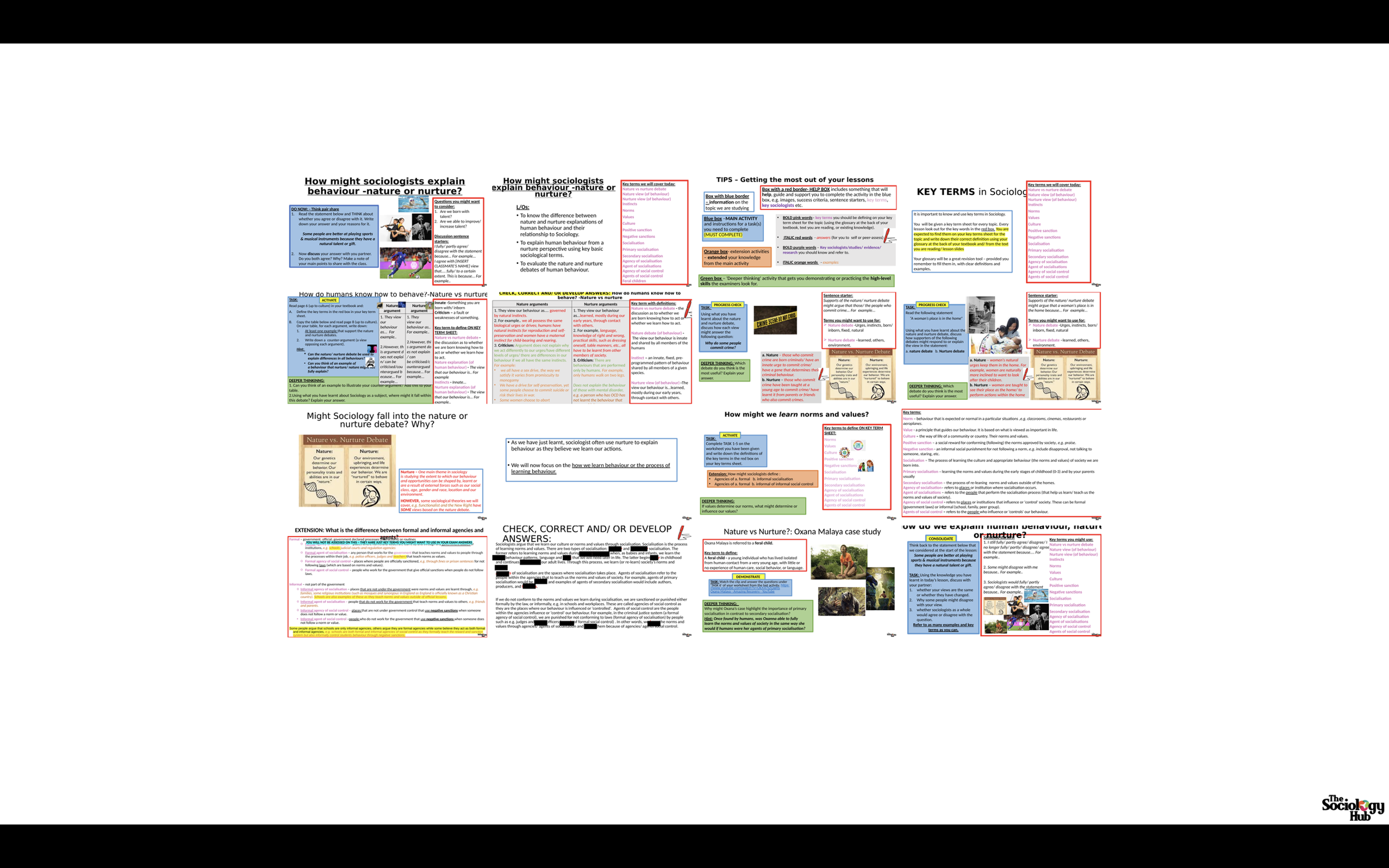
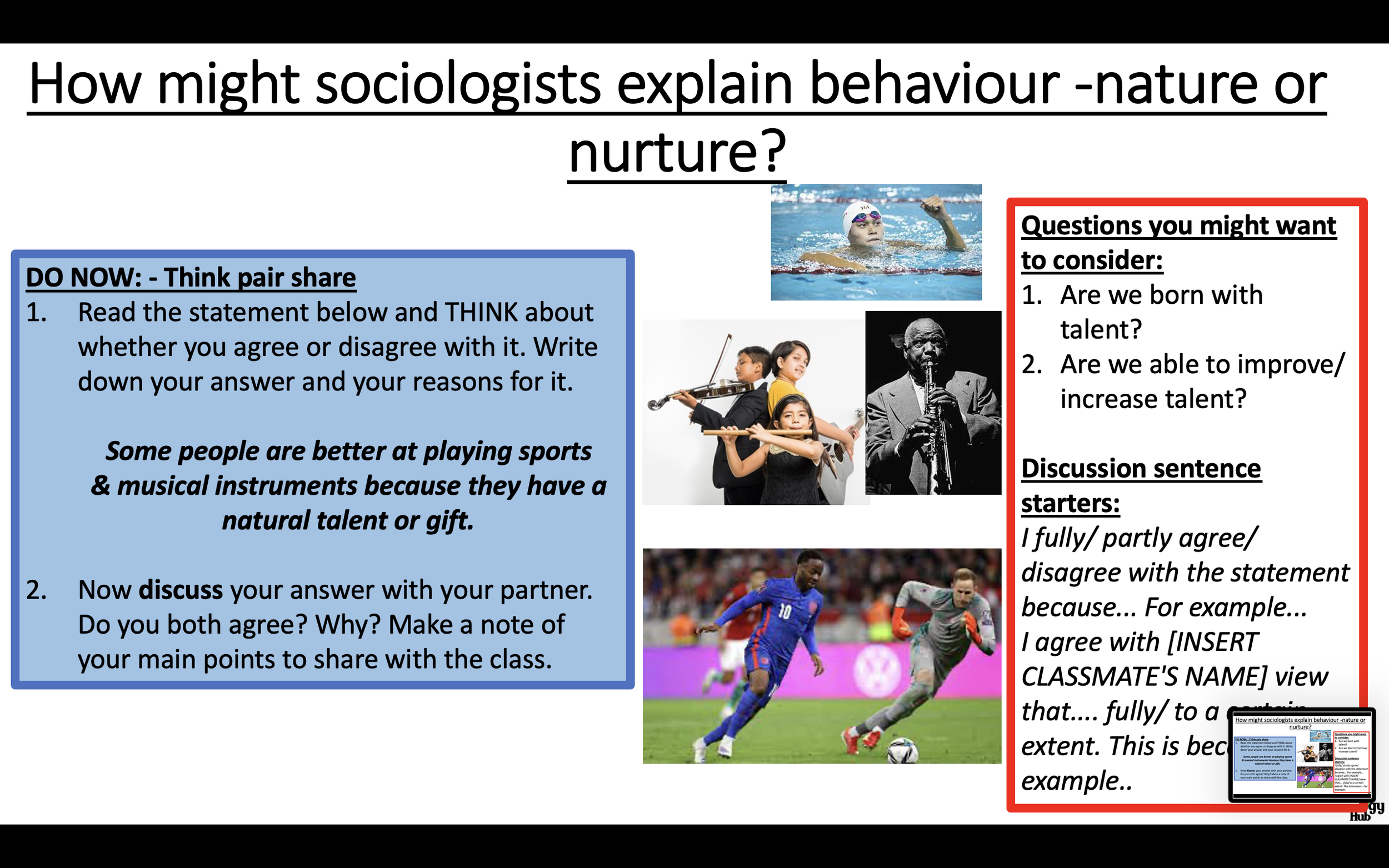
• Detailed lesson with lots of scaffolding based on adaptive teaching that helps students understand the difference between nature and nurture explanations of human behaviour, explain behaviour from a nurture perspective using key sociological terms, and evaluate the nature and nurture debates.
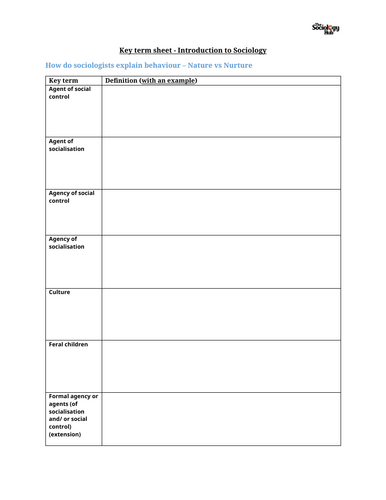
• Covers the following key terms: Nature vs nurture debate, Nature view (of behaviour), Nurture view (of behaviour), Instincts, Norms, Values, Culture, Positive sanction, Negative sanctions, Socialisation, Primary socialisation, Secondary socialisation, Agency of socialisation, Agent of socialisation, Agency of social control, Agents of social control, Feral children.
• Includes extension content on formal and informal agencies and agents of socialisation and social control.
• Includes a video activity (Oxana Malaya case study) with deeper thinking questions.
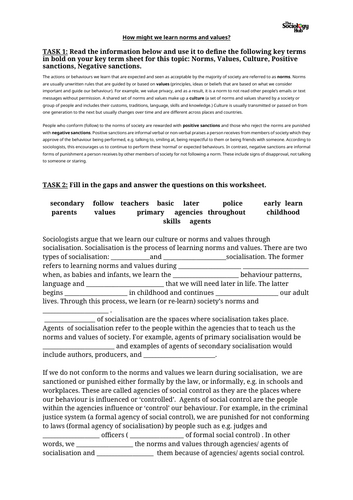
•Includes key term sheet for students to fill out definitions of key terms covered in lesson
• ANSWERS TO MAIN ACTIVITIES INCLUDED.
• Activities require the AQA A-level Book 1 by Townsend to introduces students to the nature vs nurture debate but this can be replaced and the rest of the lesson can still be used.
L3 A-level Sociology – Introduction to Functionalism (Theory of Society and Behaviour )
•Detailed lesson with lots of scaffolding based on adaptive teaching that helps students describe the key features of the functionalist theory, use key terms to explain the functionalist view of society and behaviour within it, and analyse and evaluate functionalism as a theory of society and behaviour within it.
•Covers the following key terms: Functionalism, Structuralism, Interactionism, Consensus theory/ approach, Value consensus, Conflict theory/ approach, Collective conscience, Social institutions, Organic/ biological analogy, Social order, Social solidarity and Determinism.
•Covers the following sociologist: Emile Durkheim.
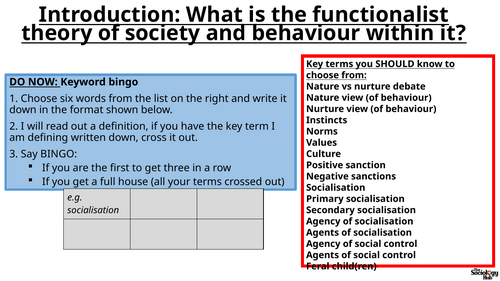
•Makes reference to the following key terms students should already know, to promote a spiral curriculum: Nature vs nurture debate – Nature view of behaviour – Nurture view of behaviour – Instincts – Norms – Values – Culture – Positive sanctions – Negative sanctions – Socialisation – Primary socialisation – Secondary socialisation – Agencies of socialisation – Agents of socialisation – Agencies of social control – Agents of social control – Feral children.
•Includes a DO NOW retrieval starter (keyword bingo) that revisits prior knowledge key terms.
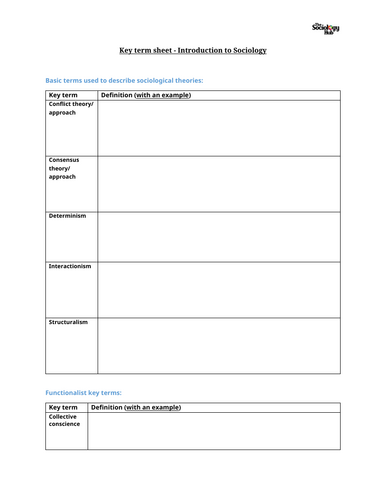
•Includes key term sheet for students to fill out definitions of key terms covered in lesson
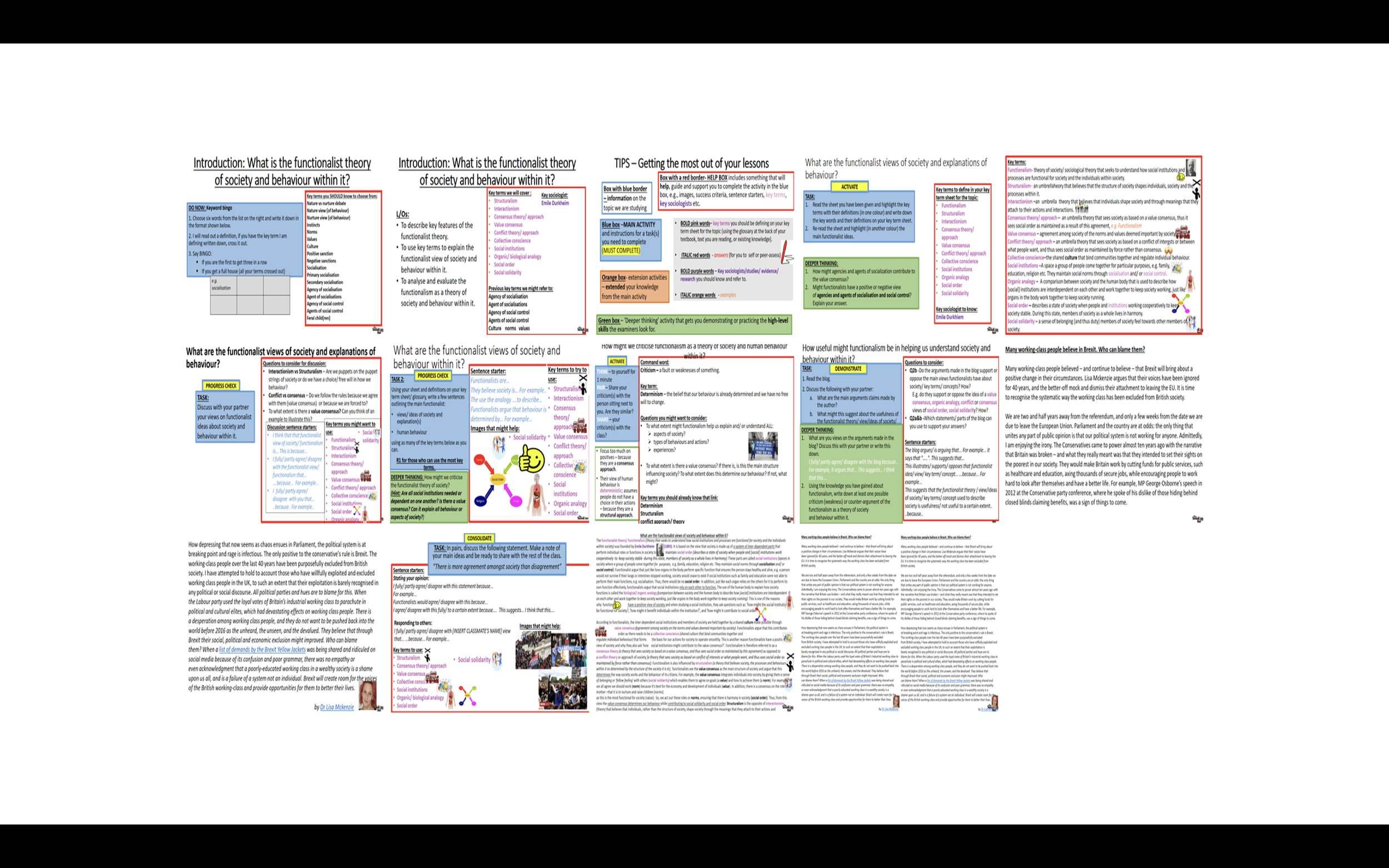
•Includes a source-based activity using a blog by Dr Lisa Mckenzie, so students can assess the usefulness of functionalism using evidence.
•Includes a consolidation discussion task on the statement "There is more agreement amongst society than disagreement".
•RESOURCES CAN BE FOUND AT THE END OF THE PPT.
L4 A-level Sociology: Introduction to Marxism (Theory of Society and Behaviour)
•Detailed lesson with lots of scaffolding based on adaptive teaching that helps students know the key terms used by the Marxist theory, use those key terms to explain society and behaviour within it, and evaluate how useful Marxism is in helping us understand society.
•Covers the following key terms: profit, social class, proletariat, ownership, exploit, inequality, capitalism, means of production, bourgeoisie, false consciousness, structuralism/structural theory and conflict theory.
•Covers the following sociologist: Karl Marx.
•Makes reference to the following key terms students might know, to promote a spiral curriculum: structuralism – interactionism – conflict theory – consensus theory – nuclear family – determinism.
•Includes a ‘Do Now’ image-based discussion starter on inequality, consumerism and capitalism.
•Includes an information sheet and key term definition activity, a progress check with a bourgeoisie/proletariat comparison table, extension and challenge tasks comparing Marxism with functionalism, and a Think–Pair–Share criticism activity.
•Includes an item-based application activity on consumerism, self-service checkouts and CEO pay with sentence starters for discussion.
•ANSWERS TO MAIN ACTIVITIES INCLUDED.
•Includes key term sheet for students to write definitions of key terms in lesson
•RESOURCES CAN BE FOUND AT THE END OF THE PPT.
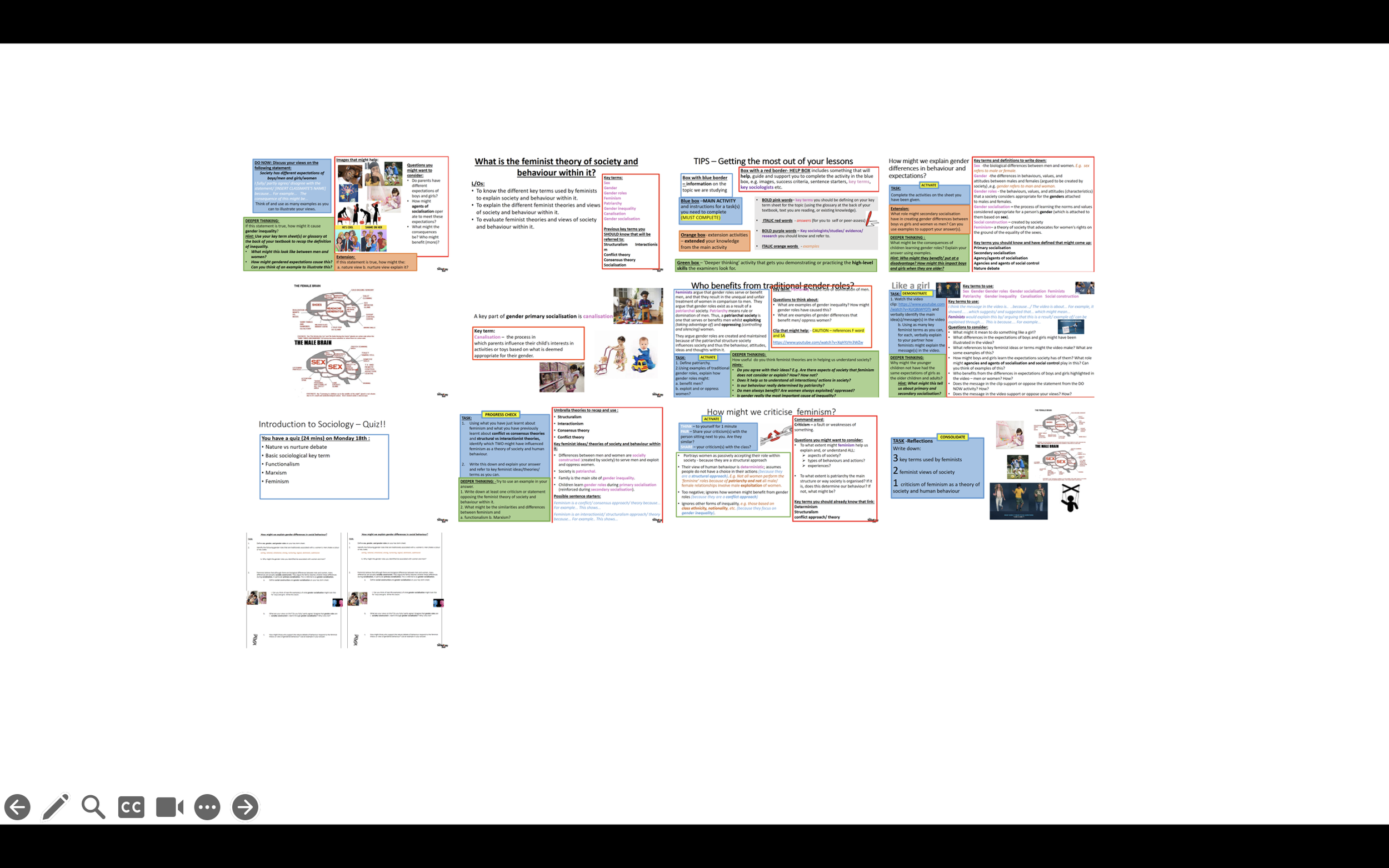
L5 A-level Sociology: Introduction Feminism – (Theory of society and behaviour within it)
•Detailed lesson with lots of scaffolding based on adaptive teaching that helps students know the key terms feminists use to explain society, explain feminist theories and views of society and behaviour within it, and evaluate those views.
•Covers the following key terms: Sex, Gender, Gender roles, Gender socialisation, Social construction, Feminism, Patriarchy, Gender inequality and Canalisation.
•Covers key feminist ideas: gender differences are socially constructed; society is patriarchal; the family is the main site of gender inequality; gender roles are learnt during primary socialisation and reinforced during secondary socialisation.
•Makes reference to the following key terms students might already know, to promote a spiral curriculum: Structuralism – Interactionism – Conflict theory – Consensus theory – Socialisation – Primary socialisation – Secondary socialisation – Agencies and agents of socialisation – Agencies and agents of social control – Nature vs nurture debate – Determinism.
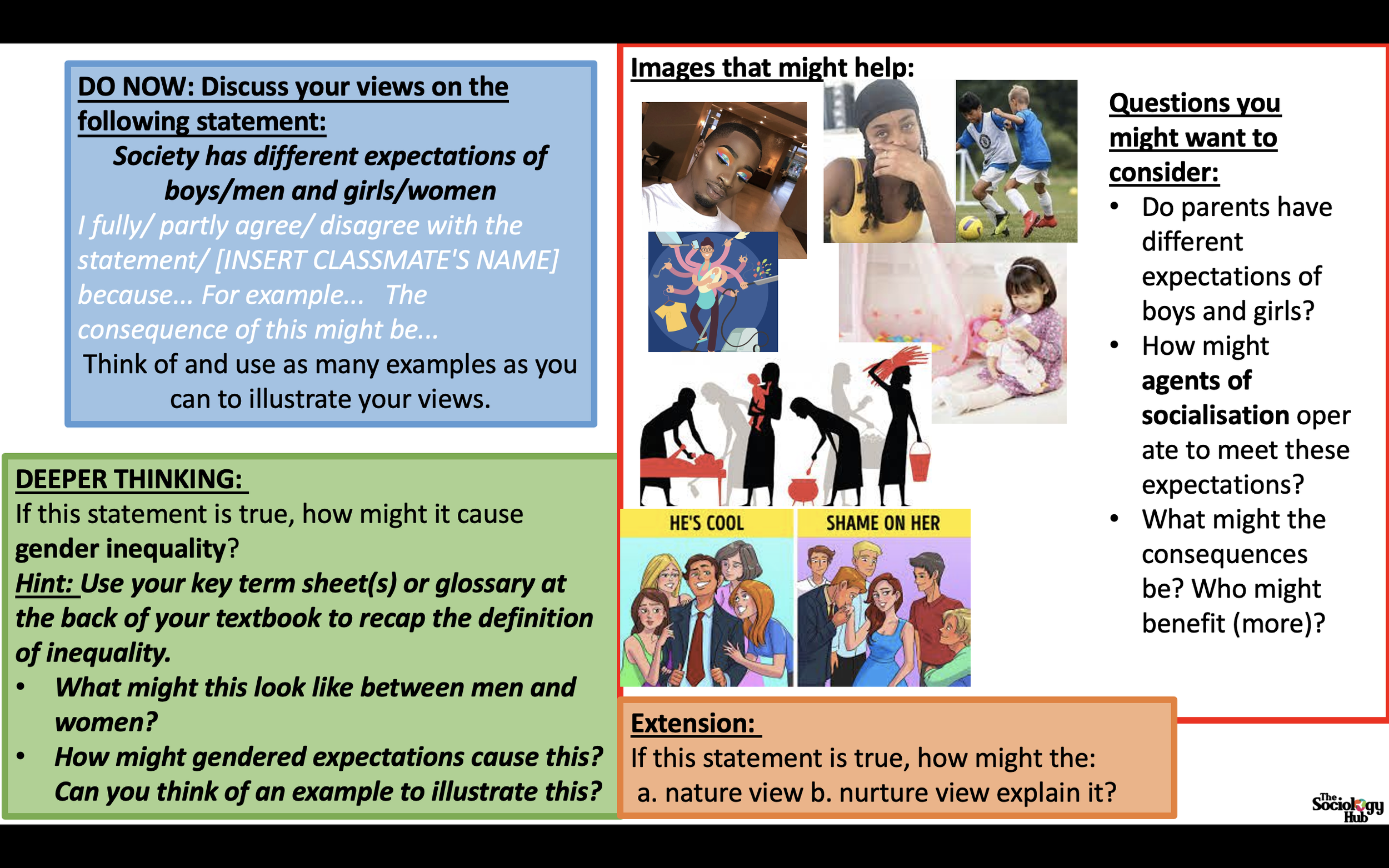
•Includes a discussion-based DO NOW with sentence starters, images and scaffolded questions.
•Includes two video clips as activities, with key terms and sentence starters to scaffold verbal responses.
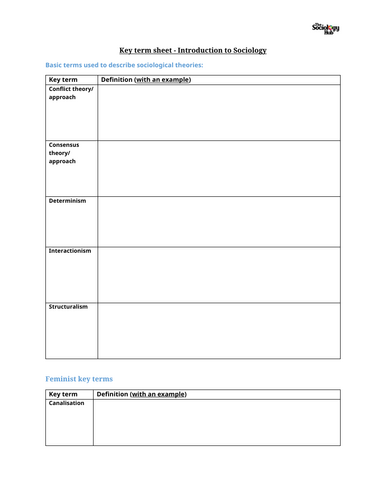
•Includes key term sheet for students to write definitions of key terms for the lesson
•Resources can be found at the end of the PPT.
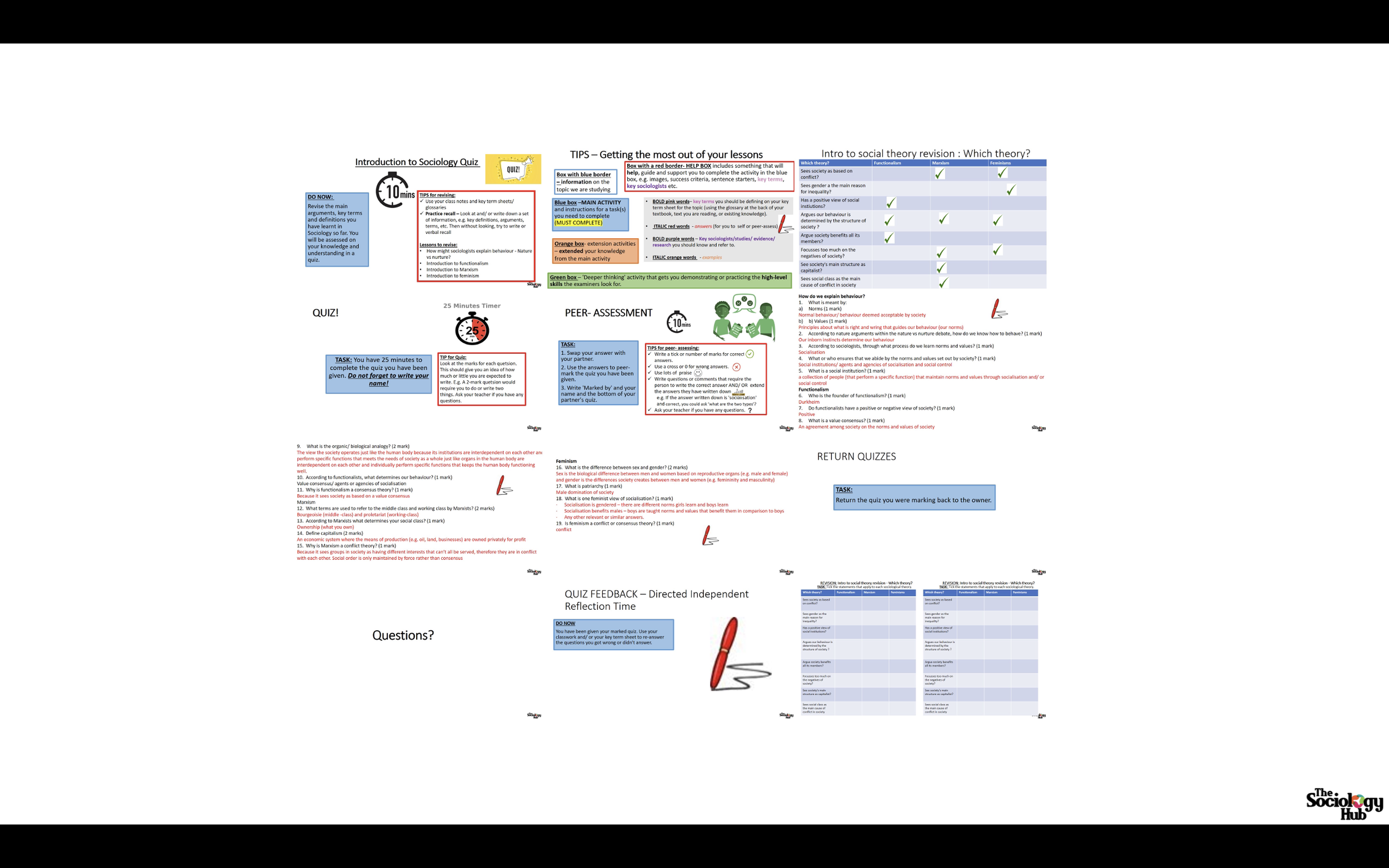
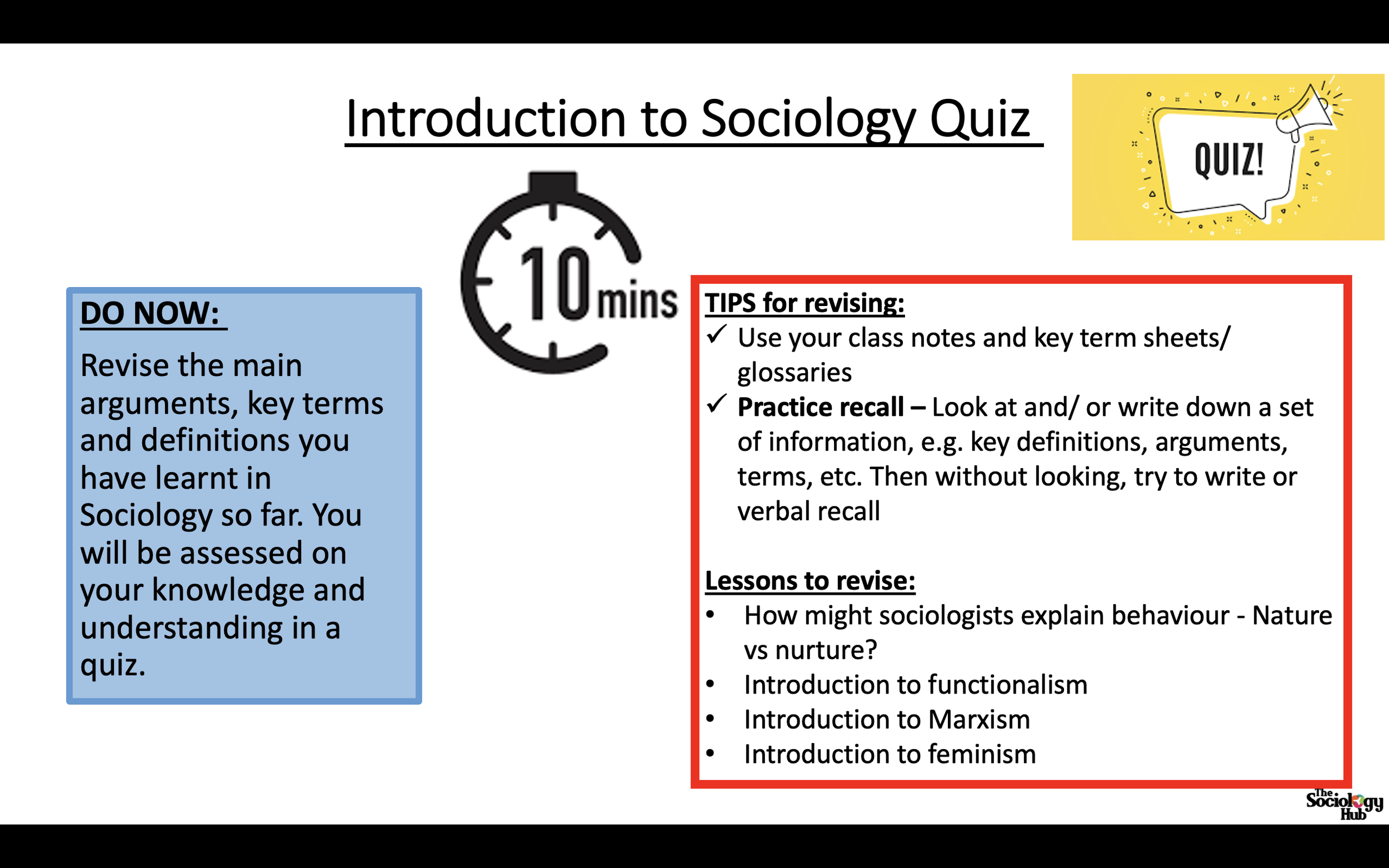
L6 A-level Sociology: Introduction to Sociology - Quiz and Feedback Lesson
•Detailed revision, assessment and feedback lesson with lots of scaffolding based on adaptive teaching that helps students recall, apply and check their knowledge of the introduction to Sociology.
•Brief revision activity on functionalism, Marxism and feminism.
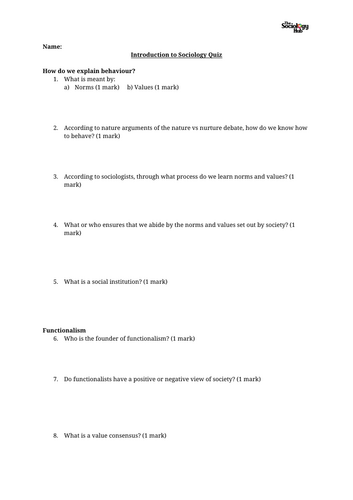
•Includes a full 25-minute quiz with mark allocations for each question.
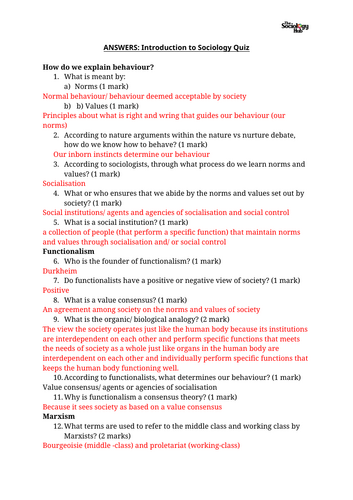
•ANSWERS TO ALL QUIZ QUESTIONS INCLUDED
•Includes a structured peer-assessment activity with tips and success criteria,
•Includes a Directed Independent Reflection Time (DIRT) feedback task so students re-answer the questions they got wrong.
•Makes reference to the following key terms students should already know, to promote a spiral curriculum: Functionalism – Marxism – Feminism – Agents and agencies of socialisation – Social structure – Social class – Inequality – Consensus vs conflict.
•Builds on the following lessons: How might sociologists explain behaviour – nature vs nurture?; Introduction to functionalism; Introduction to Marxism; Introduction to feminism.
•Students will need their class notes and key term sheets/glossaries to revise for the quiz.
6 lesson bundle including:
L1 A-Level Sociology - Introduction to Sociology & What is Sociology?
• Detailed introductory lesson with lots of scaffolding based on adaptive teaching that helps students understand the nature of sociology and sociological thinking, and examine the A-level course, its content, requirements and expectations.
• No prior sociological knowledge is required; the lesson builds understanding from students' own everyday experiences to promote a spiral curriculum into Education, Families and Households, Media, and Crime and Deviance.
• Includes a 'Do Now' ice-breaker and retrieval activity that builds a safe classroom culture.
• Includes THINK, PAIR, SHARE image-analysis activities that model sociological interpretation.
• Includes sentence starters and a scaffolded 30-word definition task for the final consolidation activity.
• Includes a full breakdown of AQA A-level Papers 1, 2 and 3, with question types, mark allocations and weightings - can be easily edited for other exam boards
• Includes guidance on equipment, folders, home learning, learning journals and independent revision routines.
• Includes a curated list of revision websites, YouTube revision channels and sociology podcasts.
• Links to 'AQA A-Level Sociology Book One Including AS Level' and 'AQA A-Level Sociology Book Two'.
• ANSWERS TO SOME ACTIVITIES INCLUDED
L2 A-level Sociology – How do sociologists explain behaviour (Nature vs Nurture)?
• Detailed lesson with lots of scaffolding based on adaptive teaching that helps students understand the difference between nature and nurture explanations of human behaviour, explain behaviour from a nurture perspective using key sociological terms, and evaluate the nature and nurture debates.
• Covers the following key terms: Nature vs nurture debate, Nature view (of behaviour), Nurture view (of behaviour), Instincts, Norms, Values, Culture, Positive sanction, Negative sanctions, Socialisation, Primary socialisation, Secondary socialisation, Agency of socialisation, Agent of socialisation, Agency of social control, Agents of social control, Feral children.
• Includes extension content on formal and informal agencies and agents of socialisation and social control.
• Includes a video activity (Oxana Malaya case study) with deeper thinking questions.
•Includes key term sheet for students to fill out definitions of key terms covered in lesson
• ANSWERS TO MAIN ACTIVITIES INCLUDED.
• Activities require the AQA A-level Book 1 by Townsend to introduces students to the nature vs nurture debate but this can be replaced and the rest of the lesson can still be used.
L3 A-level Sociology – Introduction to Functionalism (Theory of Society and Behaviour )
•Detailed lesson with lots of scaffolding based on adaptive teaching that helps students describe the key features of the functionalist theory, use key terms to explain the functionalist view of society and behaviour within it, and analyse and evaluate functionalism as a theory of society and behaviour within it.
•Covers the following key terms: Functionalism, Structuralism, Interactionism, Consensus theory/ approach, Value consensus, Conflict theory/ approach, Collective conscience, Social institutions, Organic/ biological analogy, Social order, Social solidarity and Determinism.
•Covers the following sociologist: Emile Durkheim.
•Makes reference to the following key terms students should already know, to promote a spiral curriculum: Nature vs nurture debate – Nature view of behaviour – Nurture view of behaviour – Instincts – Norms – Values – Culture – Positive sanctions – Negative sanctions – Socialisation – Primary socialisation – Secondary socialisation – Agencies of socialisation – Agents of socialisation – Agencies of social control – Agents of social control – Feral children.
•Includes a DO NOW retrieval starter (keyword bingo) that revisits prior knowledge key terms.
•Includes key term sheet for students to fill out definitions of key terms covered in lesson
•Includes a source-based activity using a blog by Dr Lisa Mckenzie, so students can assess the usefulness of functionalism using evidence.
•Includes a consolidation discussion task on the statement "There is more agreement amongst society than disagreement".
•RESOURCES CAN BE FOUND AT THE END OF THE PPT.
L4 A-level Sociology: Introduction to Marxism (Theory of Society and Behaviour)
•Detailed lesson with lots of scaffolding based on adaptive teaching that helps students know the key terms used by the Marxist theory, use those key terms to explain society and behaviour within it, and evaluate how useful Marxism is in helping us understand society.
•Covers the following key terms: profit, social class, proletariat, ownership, exploit, inequality, capitalism, means of production, bourgeoisie, false consciousness, structuralism/structural theory and conflict theory.
•Covers the following sociologist: Karl Marx.
•Makes reference to the following key terms students might know, to promote a spiral curriculum: structuralism – interactionism – conflict theory – consensus theory – nuclear family – determinism.
•Includes a ‘Do Now’ image-based discussion starter on inequality, consumerism and capitalism.
•Includes an information sheet and key term definition activity, a progress check with a bourgeoisie/proletariat comparison table, extension and challenge tasks comparing Marxism with functionalism, and a Think–Pair–Share criticism activity.
•Includes an item-based application activity on consumerism, self-service checkouts and CEO pay with sentence starters for discussion.
•ANSWERS TO MAIN ACTIVITIES INCLUDED.
•Includes key term sheet for students to write definitions of key terms in lesson
•RESOURCES CAN BE FOUND AT THE END OF THE PPT.
L5 A-level Sociology: Introduction Feminism – (Theory of society and behaviour within it)
•Detailed lesson with lots of scaffolding based on adaptive teaching that helps students know the key terms feminists use to explain society, explain feminist theories and views of society and behaviour within it, and evaluate those views.
•Covers the following key terms: Sex, Gender, Gender roles, Gender socialisation, Social construction, Feminism, Patriarchy, Gender inequality and Canalisation.
•Covers key feminist ideas: gender differences are socially constructed; society is patriarchal; the family is the main site of gender inequality; gender roles are learnt during primary socialisation and reinforced during secondary socialisation.
•Makes reference to the following key terms students might already know, to promote a spiral curriculum: Structuralism – Interactionism – Conflict theory – Consensus theory – Socialisation – Primary socialisation – Secondary socialisation – Agencies and agents of socialisation – Agencies and agents of social control – Nature vs nurture debate – Determinism.
•Includes a discussion-based DO NOW with sentence starters, images and scaffolded questions.
•Includes two video clips as activities, with key terms and sentence starters to scaffold verbal responses.
•Includes key term sheet for students to write definitions of key terms for the lesson
•Resources can be found at the end of the PPT.
L6 A-level Sociology: Introduction to Sociology - Quiz and Feedback Lesson
•Detailed revision, assessment and feedback lesson with lots of scaffolding based on adaptive teaching that helps students recall, apply and check their knowledge of the introduction to Sociology.
•Brief revision activity on functionalism, Marxism and feminism.
•Includes a full 25-minute quiz with mark allocations for each question.
•ANSWERS TO ALL QUIZ QUESTIONS INCLUDED
•Includes a structured peer-assessment activity with tips and success criteria,
•Includes a Directed Independent Reflection Time (DIRT) feedback task so students re-answer the questions they got wrong.
•Makes reference to the following key terms students should already know, to promote a spiral curriculum: Functionalism – Marxism – Feminism – Agents and agencies of socialisation – Social structure – Social class – Inequality – Consensus vs conflict.
•Builds on the following lessons: How might sociologists explain behaviour – nature vs nurture?; Introduction to functionalism; Introduction to Marxism; Introduction to feminism.
•Students will need their class notes and key term sheets/glossaries to revise for the quiz.