 Image 1 of 1
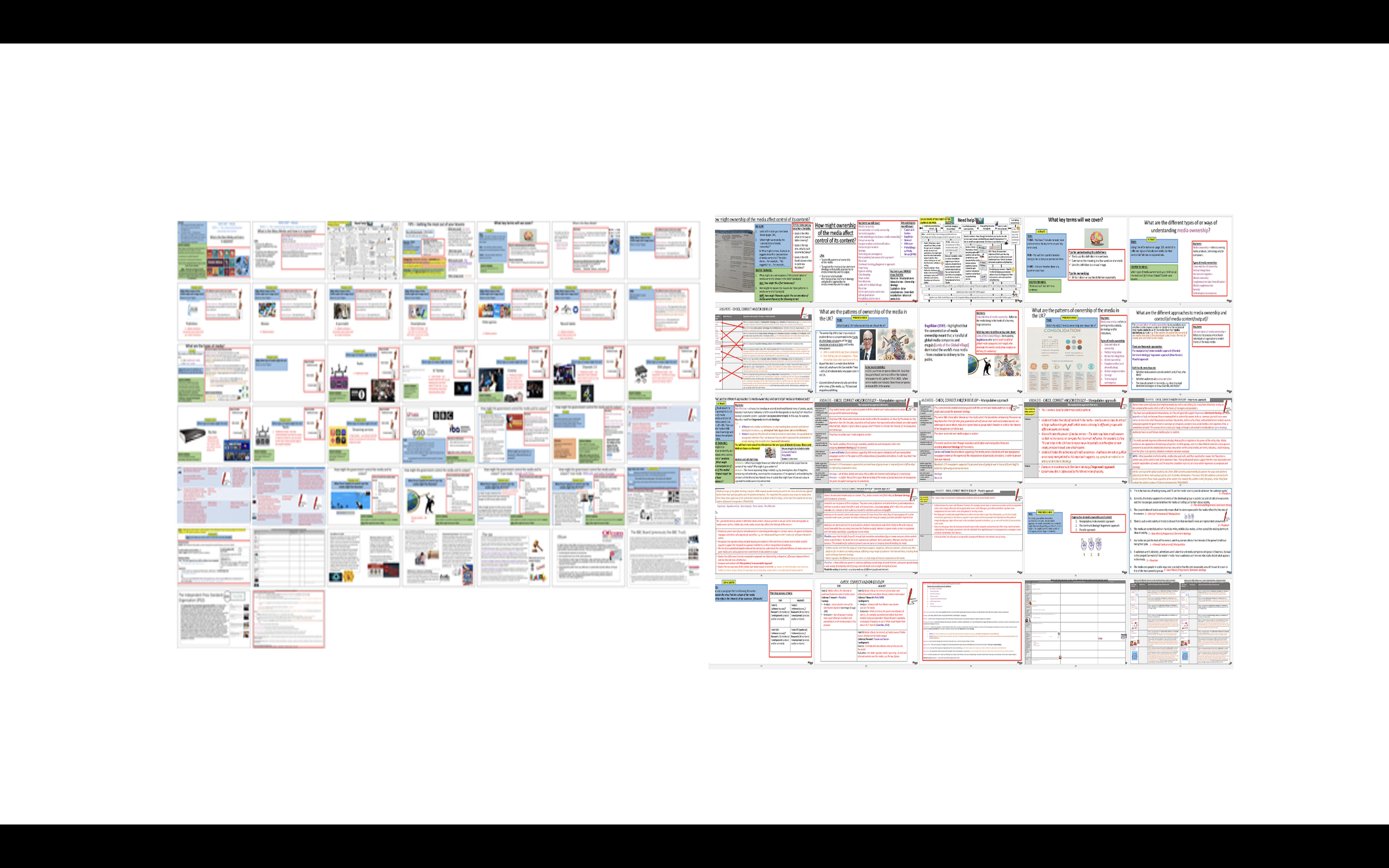
Two lesson bundle that includes:
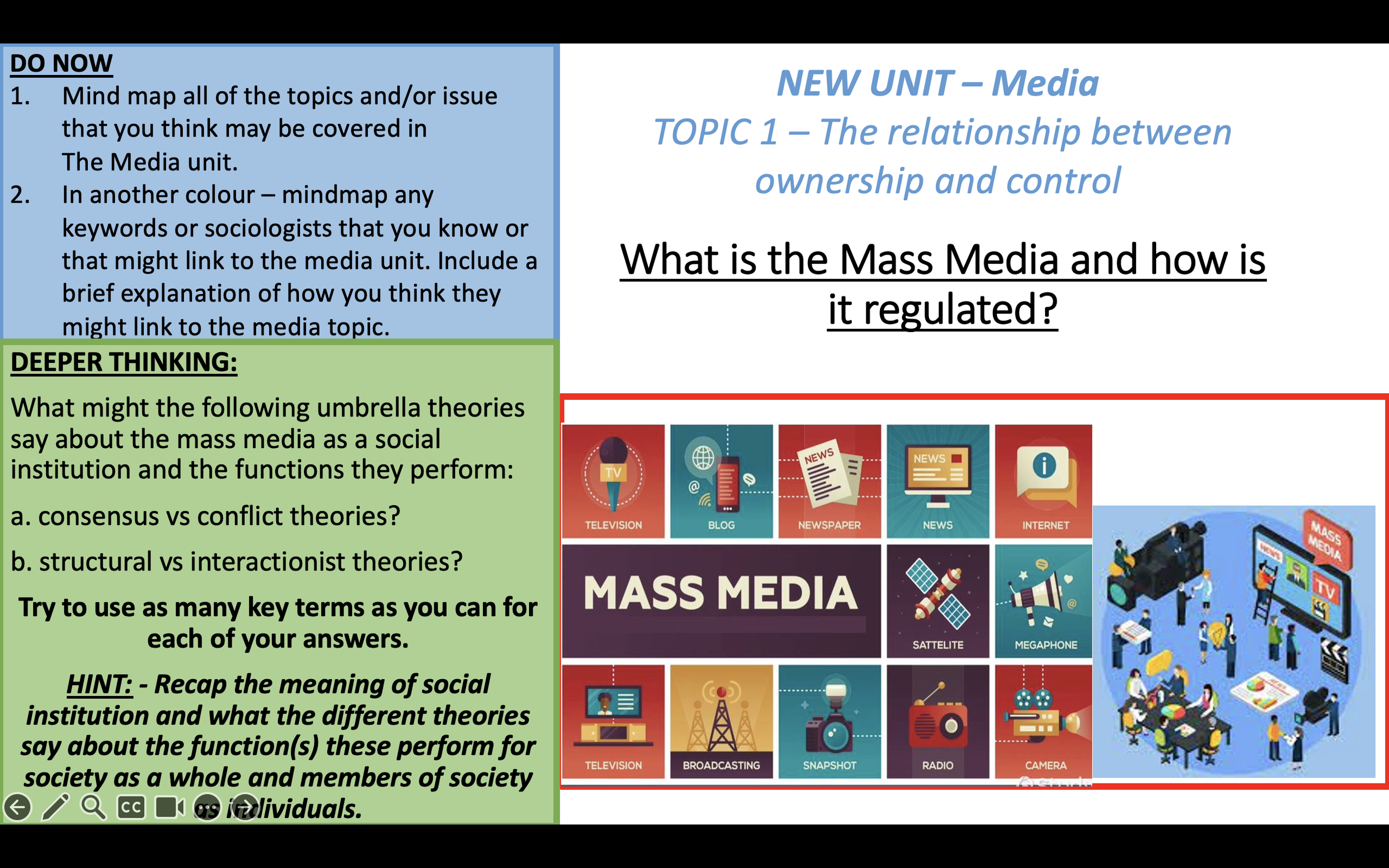
L1 AQA A-level Sociology Media Topic 1 : Ownership and Control – Intro to Mass Media and Regulation
• A detailed, fully scaffolded lesson that introduces the mass media, distinguishes media technologies, institutions and products, compares traditional, new and social media, and examines how media output is regulated through formal and informal controls.
• Covers the following key terms: Mass media, Media technology, institutions and products, Traditional media, new media and social media, Media output, Formal and informal control of the media, Independent broadcasting and Ofcom, wireless communication services (extension) and telecommunications services (extension)
• Covers the following key sociologists: Bagdikian, Bauman, Google and China case study, WikiLeaks and Julian Assange case study, The law, Ofcom, the BBC Board and IPSO
• Makes reference to the following key terms students might know that link: Formal and informal agencies (or agents) of secondary socialisation, Social institutions, Ownership, Marxism, Social control
• Key term sheet for the lesson included
• Case studies and opportunities for stretch and challenge
• Teaching to all activities included
•Print main activity table in A3
• Exam-style 4-mark question with PE success criteria and sentence starters
• No separate textbook requirement is stated in the lesson
• Discussion activity with prompts
• No separate textbook requirement is stated in the lesson
• ANSWERS TO MAIN ACTIVITIES INCLUDED
• RESOURCES CAN BE FOUND AT THE END OF THE PPT
L2 AQA A-level Sociology: Media Topic 1 Ownership and Control - The manipulative, hegemonic and pluralist approaches
A detailed lesson exploring media ownership and the relationship between ownership, control and media content. Scaffolded activities support students in comparing manipulative/instrumentalist, dominant ideology/hegemonic and pluralist approaches.
Key terms covered: Media ownership, concentration of ownership, vertical integration, horizontal integration, global ownership, conglomeration and diversification, global conglomeration, synergy, technological convergence, Lords of the Global Village, ideology, Marxism, Neo-Marxism, hegemony, agenda-setting, gate-keeping, news values and pluralism.
Key sociologists: Curran and Seaton, Bagdikian, Gramsci, Althusser and Philo/the Glasgow Media Group.
Makes reference to key terms students might know that link: structuralism and interactionism, ownership, ideology, capitalism, false consciousness, secondary socialisation and the means of production, media output, formal and informal controls over media
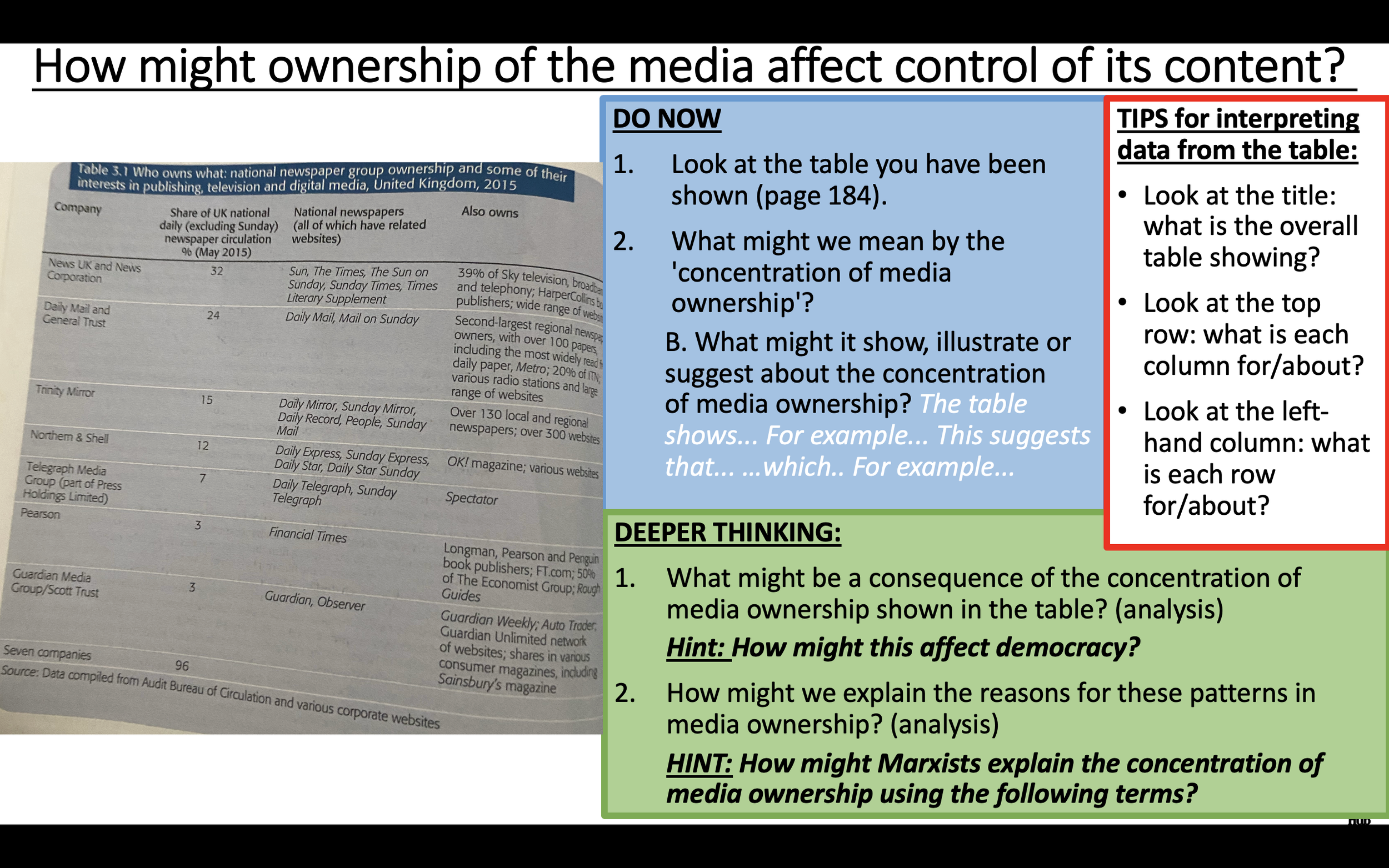
A starter activity interpreting media ownership data, with prompts and deeper-thinking questions.
Think–Pair–Share to learn key terms and strategies for understanding and remembering definitions.
A media ownership matching activity and an accompanying answer slide.
Scaffolded comparison tables, explanations, examples and evaluation points - PRINT IN A3
Teaching to all progress check using finger responses
A 20-mark evaluation question, planning scaffold and partially completed model plan.
ANSWERS TO MAIN ACTIVITIES INCLUDED - INCLUDING CRITICISMS AND ANALYSIS FOR MAIN ACTIVITY
REQUIRES textbook - 'SOCIOLOGY For AQA Volume 2 by Browne, Blundell & Law
RESOURCES CAN BE FOUND AT THE END OF PPT