 Image 1 of 1
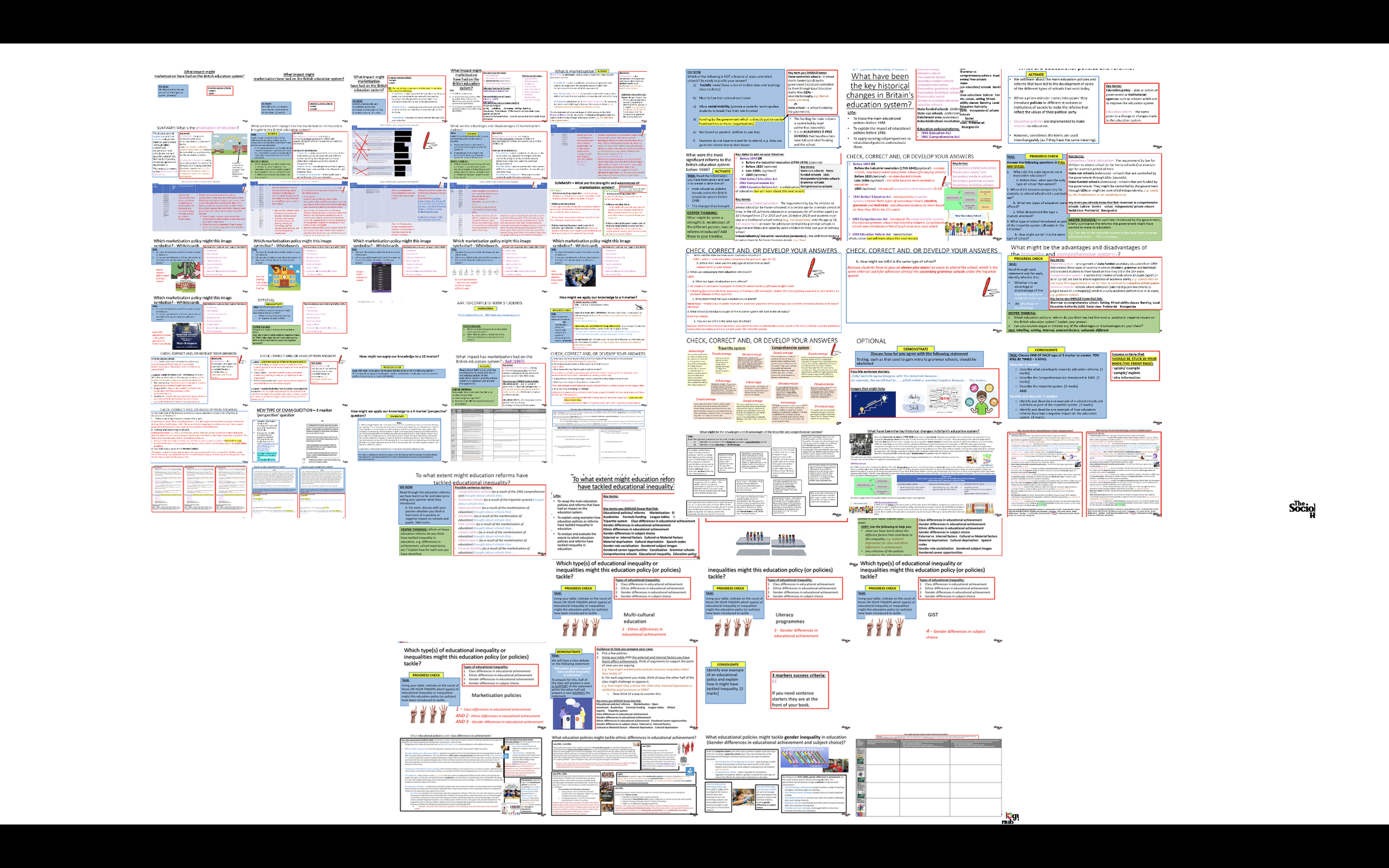
L1 AQA GCSE Sociology Education: Educational Policy - Key Historical Changes Before 1988 (Tripartite and Comprehensive Systems)
Detailed lesson with lots of scaffolding based on adaptive teaching that helps students know the main educational policies before 1988 and explain the impact of those policies, and apply and evaluate sociological perspectives on them (built around meritocracy, social mobility and class inequality arguments).
Covers the following key terms:Education policy, Education reform, The tripartite system, Secondary modern schools, Secondary grammar schools, Secondary technical schools, Comprehensive system, Eleven-plus exam, Compulsory [state] education, Selective schools, State-run schools (extension), State-funded schools (extension), Catchment area (extension), Industrialisation/industrial revolution (extension).
Makes reference to the following key terms students might know, to promote a spiral curriculum:Grammar vs comprehensive schools – Academies/free schools – State-run education/schools – Working-class subculture – Culture – Norms – Values – Setting – Mixed-ability classes – Banding – Local Education Authority (LEA) – Independent/private schools – Social class – Proletariat – Bourgeoisie.
DO NOW retrieval starter on the features of state schools and state-controlled schools
Timeline-building activity covering the 1944 Education Act, the 1965 Comprehensive Act and the 1988 Education Reform Act
Advantages and disadvantages sorting activity on the tripartite and comprehensive systems, provided as a blank version and a fully modelled answer version
DEEPER THINKING stretch prompts throughout
Optional discussion task on whether selective testing should be abolished, with sentence starters
Exam practice: a choice of 'Describe' and 'Identify and describe' 3-mark questions.
INCLUDES A KEY TERM SHEET WITH DEFINITIONS FOR THE LESSON
ANSWERS FOR ACTIVITIES INCLUDED
Pedagogical strategies include:retrieval practice, explicit vocabulary instruction, modelling and worked answers, scaffolding, metacognitive prompts, adaptive teaching, stretch and challenge, and assessment opportunities.
RESOURCES CAN BE FOUND AT THE END OF THE PPT.
L2 - AQA GCSE Sociology Education: Educational Policy – Marketisation of Education:
Detailed lesson with lots of scaffolding based on adaptive teaching that helps students define marketisation, explain the impact of the 1988 Education Reform Act on the British education system and the policies it brought about, and analyse and evaluate the impact of the marketisation of education using Ball.
Covers the following key terms: Marketisation, Marketisation of education, Market forces (extension), Privatisation, Privatisation of education, Competition, Parental choice (parentocracy).
Covers the following policies and reforms: 1988 Education Reform Act, League tables, Ofsted reports, Academies, Free schools, Specialist schools, Open enrolment, Business sponsorship and Formula funding.
Covers the following sociologists: Ball et al. (Market Forces and Parental Choice) and Ball (1981, Beachside Comprehensive - banding).
Makes reference to the following key terms students should know to promote a spiral curriculum: Education reform/policy – Labelling – Streaming – Setting – Banding – Academies – Free schools – Differences in achievement (class, gender, ethnicity) – Internal vs External factors – Local Education Authority (LEA) – Social processes.
Includes three DO NOW activities (as lesson is designed to be taught in at least two lessons.
Includes a policy matching activity with a full answer table for every policy.
Includes an advantages and disadvantages task with modelled answer tables.
Includes a whiteboard retrieval sequence using images to symbolise each marketisation policy.
Includes a reading and comprehension activity on Ball et al. with answers.
INCLUDES 3 MARKER, 4 MARKER AND 12 MARKER EXAM QUESTIONS with success criteria and sentence stems.
Includes the NEW 4 marker 'perspective' question with Item D and scaffolded success criteria.
INCLUDES A TEACHING TO ALL ACTIVITY
Deeper thinking prompts for stretch and challenge throughout.
ANSWERS TO MAIN ACTIVITIES INCLUDED.
INCLUDES KEY TERM SHEET WITH DEFINITIONS FOR THE LESSON.
Resources can be found at the end of the PPT.
Pedagogical strategies: retrieval practice, explicit vocabulary instruction, modelling and worked examples, scaffolding, metacognitive prompts, adaptive teaching, stretch and challenge, and regular assessment opportunities
L3 - AQA GCSE Sociology Education: Educational policies – To what extent have education reforms tackled educational inequality?
Detailed lesson with lots of scaffolding based on adaptive teaching that helps students recap the main education policies and reforms that have had an impact on the education system, explain using examples how education policies or reforms have tackled inequality in education, and analyse and evaluate the extent to which education policies and reforms have tackled inequality in education.
Covers (recaps) class, ethnic and gender inequality in education in a single lesson, building towards a whole-class debate on the statement "Education policies overall have tackled inequality in education".
Covers the following key term: Educational inequality.
Covers the following educational policies and reforms: Free school meals (FSM), Pupil premium, Education Action Zones, Aim Higher, Education Maintenance Allowance (EMA), 16 to 19 Bursary Fund, National Literacy Strategy, City Academies, Compensatory education, Sure Start, Assimilation policies, Race Relations Act 1976, Multicultural education, Social inclusion policies (ethnic monitoring, Saturday schools, English as an Additional Language), National Curriculum, Comprehensive schools, GIST, GATE, Raising Boys' Achievement, Reading Champions, Playing for Success, Dads and Sons Campaign.
Covers the following sources and evidence: DCSF (2000) and Ofsted findings on pupil premium and EMA.
Makes reference to the following key terms students might know to promote a spiral curriculum: Educational policies/reforms – Education policy – Marketisation – Open enrolment – Academies – Free schools – Formula funding – League tables – Ofsted reports – Tripartite system – Grammar schools – Comprehensive schools – Canalisation – Class differences in educational achievement – Ethnic differences in educational achievement – Gender differences in educational achievement – Gender differences in subject choice – External vs Internal factors – Cultural vs Material factors – Material deprivation – Cultural deprivation – Speech codes – Gender role socialisation – Gendered subject images – Gendered career opportunities.
Includes a DO NOW retrieval task with paired talk and modelled sentence starters recapping every reform studied so far.
Includes an ACTIVATE research task with a full information-gathering table and a guidance frame.
Includes four PROGRESS CHECK slides using whole-class "on your fingers" responses to check which inequality each policy was introduced to tackle.
Includes DEEPER THINKING and stretch and challenge prompts throughout, asking students to judge which policies contributed the most and the least, and why.
Includes a structured class debate with scaffolding for argument, counter-argument and rebuttal.
INCLUDES 3 MARKER..
RESOURCES CAN BE FOUND AT THE END OF PPT.
Pedagogical strategies used: Retrieval practice; explicit vocabulary instruction with prior knowledge key term lists repeated across the objectives, activate and demonstrate slides; modelling and worked sentence starters; scaffolded table frames; metacognitive prompts asking students to justify their most/least judgements; adaptive teaching through layered task framing and hint boxes; whole-class responsive checks for understanding; opportunities for stretch and challenge; and an exam-style assessment opportunity with success criteria.
L1 AQA GCSE Sociology Education: Educational Policy - Key Historical Changes Before 1988 (Tripartite and Comprehensive Systems)
Detailed lesson with lots of scaffolding based on adaptive teaching that helps students know the main educational policies before 1988 and explain the impact of those policies, and apply and evaluate sociological perspectives on them (built around meritocracy, social mobility and class inequality arguments).
Covers the following key terms:Education policy, Education reform, The tripartite system, Secondary modern schools, Secondary grammar schools, Secondary technical schools, Comprehensive system, Eleven-plus exam, Compulsory [state] education, Selective schools, State-run schools (extension), State-funded schools (extension), Catchment area (extension), Industrialisation/industrial revolution (extension).
Makes reference to the following key terms students might know, to promote a spiral curriculum:Grammar vs comprehensive schools – Academies/free schools – State-run education/schools – Working-class subculture – Culture – Norms – Values – Setting – Mixed-ability classes – Banding – Local Education Authority (LEA) – Independent/private schools – Social class – Proletariat – Bourgeoisie.
DO NOW retrieval starter on the features of state schools and state-controlled schools
Timeline-building activity covering the 1944 Education Act, the 1965 Comprehensive Act and the 1988 Education Reform Act
Advantages and disadvantages sorting activity on the tripartite and comprehensive systems, provided as a blank version and a fully modelled answer version
DEEPER THINKING stretch prompts throughout
Optional discussion task on whether selective testing should be abolished, with sentence starters
Exam practice: a choice of 'Describe' and 'Identify and describe' 3-mark questions.
INCLUDES A KEY TERM SHEET WITH DEFINITIONS FOR THE LESSON
ANSWERS FOR ACTIVITIES INCLUDED
Pedagogical strategies include:retrieval practice, explicit vocabulary instruction, modelling and worked answers, scaffolding, metacognitive prompts, adaptive teaching, stretch and challenge, and assessment opportunities.
RESOURCES CAN BE FOUND AT THE END OF THE PPT.
L2 - AQA GCSE Sociology Education: Educational Policy – Marketisation of Education:
Detailed lesson with lots of scaffolding based on adaptive teaching that helps students define marketisation, explain the impact of the 1988 Education Reform Act on the British education system and the policies it brought about, and analyse and evaluate the impact of the marketisation of education using Ball.
Covers the following key terms: Marketisation, Marketisation of education, Market forces (extension), Privatisation, Privatisation of education, Competition, Parental choice (parentocracy).
Covers the following policies and reforms: 1988 Education Reform Act, League tables, Ofsted reports, Academies, Free schools, Specialist schools, Open enrolment, Business sponsorship and Formula funding.
Covers the following sociologists: Ball et al. (Market Forces and Parental Choice) and Ball (1981, Beachside Comprehensive - banding).
Makes reference to the following key terms students should know to promote a spiral curriculum: Education reform/policy – Labelling – Streaming – Setting – Banding – Academies – Free schools – Differences in achievement (class, gender, ethnicity) – Internal vs External factors – Local Education Authority (LEA) – Social processes.
Includes three DO NOW activities (as lesson is designed to be taught in at least two lessons.
Includes a policy matching activity with a full answer table for every policy.
Includes an advantages and disadvantages task with modelled answer tables.
Includes a whiteboard retrieval sequence using images to symbolise each marketisation policy.
Includes a reading and comprehension activity on Ball et al. with answers.
INCLUDES 3 MARKER, 4 MARKER AND 12 MARKER EXAM QUESTIONS with success criteria and sentence stems.
Includes the NEW 4 marker 'perspective' question with Item D and scaffolded success criteria.
INCLUDES A TEACHING TO ALL ACTIVITY
Deeper thinking prompts for stretch and challenge throughout.
ANSWERS TO MAIN ACTIVITIES INCLUDED.
INCLUDES KEY TERM SHEET WITH DEFINITIONS FOR THE LESSON.
Resources can be found at the end of the PPT.
Pedagogical strategies: retrieval practice, explicit vocabulary instruction, modelling and worked examples, scaffolding, metacognitive prompts, adaptive teaching, stretch and challenge, and regular assessment opportunities
L3 - AQA GCSE Sociology Education: Educational policies – To what extent have education reforms tackled educational inequality?
Detailed lesson with lots of scaffolding based on adaptive teaching that helps students recap the main education policies and reforms that have had an impact on the education system, explain using examples how education policies or reforms have tackled inequality in education, and analyse and evaluate the extent to which education policies and reforms have tackled inequality in education.
Covers (recaps) class, ethnic and gender inequality in education in a single lesson, building towards a whole-class debate on the statement "Education policies overall have tackled inequality in education".
Covers the following key term: Educational inequality.
Covers the following educational policies and reforms: Free school meals (FSM), Pupil premium, Education Action Zones, Aim Higher, Education Maintenance Allowance (EMA), 16 to 19 Bursary Fund, National Literacy Strategy, City Academies, Compensatory education, Sure Start, Assimilation policies, Race Relations Act 1976, Multicultural education, Social inclusion policies (ethnic monitoring, Saturday schools, English as an Additional Language), National Curriculum, Comprehensive schools, GIST, GATE, Raising Boys' Achievement, Reading Champions, Playing for Success, Dads and Sons Campaign.
Covers the following sources and evidence: DCSF (2000) and Ofsted findings on pupil premium and EMA.
Makes reference to the following key terms students might know to promote a spiral curriculum: Educational policies/reforms – Education policy – Marketisation – Open enrolment – Academies – Free schools – Formula funding – League tables – Ofsted reports – Tripartite system – Grammar schools – Comprehensive schools – Canalisation – Class differences in educational achievement – Ethnic differences in educational achievement – Gender differences in educational achievement – Gender differences in subject choice – External vs Internal factors – Cultural vs Material factors – Material deprivation – Cultural deprivation – Speech codes – Gender role socialisation – Gendered subject images – Gendered career opportunities.
Includes a DO NOW retrieval task with paired talk and modelled sentence starters recapping every reform studied so far.
Includes an ACTIVATE research task with a full information-gathering table and a guidance frame.
Includes four PROGRESS CHECK slides using whole-class "on your fingers" responses to check which inequality each policy was introduced to tackle.
Includes DEEPER THINKING and stretch and challenge prompts throughout, asking students to judge which policies contributed the most and the least, and why.
Includes a structured class debate with scaffolding for argument, counter-argument and rebuttal.
INCLUDES 3 MARKER..
RESOURCES CAN BE FOUND AT THE END OF PPT.
Pedagogical strategies used: Retrieval practice; explicit vocabulary instruction with prior knowledge key term lists repeated across the objectives, activate and demonstrate slides; modelling and worked sentence starters; scaffolded table frames; metacognitive prompts asking students to justify their most/least judgements; adaptive teaching through layered task framing and hint boxes; whole-class responsive checks for understanding; opportunities for stretch and challenge; and an exam-style assessment opportunity with success criteria.