 Image 1 of 1
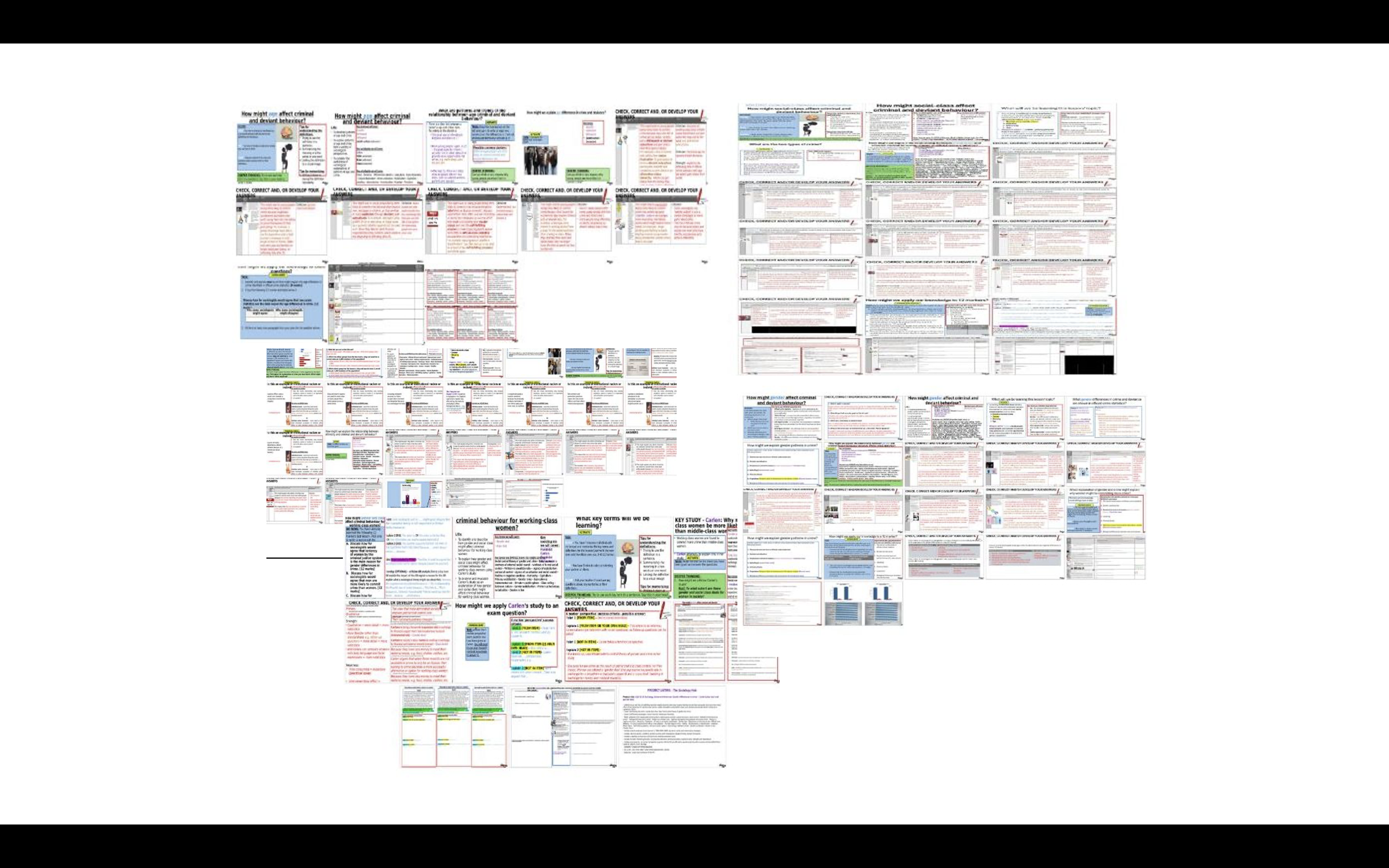
BUNDLE - AQA GCSE Sociology: Crime & Deviance Topic 5 – Patterns and Trends in Crime (SAVE 25%)
L1 AQA GCSE Sociology Crime and Deviance: Patterns in Crime and Deviance – Social Class
•Detailed lesson with lots of scaffolding based on adaptive teaching that helps students identify and describe social class patterns and trends in crime and deviance, explain them from interactionist, functionalist and Marxist perspectives, and evaluate these explanations.
•Covers these three main social class patterns in crime: working-class committing more crime than middle class, white collar and corporate crime being under-represented and middle-class being more likely to commit white-collar and corporate crime.
•Covers the following key terms: Miscarriage of justice, Occupational crime (extension), Fraud, White collar crime and Corporate crime.
•Covers the following sociologists: New Right sociologist Murray, functionalist Merton, functionalist Cohen, interactionist Becker, Marxists and interactionists, plus the following extension sociologists: Maguire, Sutherland, O'Neill, functionalist Miller and Tombs.
•Makes reference to the following key terms students should know, to promote a spiral curriculum: Social class – Over-represented vs Under-represented – Alienation – Source of statistical data on crime – Official (government) crime statistics – Reported crime – Recorded crime – Dark figure of crime – The social construction of official crime statistics – Victim survey – Self-report study – Socialisation – Primary socialisation – The New Right – Child-rearing – Social structure (extension) – Structural factors vs Cultural factors – Strain theory of crime and deviance – Anomie – Strain of anomie – The American Dream – Relative deprivation – Status frustration – Alternative status hierarchy – Criminal or deviant subculture – Subcultural theory – Material deprivation – Marxism – Capitalism – Means of production – Profit – Labelling – Self-fulfilling prophecy – Master status – Deviant career – Deviant subculture – Agents of social control.
•Includes a Think, Pair, Share retrieval practice starter on the lesson's key terms and definitions, with explicit strategies for understanding and memorising definitions.
•Covers the difference between occupational, white collar and corporate crime
•Uses fraud and burglary cost statistics to challenge assumptions about who commits crime.
•Includes a scaffolded double-sided A3 explanation table covering all three social class patterns in official crime statistics.
•Includes a progress check applying knowledge to four 12-mark questions, with a supports/opposes table to structure evaluation.
•Includes PEEL(D) modelling and sentence stems to scaffold extended writing for 12-mark responses.
•Includes deeper thinking throughout.
•ANSWERS TO MAIN ACTIVITIES INCLUDED
•Includes a key term sheet with definitions for the lesson (and key terms and definitions associated with the main explanations of crime, e.g. labelling, strain theory, subcultural theory etc.
•RESOURCE CAN BE FOUND AT THE END OF PPT
L2 AQA GCSE Sociology Crime and Deviance: Patterns in Crime and Deviance – Gender
Detailed lesson with lots of scaffolding based on adaptive teaching that helps students identify and describe gender patterns and trends in crime and deviance, explain them from interactionist, functionalist, feminist and Marxist perspectives and evaluate these explanations.
Covers these two main gender patterns in crime: men committing more crime than women and the different types of crime men and women committ.
Covers the following key terms: Chivalry thesis
Covers the following sociologists: Maguire, The Office for National Statistics (ONS), the Ministry of Justice, Heidensohn (feminist), Dobash and Dobash (feminist), Parsons (functionalist), Marxists and Interactionists.
Makes reference to the following key terms students should already know to promote a spiral curriculum: Social control theory of gender and crime - Chivalry thesis - Glass ceiling - Public sphere vs Private sphere.Official crime statistics - The social construction of official crime statistics - The dark figure of crime - Victim surveys - Self-report studies - Validity - Sex vs Gender - Gender socialisation - Gender roles - Expressive vs instrumental role - Social control - Formal vs informal social control - Agencies and agents of socialisation and social control - Positive vs negative sanctions - Patriarchy - Capitalism - White collar crime - Labelling - Master status - Self-fulfilling prophecy - Deviant career - Deviant subculture - Structuralism vs interactionism - Bedroom culture.
Includes a 12 marker planning activity with agree/disagree tables
Includes graph activity (2019 vs March 2026 and 2011-2012)
PRINT MAIN TABLE IN A3
ANSWERS TO ALL ACTIVITIES INCLUDED
Includes a key term sheet with definitions for the lesson (and key terms and definitions associated with the main explanations of crime that link, e.g. labelling,social control theory, invalid statistics, etc.
RESOURCES CAN BE FOUND AT THE END OF THE PPT
L3 AQA GCSE Sociology Crime and Deviance: Patterns in Crime and Deviance – Class diff in female crime
• Detailed lesson with lots of scaffolding based on adaptive teaching that helps students identify and describe how gender and social class might affect criminal behaviour for working-class women, explain this pattern using Carlen’s study and analyse and evaluate Carlen’s study as an explanation of this.
• Covers the following key terms: Gender deal, Class deal
• Covers the following sociologists: Carlen (feminist), Heidensohn (feminist).
• Makes reference to the following key terms students might know to promote a spiral curriculum: Social control theory of gender and crime - Social control – Methods of informal social control – Methods of formal social control – Written vs unwritten rules – Agencies and agents of socialisation and social control – Positive vs negative sanctions – Patriarchy – Capitalism – Primary vs secondary socialisation – Gender roles – Expressive vs instrumental role – Private vs public sphere – Glass ceiling – Bedroom culture – Gender socialisation – Gender vs sex
• Includes explicit vocabulary instruction with a THINK–PAIR–SHARE key terms activity and memorisation strategies.
• NOTE - Includes research methods application (unstructured interviews: primary/secondary, qualitative data, strengths and weaknesses) but can be remove if students have no learnt this unit.
• Includes exam practice: a 4 marker 'perspective' question with Item B and scaffolding - NOTE - requires knowledge of research methods but can be adapted if students have not learnt this unit.
• DO NOW provides detailed scaffolding to help students answer a 12 marker on gender and crime (three 12 markers to choose from - students may have planned in the Social class lesson if purchased)
• ANSWERS TO MAIN ACTIVITY AND PLENARY INCLUDED
• INCLUDES A KEY TERM SHEET WITH DEFINITIONS FOR THE LESSON.
• RESOURCES CAN BE FOUND AT THE END OF THE PPT.
L4 AQA GCSE Sociology Crime and Deviance: Patterns in Crime and Deviance – Ethnicity
Detailed lesson with lots of scaffolding based on adaptive teaching that helps students describe patterns of ethnicity and crime (ethnic minorities being shown to commit more crime based on official crime statistics), explain those patterns from a range of sociological perspectives, and consider how useful sociological explanations of these patterns are.
Covers the following key terms: Scapegoats, Folk devils, Crisis of capitalism, Stop and search, Moral panic (extension).
Covers the following sociologists: the Macpherson Report (1999)
Makes reference to the following key terms students might know to promote a spiral curriculum: Social control – Methods of formal social control – Agencies and agents of social control – Positive vs negative sanctions – Institutional vs individual racism – Stereotype – Racism – Racial discrimination – Dark figure of crime – Reported crime – Recorded crime – Anomie – Innovator – Rebellion – Retreatist – Alternative status hierarchy – Deviant subculture – Cultural deprivation – Master status – Self-fulfilling prophecy – Exploitation – Relative deprivation – Material deprivation.
DO NOW retrieval task using stop and search and arrest statistics (Figure A and Figure B)
THINK–PAIR–SHARE key term activity with memorisation and metacognitive tips
Explanations covered: invalid statistics, institutional racism, functionalist, Marxist, labelling and media explanations
Exam practice including a 4-mark Item A question with success criteria and a 12-mark (2021)
Includes video about the the Macpherson Report (1999)
Includes a teaching to all activity on institutional vs individual racism
PRINT MAIN ACTIVITY TABLE IN A3
ANSWERS TO MAIN ACTIVITIES INCLUDED.
RESOURCES CAN BE FOUND AT THE END OF THE PPT.
L5 AQA GCSE Sociology Crime and Deviance: Patterns in Crime and Deviance – Age
•Detailed lesson with lots of scaffolding based on adaptive teaching that helps students describe patterns of age and crime (why young people are shown in official crime statistics to commit more crime than older people), explain those patterns from a range of sociological perspectives and consider how useful those explanations are.
•Covers the following key terms: Juvenile, Adolescent, Delinquent, Ladette culture (extension).
•Covers the following sociologists: Cohen, Miller (extension), Brake (extension), Matza (extension).
•Makes reference to the following key terms students might already know to promote a spiral curriculum: Crime – Deviance – Official crime statistics – Subculture – Status frustration – Cultural deprivation – Norms and values – Socialisation – Capitalism – Labelling – Interactionism – Functionalism – Marxism – Feminism.
•Think–Pair–Share DO NOW retrieval activity on the key terms
•PRINT TABLE ACTIVITY IN A3
•Includes exam practice: a 4 mark Item A question and a 12 mark discuss question.
•ANSWERS TO MAIN ACTIVITY INCLUDED
•Includes a key term sheet with definitions for the lesson.
•RESOURCES CAN BE FOUND AT THE END OF PPT.
L1 AQA GCSE Sociology Crime and Deviance: Patterns in Crime and Deviance – Social Class
•Detailed lesson with lots of scaffolding based on adaptive teaching that helps students identify and describe social class patterns and trends in crime and deviance, explain them from interactionist, functionalist and Marxist perspectives, and evaluate these explanations.
•Covers these three main social class patterns in crime: working-class committing more crime than middle class, white collar and corporate crime being under-represented and middle-class being more likely to commit white-collar and corporate crime.
•Covers the following key terms: Miscarriage of justice, Occupational crime (extension), Fraud, White collar crime and Corporate crime.
•Covers the following sociologists: New Right sociologist Murray, functionalist Merton, functionalist Cohen, interactionist Becker, Marxists and interactionists, plus the following extension sociologists: Maguire, Sutherland, O'Neill, functionalist Miller and Tombs.
•Makes reference to the following key terms students should know, to promote a spiral curriculum: Social class – Over-represented vs Under-represented – Alienation – Source of statistical data on crime – Official (government) crime statistics – Reported crime – Recorded crime – Dark figure of crime – The social construction of official crime statistics – Victim survey – Self-report study – Socialisation – Primary socialisation – The New Right – Child-rearing – Social structure (extension) – Structural factors vs Cultural factors – Strain theory of crime and deviance – Anomie – Strain of anomie – The American Dream – Relative deprivation – Status frustration – Alternative status hierarchy – Criminal or deviant subculture – Subcultural theory – Material deprivation – Marxism – Capitalism – Means of production – Profit – Labelling – Self-fulfilling prophecy – Master status – Deviant career – Deviant subculture – Agents of social control.
•Includes a Think, Pair, Share retrieval practice starter on the lesson's key terms and definitions, with explicit strategies for understanding and memorising definitions.
•Covers the difference between occupational, white collar and corporate crime
•Uses fraud and burglary cost statistics to challenge assumptions about who commits crime.
•Includes a scaffolded double-sided A3 explanation table covering all three social class patterns in official crime statistics.
•Includes a progress check applying knowledge to four 12-mark questions, with a supports/opposes table to structure evaluation.
•Includes PEEL(D) modelling and sentence stems to scaffold extended writing for 12-mark responses.
•Includes deeper thinking throughout.
•ANSWERS TO MAIN ACTIVITIES INCLUDED
•Includes a key term sheet with definitions for the lesson (and key terms and definitions associated with the main explanations of crime, e.g. labelling, strain theory, subcultural theory etc.
•RESOURCE CAN BE FOUND AT THE END OF PPT
L2 AQA GCSE Sociology Crime and Deviance: Patterns in Crime and Deviance – Gender
Detailed lesson with lots of scaffolding based on adaptive teaching that helps students identify and describe gender patterns and trends in crime and deviance, explain them from interactionist, functionalist, feminist and Marxist perspectives and evaluate these explanations.
Covers these two main gender patterns in crime: men committing more crime than women and the different types of crime men and women committ.
Covers the following key terms: Chivalry thesis
Covers the following sociologists: Maguire, The Office for National Statistics (ONS), the Ministry of Justice, Heidensohn (feminist), Dobash and Dobash (feminist), Parsons (functionalist), Marxists and Interactionists.
Makes reference to the following key terms students should already know to promote a spiral curriculum: Social control theory of gender and crime - Chivalry thesis - Glass ceiling - Public sphere vs Private sphere.Official crime statistics - The social construction of official crime statistics - The dark figure of crime - Victim surveys - Self-report studies - Validity - Sex vs Gender - Gender socialisation - Gender roles - Expressive vs instrumental role - Social control - Formal vs informal social control - Agencies and agents of socialisation and social control - Positive vs negative sanctions - Patriarchy - Capitalism - White collar crime - Labelling - Master status - Self-fulfilling prophecy - Deviant career - Deviant subculture - Structuralism vs interactionism - Bedroom culture.
Includes a 12 marker planning activity with agree/disagree tables
Includes graph activity (2019 vs March 2026 and 2011-2012)
PRINT MAIN TABLE IN A3
ANSWERS TO ALL ACTIVITIES INCLUDED
Includes a key term sheet with definitions for the lesson (and key terms and definitions associated with the main explanations of crime that link, e.g. labelling,social control theory, invalid statistics, etc.
RESOURCES CAN BE FOUND AT THE END OF THE PPT
L3 AQA GCSE Sociology Crime and Deviance: Patterns in Crime and Deviance – Class diff in female crime
• Detailed lesson with lots of scaffolding based on adaptive teaching that helps students identify and describe how gender and social class might affect criminal behaviour for working-class women, explain this pattern using Carlen’s study and analyse and evaluate Carlen’s study as an explanation of this.
• Covers the following key terms: Gender deal, Class deal
• Covers the following sociologists: Carlen (feminist), Heidensohn (feminist).
• Makes reference to the following key terms students might know to promote a spiral curriculum: Social control theory of gender and crime - Social control – Methods of informal social control – Methods of formal social control – Written vs unwritten rules – Agencies and agents of socialisation and social control – Positive vs negative sanctions – Patriarchy – Capitalism – Primary vs secondary socialisation – Gender roles – Expressive vs instrumental role – Private vs public sphere – Glass ceiling – Bedroom culture – Gender socialisation – Gender vs sex
• Includes explicit vocabulary instruction with a THINK–PAIR–SHARE key terms activity and memorisation strategies.
• NOTE - Includes research methods application (unstructured interviews: primary/secondary, qualitative data, strengths and weaknesses) but can be remove if students have no learnt this unit.
• Includes exam practice: a 4 marker 'perspective' question with Item B and scaffolding - NOTE - requires knowledge of research methods but can be adapted if students have not learnt this unit.
• DO NOW provides detailed scaffolding to help students answer a 12 marker on gender and crime (three 12 markers to choose from - students may have planned in the Social class lesson if purchased)
• ANSWERS TO MAIN ACTIVITY AND PLENARY INCLUDED
• INCLUDES A KEY TERM SHEET WITH DEFINITIONS FOR THE LESSON.
• RESOURCES CAN BE FOUND AT THE END OF THE PPT.
L4 AQA GCSE Sociology Crime and Deviance: Patterns in Crime and Deviance – Ethnicity
Detailed lesson with lots of scaffolding based on adaptive teaching that helps students describe patterns of ethnicity and crime (ethnic minorities being shown to commit more crime based on official crime statistics), explain those patterns from a range of sociological perspectives, and consider how useful sociological explanations of these patterns are.
Covers the following key terms: Scapegoats, Folk devils, Crisis of capitalism, Stop and search, Moral panic (extension).
Covers the following sociologists: the Macpherson Report (1999)
Makes reference to the following key terms students might know to promote a spiral curriculum: Social control – Methods of formal social control – Agencies and agents of social control – Positive vs negative sanctions – Institutional vs individual racism – Stereotype – Racism – Racial discrimination – Dark figure of crime – Reported crime – Recorded crime – Anomie – Innovator – Rebellion – Retreatist – Alternative status hierarchy – Deviant subculture – Cultural deprivation – Master status – Self-fulfilling prophecy – Exploitation – Relative deprivation – Material deprivation.
DO NOW retrieval task using stop and search and arrest statistics (Figure A and Figure B)
THINK–PAIR–SHARE key term activity with memorisation and metacognitive tips
Explanations covered: invalid statistics, institutional racism, functionalist, Marxist, labelling and media explanations
Exam practice including a 4-mark Item A question with success criteria and a 12-mark (2021)
Includes video about the the Macpherson Report (1999)
Includes a teaching to all activity on institutional vs individual racism
PRINT MAIN ACTIVITY TABLE IN A3
ANSWERS TO MAIN ACTIVITIES INCLUDED.
RESOURCES CAN BE FOUND AT THE END OF THE PPT.
L5 AQA GCSE Sociology Crime and Deviance: Patterns in Crime and Deviance – Age
•Detailed lesson with lots of scaffolding based on adaptive teaching that helps students describe patterns of age and crime (why young people are shown in official crime statistics to commit more crime than older people), explain those patterns from a range of sociological perspectives and consider how useful those explanations are.
•Covers the following key terms: Juvenile, Adolescent, Delinquent, Ladette culture (extension).
•Covers the following sociologists: Cohen, Miller (extension), Brake (extension), Matza (extension).
•Makes reference to the following key terms students might already know to promote a spiral curriculum: Crime – Deviance – Official crime statistics – Subculture – Status frustration – Cultural deprivation – Norms and values – Socialisation – Capitalism – Labelling – Interactionism – Functionalism – Marxism – Feminism.
•Think–Pair–Share DO NOW retrieval activity on the key terms
•PRINT TABLE ACTIVITY IN A3
•Includes exam practice: a 4 mark Item A question and a 12 mark discuss question.
•ANSWERS TO MAIN ACTIVITY INCLUDED
•Includes a key term sheet with definitions for the lesson.
•RESOURCES CAN BE FOUND AT THE END OF PPT.